Adlib: IDP Accuracy Layer for Regulated Enterprises
On This Page
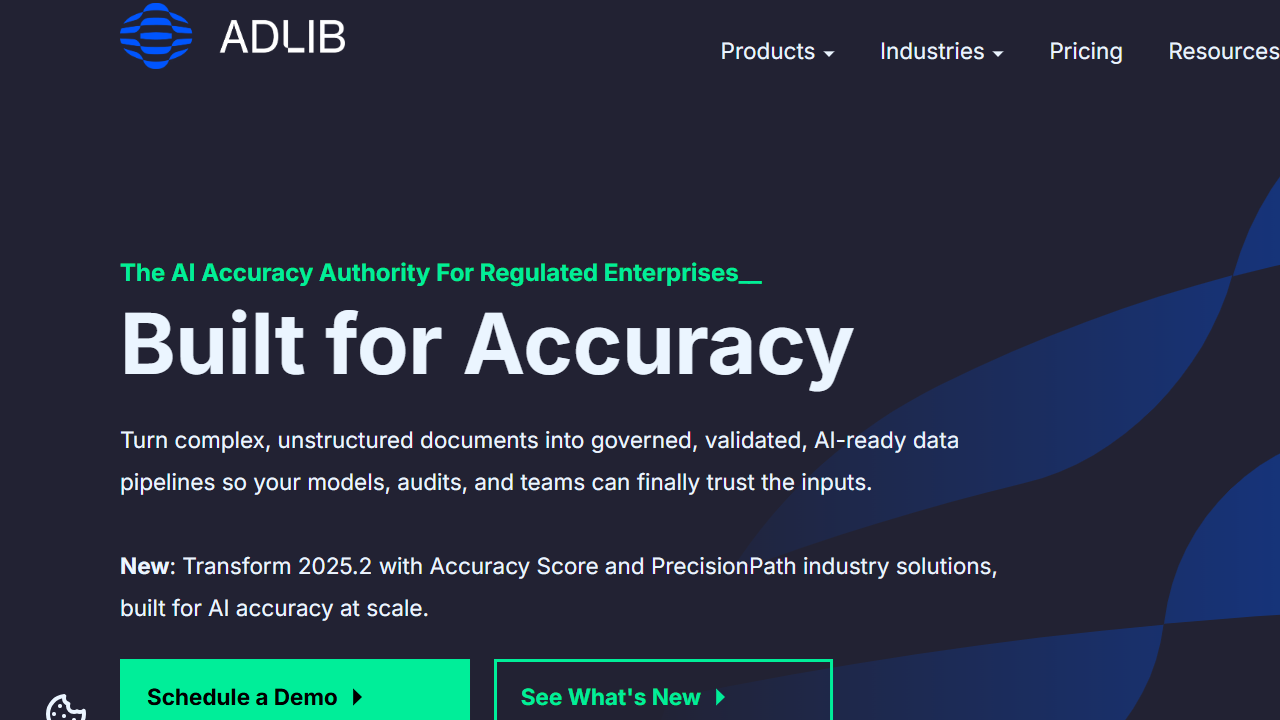
Adlib positions itself as the "Document Accuracy Layer" for regulated enterprises, sitting upstream of intelligent document processing (IDP), RPA, and GenAI pipelines to validate extracted data before downstream systems consume it.
Overview
Founded over two decades ago, Adlib serves Fortune 1000 organizations including NASA, Pfizer, Boeing, and BP through its Content Intelligence Cloud platform. The platform overlays existing enterprise infrastructure without requiring system replacement. Rather than competing head-to-head with end-to-end IDP platforms like ABBYY, Kofax, or Hyperscience, Adlib inserts itself as a validation and enrichment layer in front of those systems.
The strategic picture accelerated through early 2026. In January, Adlib secured a growth investment from Diversis Capital Partners, an LA-based private equity firm focused on lower middle-market software. Diversis VP of Strategy Joseph Lok signaled the intent to expand "both organically as well as through partnerships and M&A." That same month, Adlib launched Transform 2025.2, introducing the Adlib Accuracy Score (a multi-LLM voting and hybrid confidence-scoring metric) and PrecisionPath industry trust kits for life sciences, insurance, energy, and manufacturing.
By Q1 2026, the company launched the CorTex partner program targeting systems integrators, VARs, and ECM specialists. CEO Chris Huff framed the channel strategy directly: "Partners are being asked to operationalize AI in environments where a single document error can trigger rework, delays, or audit risk. Adlib gives partners a practical way to make AI and automation trustworthy, by adding an accuracy layer in front of the systems customers already use." The CorTex program gives partners access to PrecisionPath kits and the Adlib Solutions Hub, letting them build and distribute their own extraction configurations.
Huff's background lends credibility to the positioning. Previously CEO at Base64.ai and Chief Strategy and Growth Officer at Tungsten Automation (Kofax), he co-led Deloitte's U.S. Public Sector Intelligent Automation practice. That direct experience with the IDP competitive landscape shapes Adlib's deliberate framing as complementary rather than another rip-and-replace platform.
In December 2025, Astute Analytica recognized Adlib as a key player in the contract intelligence market, projected to grow from $1.1 billion in 2024 to $7.2 billion by 2033. No Gartner, Everest Group, or IDC positioning for Adlib was found in the research period, a gap that buyers conducting due diligence should note.
The Accuracy Score is a notable strategic move: rather than citing third-party benchmarks, Adlib has introduced its own scoring layer. This creates a differentiating narrative in sales cycles but carries credibility risk until an independent evaluation corroborates the metric's reliability, a threshold that regulated-industry buyers will likely require before production deployment.
How Adlib processes documents
Transform ingests documents across 300+ file types including CAD formats (AutoCAD DWG, SolidWorks), Visio, TIFF, and legacy formats, preserving CAD layer structure in the output PDF. The platform covers the full document lifecycle: input, assembly, extraction, validation, conversion, and delivery, with end-to-end traceability.
The Adlib Accuracy Score sits at the center of the extraction workflow. It combines multi-LLM voting, hybrid confidence scoring, and layered validation signals to score each extracted data point, then routes documents to one of three paths: automated processing, gating for secondary review, or human-in-the-loop intervention. The vendor reports this routing logic reduces exception rates by 40-60% and accelerates document cycle times by 30-50%. These figures are self-reported and have not been independently verified.
PrecisionPaths are pre-bundled extraction kits packaging models, prompts, validated demo environments, and integration starters for named enterprise platforms: ENOVIA and CARA (life sciences), Honeywell (energy), and Guidewire (insurance). Adlib claims pipelines can be stood up "in days, not months." No third-party validation of that timeline exists, but the claim positions Adlib directly against both custom-built pipelines and broader IDP platforms that require longer configuration cycles.
Transform 2026.1, previewed in April 2026, adds open-source LLM support for extraction (targeting token cost, reliability, and privacy in regulated environments), document element separation for mixed-format inputs, cross-repository document assembly with access controls, and interactive prompt/schema configuration using sample documents. The open-source LLM support directly addresses enterprise concerns about vendor lock-in and data residency when using commercial LLM APIs.
The platform's architecture includes MCP protocol support and n8n workflow integration alongside REST API connectivity. Adlib's Transform REST API v2 now describes the platform as supporting agentic high-fidelity rendering, classification, extraction, and validation, and includes an AiRagChat endpoint for retrieval-augmented generation (RAG) chat over processed document collections. Container-ready deployment connects to ECM, PLM, RIM, QMS, MES, ERP, case systems, and data lakes. The Adlib Solution Hub at hub.adlibsoftware.com provides an API-first marketplace for distributing and reusing extraction configurations across deployments.
AI model support includes native connectors for OpenAI, Anthropic, and Meta models, with open-source LLM support arriving in Transform 2026.1. Adlib PDF handles universal file translation with PDF/A compliance for long-term archival.
Use cases
Life sciences regulatory submissions
Adlib pre-configures extraction models for ENOVIA and CARA systems, targeting the standardization of clinical trial data and regulatory documentation for FDA submissions. The platform maintains complete audit trails demonstrating document integrity, a requirement for regulated submissions. An unnamed nuclear power company uses the platform for 60-year PDF retention to meet NRC compliance requirements, integrated with Dassault PLM (vendor-reported, unverified).
Insurance claims processing
An unnamed insurance client processes 90,000 claim documents per day through Adlib, integrated with Guidewire ClaimCenter and IBM FileNet. The vendor reports a 90% reduction in administrative work and $6 million in operational savings. A Director of Architecture and IS Risk at the client stated: "We very quickly realized that Adlib was the right tool for us, it was the only PDF rendition product out of the seven or eight we looked at that met our requirements for 100% fidelity and integration." All figures are vendor-reported; no independent confirmation was found.
Financial services compliance archiving
An unnamed bank uses Adlib to archive 20,000 trade documents per day, eliminating 95% of manual steps and addressing a SOX and SEC compliance backlog. A Senior System Analyst at the institution rated Adlib "10 out of 10." These are vendor-sourced claims without independent corroboration.
Manufacturing and industrial AI
Adlib has invested heavily in positioning as the data preparation layer for industrial AI in brownfield environments. The company sponsored multiple IIoT World Manufacturing Day sessions in Q1 2026 with co-speakers from Siemens (Sabrina Joos) and New Space AI (Hamish Mackenzie), signaling at minimum a customer or partnership relationship in manufacturing AI. The pitch targets a specific problem: legacy plants hold decades of unstructured knowledge in P&IDs, CAD files, maintenance logs, and quality certificates that current AI systems cannot reliably consume. Adlib positions itself as the bridge.
Anthony Vigliotti of Adlib published a thought leadership piece on IIoT World articulating the "Document Accuracy Layer" concept specifically for industrial AI readiness, using Adlib's own product terminology throughout. The IIoT World 2026 smart manufacturing ecosystem report listed Adlib among 27 smart factory platforms under "Data Infrastructure and Management" alongside Snowflake, Databricks, and Litmus. This is sponsor-influenced coverage, not independent editorial, but it reflects the vertical Adlib is targeting.
CAD layer preservation from AutoCAD and SolidWorks files in PDF output remains the primary technical differentiator for manufacturing customers managing technical drawing archives. An Enterprise Information Management Manager at an unnamed engineering firm noted "Adlib seemed more mature as a software option" after evaluating three vendors (vendor-sourced, unverified).
Energy asset management
Adlib ingests field operation documents and CAD files with pre-built integration starters for Honeywell systems, extracting operational data for regulatory filing compliance. An unnamed energy company automated CAD and mixed-format ingestion through a Haistaq integration. The brownfield industrial AI narrative identifies six scaling challenges in industrial environments where document accuracy failures cascade into AI model reliability problems, as detailed in Huff's analysis of industrial AI scaling barriers.
Technical specifications
| Feature | Specification |
|---|---|
| Accuracy algorithm | Adlib Accuracy Score: multi-LLM voting with hybrid confidence scoring and layered validation signals |
| Routing logic | Automated processing, gating, or human-in-the-loop review based on confidence threshold |
| Supported formats | 300+ file types including CAD (DWG, SolidWorks), Visio, TIFF, and legacy formats |
| CAD handling | Preserves AutoCAD and SolidWorks layer structure in PDF output |
| Deployment options | Content Intelligence Cloud; on-premise |
| Integration capabilities | ECM (OpenText, Documentum, IBM FileNet), ERP, MES, PLM, QMS, RIM, case systems, data lakes via REST API |
| Workflow automation | n8n integration; MCP protocol support |
| AI model support | OpenAI, Anthropic, Meta models; open-source LLM support (Transform 2026.1) |
| Agentic processing | REST API v2 with agentic rendering, classification, extraction, validation; AiRagChat endpoint for RAG workflows |
| Industry kits | PrecisionPaths for life sciences (ENOVIA, CARA), insurance (Guidewire), energy (Honeywell), manufacturing |
| Asset marketplace | Adlib Solution Hub (hub.adlibsoftware.com): API-first distribution of accuracy assets |
| Certifications | Office 365, Windows Server 2022, AWS elasticity |
| Product tiers | Standard, Speed and Throughput, Advanced Image Processing, Business Connectivity, Regulatory Compliance Validator |
| Compliance formats | PDF/PDF-A for long-term archival |
| Reported performance | 40-60% exception rate reduction; 30-50% faster cycle times (vendor-reported, unverified) |
| Third-party rating | 4.3/5 on Software Advice (3 reviews, 2022-2023) |
Resources
- Website
- Platform overview
- Transform 2025.2 launch announcement
- CorTex partner program
- Diversis Capital investment announcement
- Transform REST API v2 samples (GitHub)
- IIoT World manufacturing AI coverage
- Contact page
Company information
Headquarters: Grapevine, TX, United States (January 2026 press releases use a Grapevine, TX dateline; the company previously listed Toronto, Canada)
Founded: Over 25 years of operation (est. 2000)
Customers: NASA, Pfizer, Boeing, BP
Investor: Diversis Capital Partners (growth investment, January 2026; amount undisclosed)
CEO: Chris Huff (previously CEO at Base64.ai; Chief Strategy and Growth Officer at Tungsten Automation/Kofax; co-led Deloitte U.S. Public Sector Intelligent Automation; former U.S. Marine Corps Major)
Key personnel: Mickey Garcia (25+ years enterprise document management; previously at Dassault Systemes, MasterControl, M-Files, Epicor ECM, Johnson and Johnson); Stephen Torkington (Director of Partnerships, leads CorTex program)
Channel: CorTex partner program for SIs, VARs, and ECM specialists (launched January 2026)
For quality and verification approaches across the IDP market, including how confidence scoring and human-in-the-loop routing compare across vendors, see the capabilities overview. For regulated-industry deployment considerations, the security and compliance and on-premise document processing guides cover the architectural trade-offs relevant to Adlib's target buyers.