Hyperscience Intelligent Document Processing
On This Page
Founded in 2014 by Peter Brodsky, Hyperscience develops AI-powered document processing for complex, unstructured documents. The New York-based company raised $100 million in a Series E round in December 2021 from investors including Tiger Global Management, bringing total funding to approximately $439 million.
Led by CEO Andrew Joiner, Hyperscience holds a Leaders placement in the 2025-2026 IDC MarketScape for Worldwide Intelligent Document Processing (report ID: US53014125) and a Leader position in The Forrester Wave for Document Mining and Analytics Platforms. IDC cited Hyperscience's hybrid AI architecture, FedRAMP High authorization, and enterprise-scale positioning as distinguishing factors. The available source is a vendor-authored blog post summarizing the report; no verbatim IDC analyst language is reproduced. These two analyst recognitions place Hyperscience alongside Microsoft, AWS, and Google at the top tier of the IDP market.
The platform's proprietary AI layer is named ORCA (Optical Reasoning and Cognition Agent), combining Vision Language Models (VLMs), Small Language Models (SLMs), and Large Language Models (LLMs) while also supporting third-party open-source and commercial LLMs. The Hypercell R40 release in September 2024 extended ORCA with deep learning models for long-form documents of 50 to 200 pages, addressing a gap most IDP platforms leave open by optimizing only for short, structured documents.
The Hypercell Spring 2026 release on April 7, 2026 added two architectural moves that reframe the platform as inference infrastructure. Inference layering optimization dynamically routes workloads across CPUs, GPUs, and diverse model architectures, directing high-volume routine transactions to cost-efficient CPU models while reserving advanced VLMs for complex tasks. The release also opened the VLM framework with explicit support for NVIDIA Blackwell GPUs, NVIDIA Nemotron 3, Google Gemini 1.5 Flash, and Gemini 2.5 Pro. Eight days later, on April 15, Everest Group named Hyperscience one of ten Leaders in its 2026 IDP PEAK Matrix Assessment, alongside ABBYY, Microsoft, Rossum, Tungsten Automation, UiPath, Nanonets, Infrrd, EdgeVerve, and HCL Tech. Coverage in the May 12, 2026 news brief.
Overview
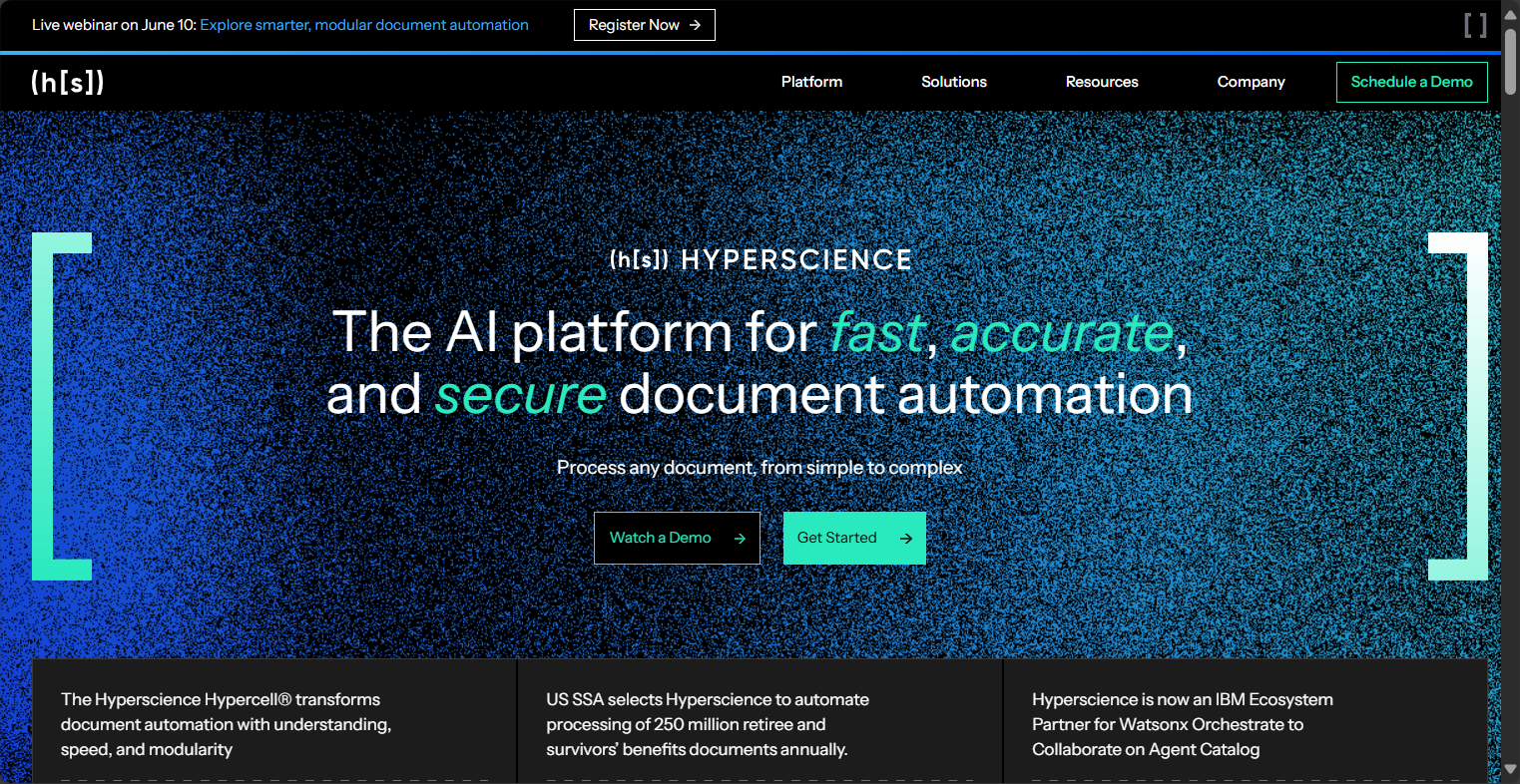
The Hypercell platform delivers 99.5% accuracy and 98% automation rates across structured, semi-structured, unstructured, and handwritten documents. Its modular workflow assembly lets organizations configure processing blocks for specific business needs, while intelligent exception routing handles edge cases through human-in-the-loop review.
Hyperscience holds six regulatory certifications: FedRAMP High, HIPAA, GDPR, CCPA, SOC 2 Type II, and TX-RAMP Level 2 for the State of Texas, plus Cyber Essentials Plus. The FedRAMP High authorization, achieved in partnership with Palantir Technologies, is a structural competitive advantage in U.S. federal procurement. The authorization process is lengthy and costly; competitors without it are structurally excluded from certain agency contracts. IDC flagged the full certification stack as a differentiator specifically for public sector and healthcare buyers.
InfoseeMEDIA's 2026 IDP implementation guide positions Hyperscience alongside ABBYY as leaders on extraction accuracy for complex and long-form documents, recommending Hyperscience specifically for "heavy contracts and long unstructured docs." The same guide reports that mature IDP implementations achieve 93 to 99% field-level accuracy and 75 to 90% straight-through processing (STP) rates across invoices, claims, and KYC workflows. Hyperscience does not publicly disclose where its own customer deployments fall on this curve. Buyers should request STP rates specific to their document types before any deployment decision.
Source gap: No competitor comparisons, throughput benchmarks, customer counts, or named enterprise deployments appear in available research. A complete competitive assessment requires the full IDC MarketScape report (US53014125). See also: Hyperscience competitive analysis.
How Hyperscience processes documents
The Hypercell platform's ORCA framework combines VLMs, SLMs, and LLMs in a hybrid architecture that also accepts third-party open-source and commercial LLMs. This layered approach is designed to avoid the accuracy ceiling of any single model while preserving flexibility for regulated environments where model provenance matters. ORCA includes zero-shot capabilities, enabling extraction without pre-configured templates.
The R40 release added deep learning models specifically for long-form document extraction across 50 to 200 page documents, along with model lifecycle management and expanded developer tools for GenAI and LLM integration. As Joiner stated at the R40 launch: "The latest release of the Hyperscience Hypercell delivers on the promise of transformation by setting the technology foundation to harness the power of GenAI and LLMs, and enabling our customers to convert back office documents and processes into strategic advantage."
At the workflow level, Hypercell uses modular processing blocks configurable for specific document types and business rules. OCR and full-page transcription handle initial digitization; machine learning models classify and route documents; NLP extracts structured fields from unstructured text. Complex or low-confidence cases route to human reviewers through an exception-handling layer, with reviewer decisions feeding back into model lifecycle management for continuous improvement.
Integration with downstream systems runs through APIs, webhooks, and pre-built connectors. Deployment options span cloud, on-premises, and hybrid configurations. Combined with FedRAMP High authorization, this makes Hypercell one of the few enterprise IDP platforms accessible to U.S. federal agencies with strict data residency requirements. For teams evaluating open-source alternatives that also target on-premises deployment, Unstract offers a no-code LLM platform with hallucination mitigation as a contrasting approach.
Use cases
Government benefit processing
Hyperscience announced Hypercell for SNAP in October 2025, a purpose-built IDP solution for state Supplemental Nutrition Assistance Program (SNAP) benefit processing. The platform processes 30 or more eligibility document types, including driver's licenses, passports, utility bills, pay stubs, tax returns, bank statements, and vehicle registrations. It reduces average payment processing time from 26 days to approximately 7 days and cuts payment errors by 50%.
The regulatory context makes this a durable market opportunity. H.R. 1 doubles SNAP reapplication frequency from annual to semi-annual for 42 million beneficiaries. Currently 44 states exceed the 6% SNAP Payment Error Rate threshold, exposing them to federal penalties. An estimated 40% of SNAP applications are rejected due to being incomplete, illegible, or incorrectly filled out. As Joiner put it: "State governments have invested millions in legacy technologies that have failed to solve the core SNAP challenge, leaving applicants facing weeks of delays and exposing states to costly penalties under new compliance mandates. The problem isn't the portal; it's the paper."
Hyperscience reports that over 85% of Hypercell for SNAP capabilities apply directly to other entitlement programs including Medicaid, TANF, and LIHEAP, signaling a government entitlements franchise rather than a single-program deployment. Captova Technologies is one of the few other IDP vendors also targeting government and defense markets with on-premises deployment, though it focuses on high-speed throughput rather than benefit program workflows.
Insurance claims processing
Automated extraction from claim forms, medical records, and damage assessments, with policy matching and claims management system integration. The platform's handling of handwritten and semi-structured documents addresses a persistent gap in insurance workflows where legacy OCR fails on non-standard form layouts.
Financial services
Mortgage and loan processing with automated document classification, borrower information consolidation, and underwriting criteria matching. The R40 release's long-form document capability is directly applicable here: mortgage files routinely run to 100 or more pages across multiple document types. See the mortgage processing capability page for implementation patterns applicable to Hypercell deployments.
Healthcare documentation
Patient record digitization with HIPAA-compliant processing, handwriting recognition for clinical notes, and EHR system integration. Hyperscience holds HIPAA, GDPR, and CCPA certifications for organizations operating across jurisdictions. Buyers in this segment requiring video and multimedia evidence management alongside document AI may also evaluate VIDIZMO, which targets government and regulated enterprise workflows with a combined intelligence hub and redaction offering. Organizations with a narrower focus on prescription capture and handwritten clinical forms may also consider ScriptScan, which specializes in handwritten prescription processing for healthcare providers and pharmacies.
Technical specifications
| Feature | Specification |
|---|---|
| Accuracy | Up to 99.5% for data extraction |
| Automation rate | Up to 98% for document processing |
| AI framework | ORCA (VLMs, SLMs, LLMs); third-party open-source and commercial LLMs supported; zero-shot extraction |
| Long-form documents | Deep learning models for 50-200 page documents (R40, September 2024) |
| Document types | Structured, semi-structured, unstructured, handwritten |
| Deployment | Cloud, on-premises, hybrid |
| Integration | APIs, webhooks, pre-built connectors |
| Certifications | FedRAMP High, HIPAA, GDPR, CCPA, SOC 2 Type II, TX-RAMP Level 2, Cyber Essentials Plus |
| Security | Enterprise-grade encryption, access controls |
| Government partner | Palantir Technologies (FedRAMP High deployment) |
Resources
- Hypercell Platform
- Hypercell R40 Release Notes
- Industry Solutions
- Customer Success Stories
- Deep Analysis Vendor Profile 2025 (PDF)
- IDC MarketScape Leaders Placement (vendor summary)
- IDC MarketScape Full Report US53014125
Company information
- Founded: 2014
- Headquarters: New York, NY
- Founder: Peter Brodsky
- CEO: Andrew Joiner
- Address: 285 Fulton Street, New York, NY 10007
- Phone: (646) 767-6210
- Email: info@hyperscience.com
- Website: hyperscience.ai