Cambrion, IDP Software Vendor
On This Page
Munich-based agentic AI platform using vision-language models for zero-shot document processing, bypassing traditional OCR workflows.
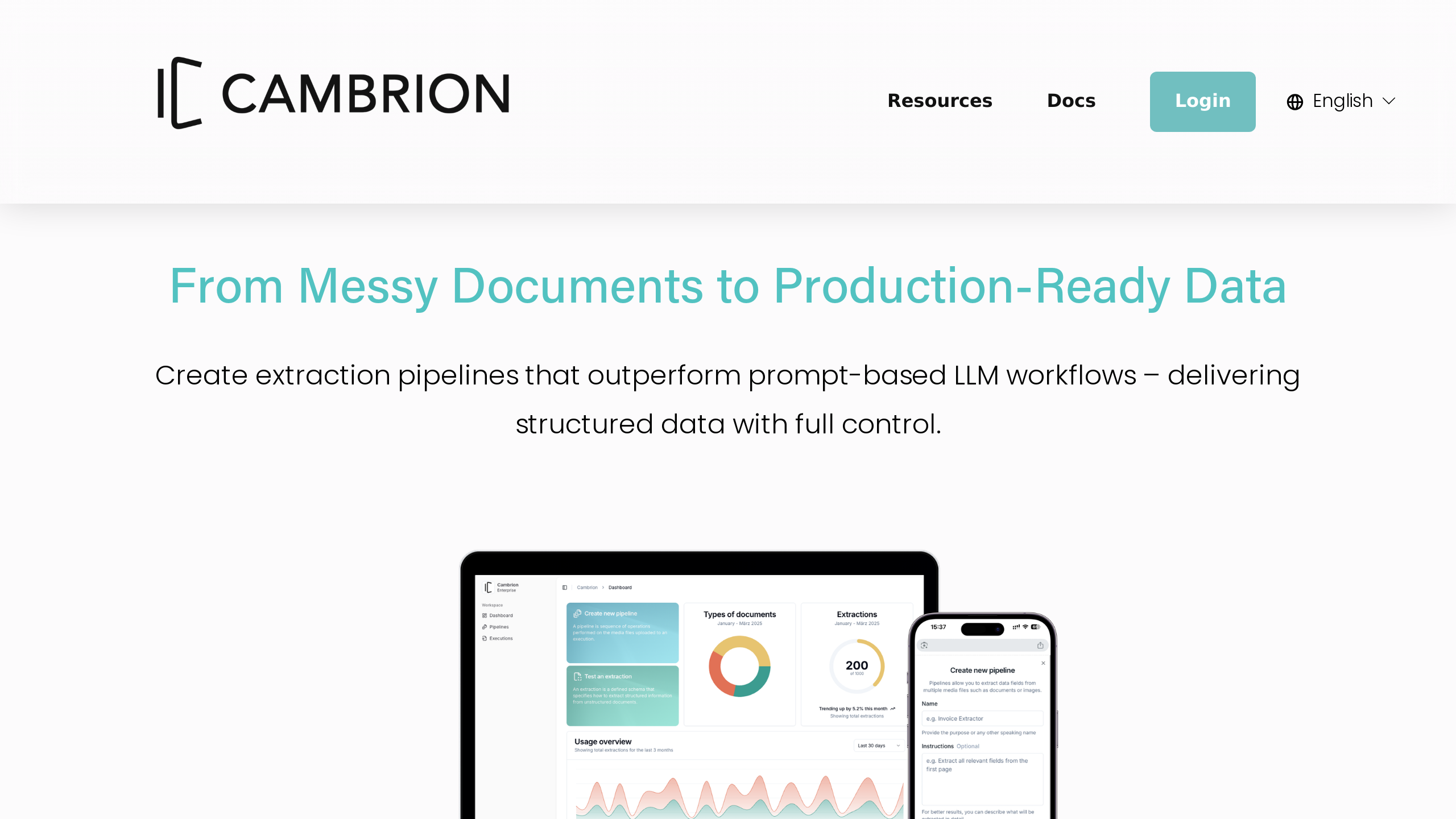
Overview
Founded in June 2024 by CEO Daniel Gambier, CTO Daniel Tiarks, and co-founder Lars Kornhoff (role unspecified), Cambrion represents what Deep Analysis senior analyst Dan Lucarini calls the "4th Wave of IDP": vendors that discard OCR and custom ML training entirely in favor of multimodal large language models (LLMs) and vision-language models (VLMs). As Lucarini put it: "We call them 4th Wave because they rely on a multi-modal LLM to handle classification, image pre-processing, and data extraction. This is in stark contrast to the industry's historic reliance on OCR, pre-processing tools, and custom machine learning models."
The Munich-based company has raised €450k across angel funding and grants since launch, reaching a valuation of €1.2m to €1.8m with 7 employees. The company closed its first pre-seed round with angel investors by April 2025. Round size has not been disclosed.
Where legacy intelligent document processing (IDP) vendors like ABBYY and UiPath historically required 1,000+ labeled documents to train models to acceptable automation levels, Cambrion's Pipeline Agent requires only a plain-language description of requirements and a single example document, then constructs the processing pipeline automatically. The platform routes between OpenAI, Google, Anthropic, DeepSeek, Llama, and other foundation models, positioning itself as model-agnostic. No model selection criteria or switching logic has been disclosed publicly.
The Deep Analysis briefing is Cambrion's first known third-party analyst coverage. This is a credibility signal for a sub-two-year-old startup, though independent validation beyond a single analyst firm is still absent. No benchmark data, pricing, plan tiers, or automation rate figures have been published. For a vendor targeting regulated industries including healthcare, logistics, and HR, that gap will need to close before serious procurement conversations begin.
The company name itself signals intent. As CTO Daniel Tiarks explained: "The idea came from the geological era known as the 'Cambrian explosion'. During that era, living beings first gained the ability to see and eyesight, as we know it today, happened. With 'Cambrion', now the machines are beginning to 'see' documents in a new way, similar to the Cambrian explosion of vision."
How Cambrion processes documents
Cambrion's Pipeline Agent handles classification, image pre-processing, and data extraction entirely through multimodal LLMs and VLMs, with no OCR pipeline and no custom model training. Configuration happens in natural language; a single example document is sufficient to generate a processing workflow.
The company positions itself against two failure modes it sees in the current market. Standard OCR breaks when document layouts change across carriers, regions, or versions. Prompt-based LLM approaches produce quick pilots but require constant maintenance and degrade at production scale. Cambrion's answer is a scaffolding and validation layer built around the VLM/LLM core, designed to produce consistent structured output.
CEO Gambier described the production-scale problem directly: "While teams can achieve quick results using models like Gemini or Flash, maintaining these systems at scale, especially for production use, often uncovers significant challenges. These include consistent output structures, managing extensive input-output contexts (e.g., handling long invoices with numerous line items), and technical complexities like caching, concurrency, and resource management."
That scaffolding layer is also Cambrion's answer to the build-vs-buy challenge: enterprise teams can prototype with foundation model APIs quickly, but Cambrion argues production-scale reliability is where internal builds break down. The claim is plausible but unquantified. No accuracy figures or automation rates from live deployments have been published.
The platform accepts DOCX, XLSX, PDF, JPG, and email inputs, delivers structured JSON output via API, and deploys on EU cloud, private cloud, or on-premise infrastructure to meet data residency requirements. Integration targets include TMS, WMS, ERP systems, and carrier portals.
Use cases
Manufacturing test protocols
LAUDA manufacturing uses Cambrion to automate handwritten test protocol processing, converting complex technical documentation into validated data. Florian Grunwald at LAUDA reports the platform "turns complex, handwritten test protocols into validated data in seconds," saving "hundreds of hours of manual work." The system handles varied handwriting styles and technical terminology without prior training on domain-specific documents.
Freight document processing
Cambrion processes freight documents including CMR, bill of lading, air waybill, manifests, packing lists, carrier invoices, and booking confirmations without templates or OCR. The platform extracts parties, routes, weights, charges, references, container IDs, vessel details, and harmonized codes across carriers, lanes, and regions without template reconfiguration or manual labeling. This directly addresses a core logistics pain point: document formats vary by carrier and region, making template-based systems expensive to maintain.
Logistics invoice processing
The platform processes commercial invoices and delivery documents for logistics companies, extracting shipping details, costs, and tracking information from varied formats. David Siegel at Zoll Experts reports "far more effective and intelligent automation than our old template-based system."
Automotive supplier documentation
Automotive manufacturers deploy Cambrion for supplier reports and quality documentation, handling multi-format documents including PDFs and Excel files while maintaining EU data residency requirements.
Expanding target verticals
Beyond its initial manufacturing and logistics deployments, Cambrion is targeting healthcare, HR, and production industries as it scales. No named customers or case studies in these verticals have been disclosed.
Technical specifications
| Feature | Specification |
|---|---|
| Platform type | Agentic AI with vision-language models |
| AI models | OpenAI, Google, Anthropic, DeepSeek, Llama, Mistral AI, Qwen |
| Document formats | DOCX, XLSX, PDF, JPG, email |
| Learning approach | Zero-shot (no training required; single example document sufficient) |
| Output format | Structured JSON via API |
| Deployment | EU cloud, private cloud, on-premise |
| Integrations | TMS, WMS, ERP, carrier portals |
| Setup time | Minutes with natural language configuration |
| Pricing | Not disclosed |
| GA / Beta status | Not disclosed |
| Founded | June 2024, Munich, Germany |
| Employees | 7 |
Market context
The IDP sector Cambrion enters is growing fast. Infosource's 2025 Global IDP Market Report valued the sector at over $8 billion with 14.5% year-over-year growth and a 16% compound annual growth rate projected through 2029. Deep Analysis tracked 456 IDP companies in July 2025, a 15% year-over-year increase, segmenting the market into seven categories from pure-play IDP to hyperscaler document AI.
Cambrion's zero-shot approach differentiates it from template-based OCR vendors and from prompt-engineering-dependent solutions that require ongoing maintenance. The closest competitive comparison is with template-free vendors like Hyperscience and Instabase, though Cambrion's reliance on public LLM APIs rather than proprietary models may limit differentiation in highly regulated verticals where data sovereignty and model auditability matter most.
The favorable market conditions also attract well-capitalized competitors. Hyperscalers including Microsoft, Google, and AWS are all expanding their document AI offerings, and established IDP vendors are integrating LLM capabilities into existing platforms. Cambrion's bet is that production-grade scaffolding around foundation models is a distinct engineering problem that neither hyperscalers nor legacy vendors have solved cleanly.
Resources
- Website
- FAQ
- Freight document processing use case
- Deep Analysis: The Cambrion Explosion (first independent analyst briefing)
- IDP Community Newsletter #149 (notable new entrant mention, confirms third co-founder)
- IDP 2025 Year-End Recap (market context, 4th Wave classification)
Company information
Munich, Germany
Founded: June 2024 Employees: 7 Funding: €450k total (€300k angel + €150k grants); pre-seed round closed April 2025, size undisclosed Valuation: €1.2m to €1.8m Co-founders: Daniel Gambier (CEO), Daniel Tiarks (CTO), Lars Kornhoff (role unspecified)
:::recent 3 :::