ClearDox: Commodities Intelligence Platform
On This Page
ClearDox is an AI-native commodities intelligence platform providing intelligent document processing and automation for commodity trading operations, covering the full trade lifecycle from confirmation through settlement and payment.
Note on brand search queries: Search data shows significant traffic for terms like "cleardox scam," "cleardox phishing," and "cleardox ddos." These queries relate to a separate entity, cleardox.com, that has been associated with DDoS-for-hire and cybercrime activity. ClearDox the commodities software vendor (cleardox.com) is an unrelated legitimate business headquartered in Stamford, Connecticut.
Overview
Founded in 2018 and headquartered in Stamford, Connecticut, ClearDox specializes in intelligent automation for commodity-intensive businesses. The company employs approximately 28 people and was named FIA Innovator of the Year in 2023. Named clients include Freepoint Commodities, StoneX, SOCAR, DRW, Occidental Petroleum, Vitol, and ADNOC across energy, agriculture, metals, renewables, oil, and gas sectors.
ClearDox positions itself as a vertical platform purpose-built for commodities and energy, not a horizontal IDP tool like ABBYY adapted to the sector after the fact. That distinction sharpens the value proposition for commodity trading buyers but limits total addressable market compared to generalist IDP vendors.
As CEO Rick Nelson wrote in March 2026: "The front office has benefited from technology-driven insights for decades. The back office has not, and the cost of that imbalance is becoming impossible to ignore." That thesis drives the platform's design: a data and intelligence layer sitting between raw commodity documents and core trading systems, surfacing exceptions rather than requiring manual review of every transaction.
Two quantified case studies establish production-grade deployment. Freepoint Commodities (physical merchant: natural gas, oil, power) cut per-employee daily reconciliation time from 30 minutes to 3 minutes, a 10x reduction, by automating reconciliation across thousands of transactions and surfacing only exceptions. StoneX reaches a 90-95% success rate ingesting, normalizing, and rekeying settlement statement data into its ETRM system for its agriculture business line. Both case studies are self-published; no independent analyst validation from Gartner, Everest Group, or IDC was present in available sources.
The platform's most significant recent development is its shift to an agentic architecture. In January 2026, release 24.05 introduced autonomous agents that reason and act across commodity business tasks, moving beyond rule-based document processing. CTO and Co-Founder Marc Lefebvre stated in December 2025: "ClearDox sees AI agents as the foundational technology for future AI applications in the commodity and energy sectors, given their flexibility and broad applicability."
The most recent strategic signal is a partnership with BBGC, a commodity trading and risk management (CTRM) consultancy. CTRM consultancies control implementation decisions at commodity trading firms; the partnership extends ClearDox's reach without requiring a direct enterprise sales force for a highly specialized buyer. No other distribution partnerships were disclosed, which represents a channel dependency risk for buyers evaluating long-term vendor stability.
Comparable IDP vendors include Hyperscience.
How ClearDox processes documents
ClearDox Spectrum provides intelligent document processing using a multi-engine OCR approach achieving 95-99% accuracy on quality scans, combined with AI-powered reconciliation engines that automate trade confirmation matching. The platform is delivered as cloud-based SaaS, processing PDFs, emails, and images via REST APIs, messaging buses, and SFTP/FTP. It combines proprietary machine learning with third-party large language models (LLMs), trained specifically on commodities data, documents, and trading logic rather than generic corpora.
The agent architecture, documented by ClearDox leadership in December 2025, distinguishes two agent types. Chat Agents are LLM-powered and user-initiated: they handle file download, data upload and download, email drafting, mapping suggestions, and record approval. Process Agents are non-interactive and system-driven: they automate document linking based on business rules, run prompts automatically, classify insights, and push alerts based on events or thresholds. Critically, agent configuration is performed through the UI with no programming skills required, according to the same source.
Vice President of Product Katie Carter noted in December 2025: "Human in the loop is the essential part of concept of AI based automation." The platform routes exceptions to human reviewers rather than attempting fully autonomous resolution of ambiguous cases, a design choice that reflects the high-stakes nature of commodity trade operations.
To address AI reliability concerns, ClearDox uses retrieval-augmented generation (RAG) architectures and vector database improvements to reduce hallucinations compared to early AI models. The company is also exploring consensus agents, where multiple AI agents evaluate and cross-check each other to determine result reliability before surfacing outputs to users. This is on the roadmap, not yet in production.
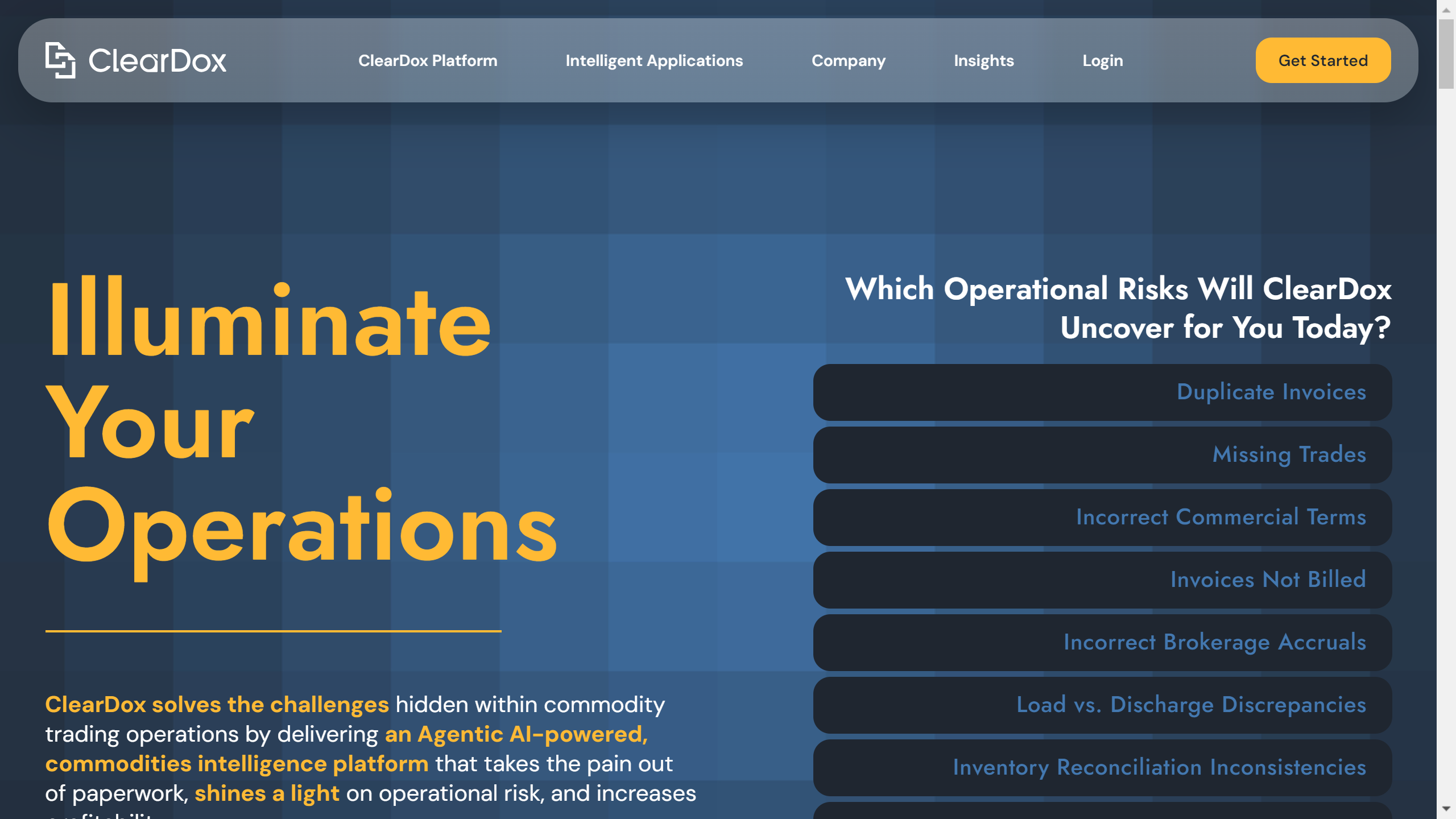
Four application modules cover the commodity trade lifecycle. Trade Confirmation automates confirmation document workflows, identifies duplicate or missing trades, corrects trade capture errors, and flags noncompliant contract clauses. Finance Optimization handles documentary letter of credit verification, incorrect commercial term detection, and missing or inconsistent documentation identification. Operations Intelligence provides automated workflows for inventory and movement data with discrepancy detection between load and discharge data. Payment Processing automates invoice validation, settlement, and cash flow optimization, detecting duplicate invoices and payment anomalies.
In December 2025, ClearDox announced Application Agents, purpose-built agents embedded within specific applications for structured, targeted automation. Finance Optimization is the first application of this approach. The system automates letter of credit ingestion, routing, and categorization with UCP 600 compliance validation performed clause-by-clause upon upload. Supporting document requirements are automatically extracted from LC sections 46A and 47A, with conditions mapped to each document type. When amendments are linked to master LC records, the system triggers full re-evaluation of all previously established statuses.
ClearDox CoPilot, a domain-specific LLM trained on commodities data and integrated across all applications, allows users to query operational data and risk insights via natural language in a secure environment. ClearDox AMS handles archived records management with automated destruction notifications when retention periods expire, extending the platform into data governance. This positioning was recognized in the UK compliance software market alongside providers like Iron Mountain.
Use cases
Reconciliation automation
Freepoint Commodities (physical merchant: natural gas, oil, power) reduced per-employee daily reconciliation time from 30 minutes to 3 minutes by automating reconciliation across thousands of transactions and routing only exceptions to human review. The 10x reduction in routine matching time is the strongest quantified outcome in ClearDox's public case study library.
Settlement and ETRM integration
StoneX achieves a 90-95% success rate ingesting, normalizing, and rekeying settlement statement data directly into its ETRM system for its agriculture business line, eliminating manual rekey work at scale. The remaining 5-10% of exceptions route to human review rather than failing silently.
Trade confirmation workflows
Trading desks deploy ClearDox to automate confirmation document workflows, extracting trade details and matching against internal systems. The Document Process Agent provides context-aware monitoring across commodity trading workflows. Implementation typically completes within 3 calendar weeks, according to ClearDox.
Letter of credit and trade finance processing
Finance departments process commodity letters of credit with automated UCP 600 clause-by-clause compliance validation, AI extraction of supporting document requirements from LC sections 46A and 47A, and full re-evaluation triggered automatically when amendments are received.
Commodity invoice processing
Payment Processing automates invoice validation, settlement, and cash flow optimization, detecting duplicate invoices and payment anomalies before they reach accounts payable teams.
Data retention compliance
Organizations use ClearDox AMS for systematic data governance with automated notifications for archived record destruction when retention dates expire, covering regulated data lifecycle management across commodity trading records.
Technical specifications
| Feature | Specification |
|---|---|
| Core platform | ClearDox Spectrum (IDP), ClearDox CoPilot (AI assistant), ClearDox AMS (records management) |
| AI technology | Agentic AI (Chat Agents + Process Agents), LLMs (proprietary + third-party), ML, NLP, multi-engine OCR |
| OCR accuracy | 95-99% for quality scans |
| Supported file types | .htm, .html, .xml, .json, .csv, .txt, .xls, .xlsx, .doc, .docx, .pdf, .zip, .jpg, .tiff, .png, .bmp |
| Languages | English, French, German, Italian, Portuguese, Spanish |
| Deployment | Cloud-agnostic, private cloud, AWS, Azure, on-premises |
| Integration | REST API, Event Hub, SFTP/FTP, web scraping, CTRM/ETRM/ERP |
| Security | TLS encryption, SAML SSO, 2FA, SOC 2 Type 2, ISO/IEC 27001 |
| Implementation time | Under 3 weeks typical |
| Hallucination mitigation | RAG architecture, vector database, consensus agents (roadmap) |
| Agent configuration | UI-based, no programming required |
No pricing, plan tiers, or benchmark comparisons against competitors are publicly available. Buyers conducting due diligence should note the absence of third-party analyst validation from Gartner, Everest Group, or IDC.
Company information
Headquarters: Stamford, Connecticut, United States
Founded: 2018
Employees: approximately 28
Recognition: FIA Innovator of the Year 2023
CEO: Rick Nelson
CTO and Co-Founder: Marc Lefebvre
VP Product: Katie Carter
Rick Nelson described the company's evolution in March 2026: "Our evolution reflects what we are seeing across the industry. Operational automation and risk have moved from being back-office concerns to leadership issues." A 28-person Stamford startup competing for enterprise commodity trading accounts against larger horizontal IDP vendors, ClearDox bets that deep vertical specialization in commodities beats horizontal scale. The BBGC partnership is the primary mechanism for extending enterprise reach without proportional headcount growth.
Resources
- ClearDox platform overview
- Freepoint Commodities case study
- StoneX settlement automation case study
- Agentic AI strategy explained by ClearDox leadership
- Finance Optimization and Application Agents coverage via CTRMCenter
- Platform capabilities overview via ETT Center
- BBGC partnership announcement
- FAQs