Workist: IDP Software Vendor
On This Page
Berlin-based intelligent document processing (IDP) platform with €11.8M in funding, 50+ enterprise clients, and documented 96% time savings on order processing. No template training required.
Overview
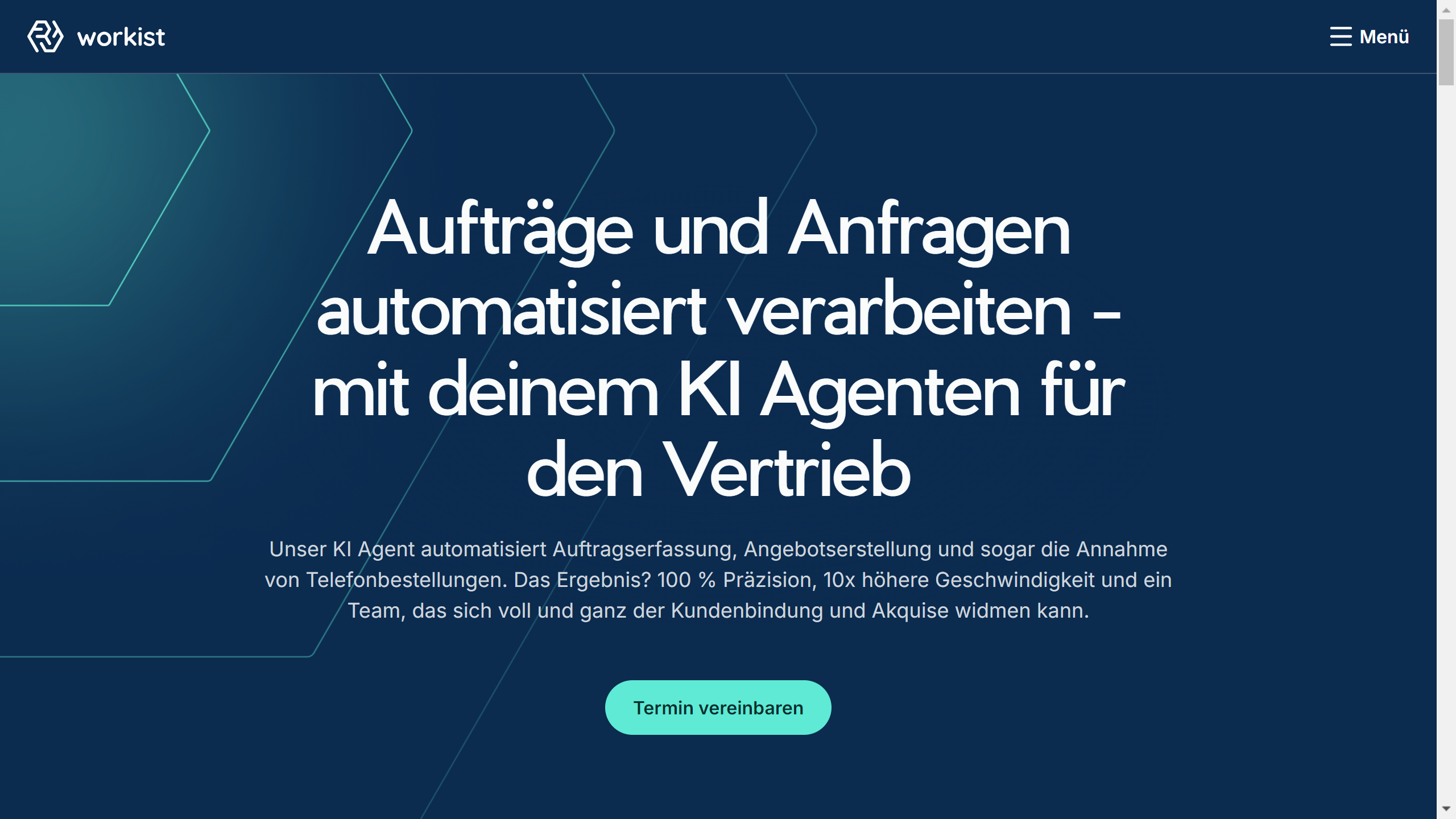
Founded in 2019, Workist targets mid-market enterprises that need to automate incoming business documents without rebuilding their ERP workflows. The platform processes PDFs, spreadsheets, emails, and faxes, then pushes structured data directly into connected ERP and CRM systems, eliminating manual data entry from B2B transactions.
The company raised €9 million in Series A funding in September 2022, led by Earlybird Venture Capital, with participation from 468 Capital, LEA Partners, and another.vc, bringing total funding to €11.8 million. By that point, Workist had reached seven-figure annual revenue and served more than 50 customers, including PepsiCo and Deutsche Bahn.
The core claim is zero-template implementation. Rather than requiring IT teams to configure document templates or train models on specific layouts, Workist's AI adapts to document variations automatically. The company claims a 2-day implementation timeline and has processed over 3 million documents across its customer base.
A building materials company processing thousands of incoming purchase orders each month reported on Software Advice that Workist delivered "the highest automation rate out of all the vendors while improving data quality," the only third-party review platform citation available for this vendor.
What users say
Practitioner feedback clusters around two themes: speed of results and format flexibility. Stefan Underwood, Head of Logistics at Contorion, states: "Workist's tool stands out because it produces very good results very quickly, regardless of the format of the document." Hans Peter Härle, Head of IT at Brennenstuhl, notes the operational shift: "Workist has transformed our day-to-day work in order entry. Suddenly, the team has time to focus on other, more challenging and value-adding tasks."
The building materials customer on Software Advice specifically compared Workist against other vendors before selecting it, citing automation rate and data quality as the deciding factors. No negative practitioner feedback appears in available third-party sources, though the review volume on independent platforms remains limited for a vendor of this size.
How Workist handles document processing
Workist runs a four-step pipeline: documents arrive by email or upload, the AI extracts and validates the structured data, a human-in-the-loop review step catches exceptions, and the output posts directly to the connected ERP via EDI or API. The system supports 60+ languages and handles infinite document layouts without pre-configuration.
The no-training model is the primary differentiator against template-dependent platforms. Traditional OCR-based systems require IT teams to map fields for each supplier's document format. Workist's approach means a new supplier's purchase order format does not trigger a reconfiguration cycle. The platform learns continuously from the 3+ million documents already processed across its customer base, which compounds accuracy over time.
ERP connectivity covers SAP, Microsoft Dynamics, NetSuite, ABAS, proALPHA, and Business Central. Output formats include XML and EDI, covering the standards most mid-market procurement teams already use.
Use cases
Order processing automation
The most documented use case is purchase order intake. EVG reduced order processing time from 4.5 minutes to 16 seconds per document, a 96% reduction. Brennenstuhl eliminated a 300-document order backlog that previous static solutions could not clear. RUKO achieved 87% time savings on order entry. Wero saved 43 days of processing time per quarter across 6,000 documents.
These results share a pattern: the bottleneck was manual keying of supplier POs into ERP systems, and Workist replaced that step entirely rather than accelerating it.
Multi-industry document processing
Documented deployments span biotechnology (EVG), electronics (Brennenstuhl), construction (RUKO), building materials, and enterprise procurement (PepsiCo, Deutsche Bahn). The breadth across industries reflects the format-agnostic design. Unlike vertical IDP platforms built for specific document types, Workist competes on horizontal document intake, which means it sits alongside broader document processing platforms in procurement and finance evaluations.
Technical specifications
| Feature | Specification |
|---|---|
| Languages supported | 60+ |
| Document formats | PDF, Excel, email, fax |
| ERP integrations | SAP, Microsoft Dynamics, NetSuite, ABAS, proALPHA, Business Central |
| Output formats | XML, EDI, API |
| Implementation time | 2 days (vendor-claimed) |
| Processing corpus | 3+ million documents |
| Peak automation rate | 96% (customer-reported) |
Company stability
Workist was founded in 2019 by Alexander Müller (Managing Director) and Fabian Brosig (Chief Technology Officer). The September 2022 Series A brought total funding to €11.8 million. Dr. Andre Retterath of Earlybird Venture Capital stated at the time: "The Workist team is poised to change this and replace manual document processing in B2B transactions, fundamentally changing the way businesses interact globally."
No funding announcements, leadership changes, or product releases have been confirmed in public sources since September 2022. The most recent verified company milestones date to that period. Evaluators should request current headcount, ARR, and customer count directly from the vendor before making procurement decisions.
The most recent independently verified company data for Workist dates to September 2022. No public announcements covering 2023, 2024, or 2025 were found during research. Product capability claims on the vendor's own site reflect current positioning but carry no independent verification date.
Resources
Location: Berlin, Germany
Website: https://www.workist.com
Key links:
- AI document processing overview
- How it works
- Software Advice profile
- Series A coverage, tech.eu