M-Files: Metadata-Driven Document Management
On This Page
- Overview
- How M-Files processes documents
- Aino AI layer
- Microsoft 365 Copilot integration
- Version 26.3 platform updates
- Developer access
- Use cases
- Life sciences and drug research
- Audit, advisory, and professional services
- Manufacturing and quality management
- Enterprise document management
- 2026 platform packages
- Technical specifications
- Resources
- Company information
M-Files is an intelligent document processing vendor providing metadata-driven document management that organizes content by what it is rather than where it's stored, serving 6,000+ organizations across 100+ countries with approximately 2 petabytes of data under management.
Overview
Founded in 2001 and headquartered in Helsinki, M-Files has evolved from traditional document management into a "context-first" intelligent information platform that organizes documents through an enterprise knowledge graph rather than folder hierarchies. The company added nearly 500 new customers in FY2025, and a Forrester Total Economic Impact study quantified the platform's value at $7.5 million in business benefits and 294% ROI over three years.
Analyst recognition is credible but not top-tier. M-Files holds Gartner Peer Insights Customers' Choice for Document Management and Strong Performer status in the Forrester Wave: Content Platforms, Q1 2025, positioned in the wave but not among the Leaders. For enterprise buyers using Forrester as a shortlist filter, that distinction matters. The Gartner peer recognition partially offsets it by signaling strong practitioner satisfaction.
Two customer outcomes anchor the ROI claims with hard figures. Charles River Laboratories achieved 65% faster client report processes, saving an estimated $2.4 million annually through M-Files workflows. Crowe UK LLP connected 800,000+ documents to workflow processes, generating $2.2 million in annual efficiency gains without adding headcount.
Through Q1 2026, M-Files executed three interconnected moves: deepening its Microsoft co-development partnership into native Copilot integration, restructuring its commercial packaging to embed AI as standard across all cloud tiers, and scaling revenue through an overhauled partner programme led by newly appointed channel VP Mike O'Neill, hired from Box and Dell Technologies (EMC) in October 2025. CEO Jay Bhatt stated in January 2026: "We see an enormous opportunity to continue to scale our impact through our strategic partnership with Microsoft and accelerated product co-development."
How M-Files processes documents
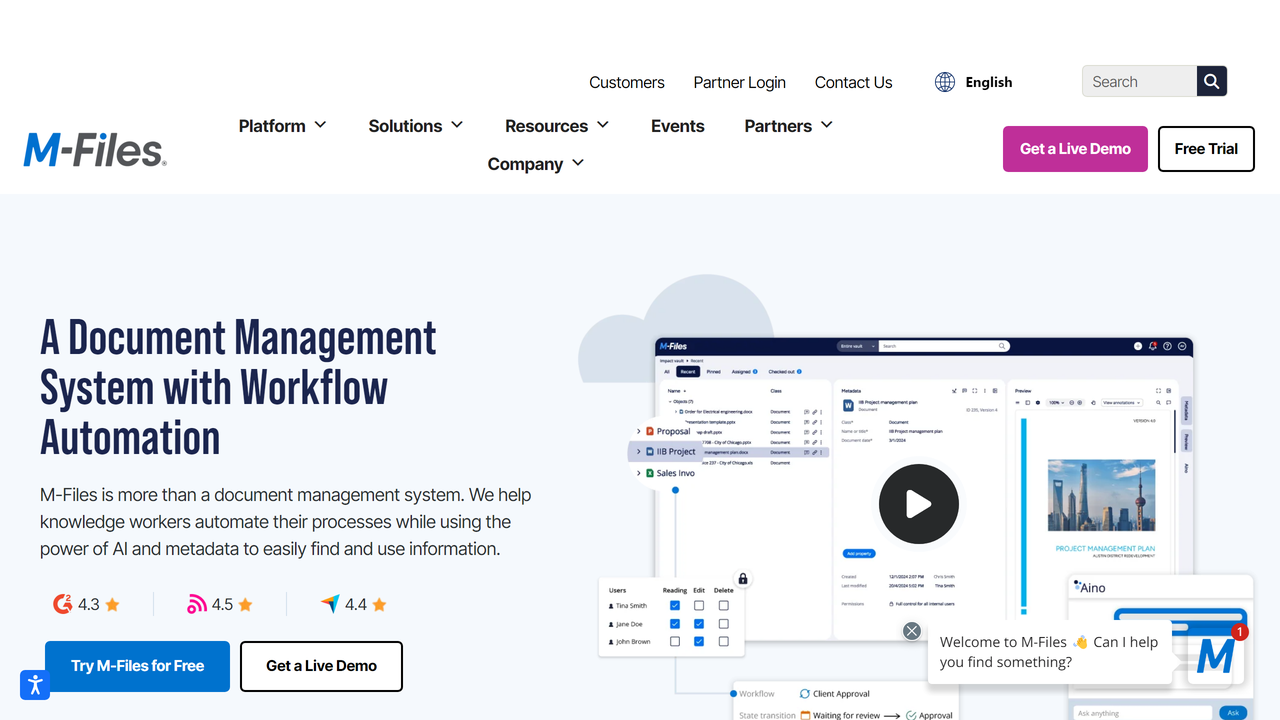
M-Files organizes content through a metadata-driven architecture rather than folder location. Every document is described by what it is: its type, relationships, status, and context. The platform surfaces it dynamically based on those properties rather than where it was saved.
The enterprise knowledge graph sits at the center of this architecture. Documents derive value from their relationships to people, projects, and processes. The graph makes those relationships queryable and actionable, so a contract surfaces alongside the client, project, and team members it belongs to, without requiring anyone to know which folder it was saved in. M-Files Workspaces presents each user a role-based, contextually relevant view built on this graph.
The repository-neutral approach means M-Files connects to existing systems without requiring migration. SharePoint, network drives, and other repositories remain in place. M-Files creates unified access across them through metadata rather than consolidation.
Aino AI layer
The Aino AI Fabric is M-Files' orchestration layer for intelligent document processing. Two capabilities introduced in FY2025 are most relevant to IDP use cases.
Aino Metadata Multimodal extends metadata extraction beyond text-native documents to handwriting, graphs, and scanned or image-based files, moving M-Files into mixed-format document processing territory. No accuracy benchmarks or supported document-type lists have been disclosed publicly.
Aino Metadata Agent at Scale automates discovery and enrichment of large document collections with a human-in-the-loop review step and AI-flagged values, targeting regulated industries where compliance requires auditable metadata provenance. Roman Bulkiewicz, Director of Information Technology at Fey Industries, explained the selection: "Unifying content into a trusted, context-rich system lets us automate document-heavy workflows now and improve the accuracy of AI across our processes going forward."
As of the 2026 Platform Packages restructure announced March 16, 2026, M-Files Aino is included as standard across all cloud tiers rather than as an add-on. Self-hosted packages exclude AI and Microsoft-native cloud capabilities, a deliberate signal that cloud is the primary innovation path going forward.
Microsoft 365 Copilot integration
On March 16, 2026, M-Files launched native integrations with Microsoft 365 Copilot and Copilot Agent Builder. The integration feeds structured, metadata-rich information into Copilot to help the model understand relationships between business concepts: customers, contracts, processes, and components. Critically, the integration is permission-aware, meaning Copilot outputs respect user access rights defined within M-Files rather than surfacing content users should not see.
M-Files is the first document management system to leverage SharePoint Embedded, allowing organizations to store content natively within Microsoft 365 while M-Files governs the metadata layer. John Mighell, Director of Product Marketing for SharePoint and OneDrive at Microsoft, confirmed: "These new solutions enrich Microsoft Work IQ with context from M-Files' enterprise knowledge graph empowering differentiated AI experiences."
Ryan Barry, VP of Strategic Operations and Corporate Development at M-Files, framed the underlying problem the integration solves: "Many organizations are realizing that AI is only as strong as the information behind it. Without the right context, even the most advanced models struggle to deliver accurate, actionable insights or reliably execute agentic workflows with the precision required to generate measurable business efficiency."
The March 31, 2026 Microsoft Search partnership extends this further, integrating metadata-driven document discovery across disconnected enterprise systems to address knowledge silos where content gets buried and teams duplicate work.
The platform dependency risk is real but unaddressed in available sources. Deeper Microsoft integration narrows M-Files' differentiation from Microsoft's own content services roadmap. The geographic scope of the Finland Marketplace Solution Partner of the Year award also suggests the partnership may still be in early adoption phases outside Nordic markets.
Version 26.3 platform updates
The March 2026 release (Desktop version 26.3, shipped March 15-18) delivered several capabilities relevant to enterprise document workflows. Native Microsoft 365 Copilot integration shipped in this release. Document comparison now supports DOC, DOCX, PDF, and RTF formats with a side-by-side view. Workspace improvements include shareable workspace links, configurable reference direction for tabs, and property links that open workspaces directly. The Event Log now displays names and timestamps of all users who edited documents through co-authoring, improving audit trails for collaborative work.
Five new vault API endpoints shipped in UIXv2: GetObjectFiles, GetWorkflowStates, GetLatestFileVersion, GetObjectHistory2, and GetObjectDataOfMultipleObjects. New M-Files Desktop is now the primary focus for all future features, signaling that development investment is consolidating on the modern client.
The February 2026 cloud release (shipped February 15, auto-updates available February 18) added version history rollback in both Desktop and Web clients, administrator version deletion from version history, a React-migrated listing component for faster content loading, a server-side search engine replacement for improved reliability, and UIX 2.0 developer documentation covering supported API versions, experimental features, and a "Deprecated Features and Alternatives" section to assist migration from UIX 1.0.
Developer access
A Python API wrapper (MIT License, version 0.5.4, released December 2025) provides open-source REST API integration. Python versions 3.5-3.8 are supported. The wrapper carries alpha status. Teams evaluating open-source LLM-based extraction alongside M-Files' REST layer may also want to review Unstract, which offers a no-code LLM platform with hallucination mitigation designed for production-grade document workflows.
Use cases
Life sciences and drug research
Regulated research organizations use M-Files to connect study components: clients, templates, sites, and actions. These connections flow through metadata rather than navigating disconnected folder structures. Jenith Charpentier, Senior Director of Data and Report Delivery Services at Charles River Laboratories, described the outcome: "With M-Files, we now understand all elements of the study design in one connected view. We get our client, our templates, our sites, and we're really able to drive actions through that metadata." The result was 65% faster client report processes and $2.4 million in annual savings.
The platform's FDA 21 CFR Part 11 compliance and auditable metadata provenance through Aino Metadata Agent at Scale make it applicable to submission management and regulatory documentation workflows. Organizations processing scientific literature alongside regulatory submissions may also evaluate PaperQA Nemotron, an open-source platform combining retrieval-augmented generation with NVIDIA models for scientific document analysis.
Audit, advisory, and professional services
Professional services firms use M-Files to connect large document collections to workflow processes without adding headcount. Ian Norman, National Technology Director at Crowe UK LLP, described the scale: "We've been able to scale our operations without adding headcount and now have full collaboration across our employee base, working from the most trusted information." Crowe connected 800,000+ documents to multiple workflow processes, generating $2.2 million in annual efficiency gains.
The repository-neutral approach allows firms to unify content across existing systems: email, SharePoint, network drives, without migration projects. Firms evaluating purpose-built audit document automation may also want to assess Adlib, a Toronto-based IDP provider specializing in accuracy validation for regulated enterprises.
Manufacturing and quality management
Manufacturing and regulated organizations implement M-Files as an electronic quality management system with automated workflows and compliance tracking. The platform maintains audit trails for ISO 9001, FDA, and other regulatory requirements while managing nonconformance and CAPA processes through systematic documentation. Fey Industries selected M-Files specifically for its Aino agentic orchestration layer to automate document-heavy manufacturing workflows.
Enterprise document management
Organizations with fragmented content repositories use M-Files' repository-neutral architecture to create unified access across multiple systems. The knowledge graph surfaces documents by context: project, client, document type, status, rather than requiring users to know where files were saved. Role-based workspaces adapt the interface to each user's responsibilities without requiring separate deployments.
The Microsoft 365 Copilot integration extends this to AI-assisted work: Copilot queries draw on M-Files' metadata graph for context, and permission enforcement ensures outputs stay within each user's access scope. Mikko Pippuri, Digital Ninja at Berggren, assessed the combination: "Deriving AI value starts with accurate, governed information, and pairing Microsoft 365 Copilot with M-Files represents a compelling approach to enabling precision, compliance, and auditability for confident AI use across our business."
Organizations in government and defense with additional requirements around video evidence and multimedia redaction may also evaluate VIDIZMO, a US-based enterprise platform offering intelligence hub and evidence management capabilities alongside document AI.
2026 platform packages
Essentials
Enterprise {primary}
Foundation
Self-Hosted (Core / Advanced)
The packaging restructure announced March 16, 2026 makes the cloud-versus-self-hosted trade-off explicit. AI capabilities and Microsoft-native features are cloud-only. Self-hosted customers retain their existing deployments without forced migration, but new AI and Copilot capabilities will not reach them. For organizations evaluating M-Files, this is a meaningful architectural decision: choosing self-hosted means opting out of the platform's primary innovation track.
Pricing is not publicly disclosed across any tier.
Technical specifications
| Feature | Specification |
|---|---|
| Architecture | Metadata-driven, repository neutral, enterprise knowledge graph |
| AI capabilities | Aino AI Fabric; Aino Metadata Multimodal (handwriting, graphs, scanned images); Aino Metadata Agent at Scale (human-in-the-loop, AI-flagged values) |
| Microsoft integration | Native Microsoft 365 Copilot and Copilot Agent Builder; SharePoint Embedded (first DMS to use); co-authoring in Word, PowerPoint, Excel, Teams; Microsoft Search partnership |
| Data scale | ~2 petabytes under management |
| Deployment options | Cloud (Essentials, Enterprise, Foundation), on-premises (Core, Advanced), hybrid |
| API | REST API; Python wrapper v0.5.4 (MIT License, alpha status, Python 3.5-3.8); five new UIXv2 vault endpoints in v26.3 |
| Mobile support | iOS, Android, Windows |
| Compliance | FDA 21 CFR Part 11, ISO 9001, GDPR, HIPAA |
| Version 26.3 (March 2026) | Native Copilot integration; document comparison (DOC, DOCX, PDF, RTF); shareable workspace links; co-authoring event log; five new vault API endpoints |
| February 2026 release | Version history rollback (Desktop + Web); admin version deletion; React-migrated listing component; search engine upgrade; UIX 2.0 developer docs |
| Pricing | Not disclosed |
Resources
- Company Website
- Vendor Profile 2024 (PDF) created by Deep Analysis
- Python API Wrapper v0.5.4
- FY2025 Annual Results (GlobeNewswire)
- Microsoft 365 Copilot Integration Announcement (GlobeNewswire)
- 2026 Platform Packages and Pricing (M-Files Community)
- Partner Programme Overhaul (Fintech Global)
- Microsoft AI Partnership Deepened (Fintech Global)
- M-Files: Competitive Analysis
Company information
M-Files Corporation Kaisaniemenkatu 10A 00100 Helsinki, Finland Phone: +358 3 3138 7500 Email: info@m-files.com Website: m-files.com
Founded 2001. 6,000+ customers across 100+ countries as of early 2026. Employee count not publicly disclosed.
HireLayer: Resume Parsing and Candidate Matching APIs
October 11, 2026
HireLayer: French resume parsing API that turns CVs into normalized JSON, plus job parsing, matching and ranking, from EUR 0.0445 per call.
HireLayer →DocuPipe: Schema-Driven Document Extraction Platform
October 6, 2026
New York schema-based extraction platform that turns PDFs, scans and spreadsheets into JSON, priced in credits, with an option to run it on-premises.
DocuPipe →Claix: Evidence-Backed Document JSON API for Agents
September 29, 2026
Madrid pay-per-call API that turns PDFs, spreadsheets, images and audio into schema-bound JSON with a cited source per field, built for AI agents.
Claix →