Extend AI: Agentic Document Processing Platform
On This Page
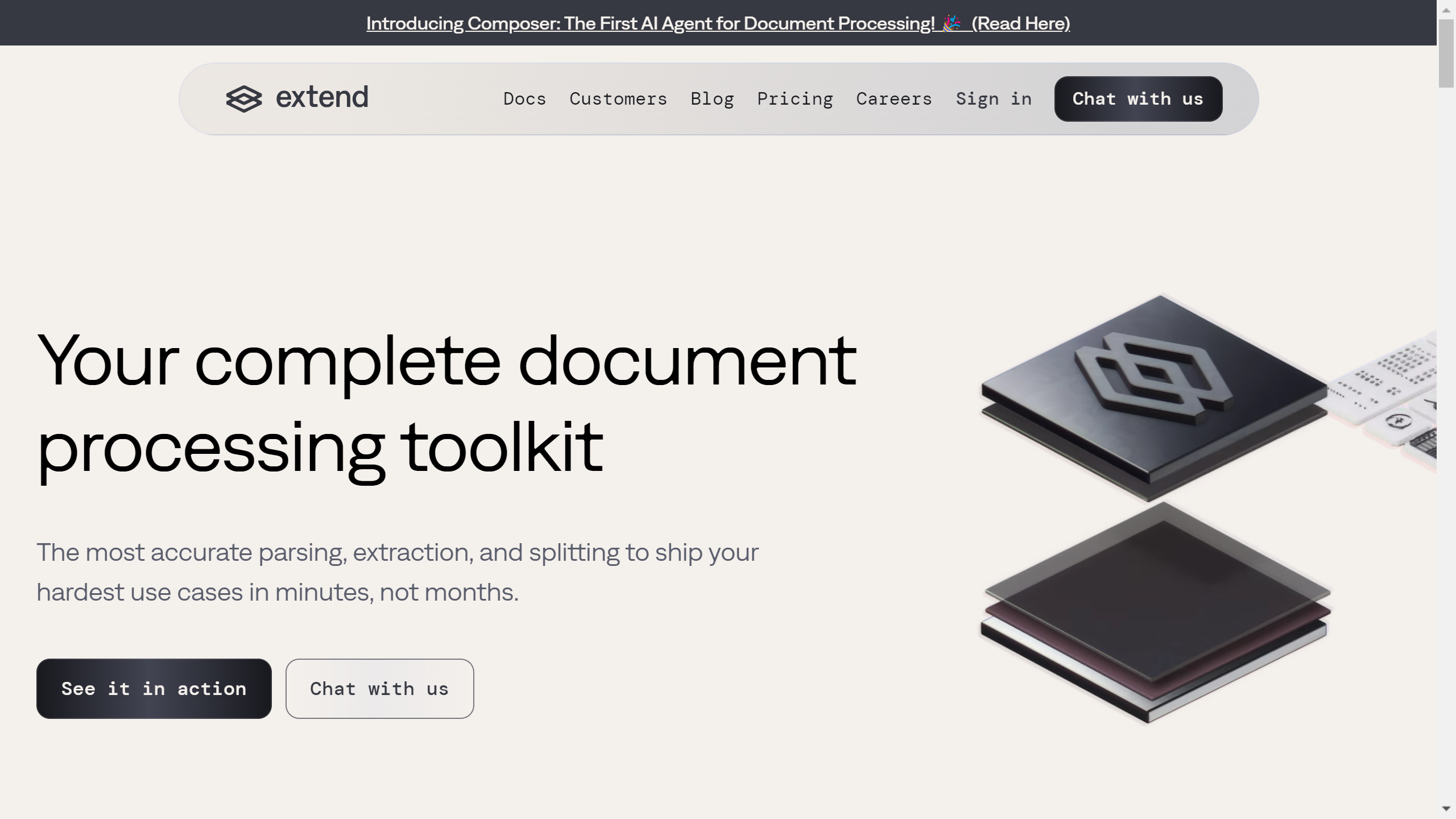
Extend AI is a Canadian document processing company founded in 2023, building an API-first platform that uses agentic optical character recognition (OCR) and vision-language models (VLMs) to extract structured data from complex documents. The company's core claim: 99%+ accuracy on handwriting, tables, and mixed-format documents through ensemble methods that combine multiple frontier large language models (LLMs) with proprietary context engineering.
Overview
Founded by Eli Badgio and Kushal Byatnal, Extend AI raised $17 million across seed and Series A rounds led by Innovation Endeavors in June 2025. The company targets technical teams in fintech, real estate, and healthcare that need production-grade document extraction without building and maintaining their own OCR infrastructure.
Named customers include Brex, which processes millions of financial documents at 99% accuracy, and HomeLight, which achieved 99% accuracy and eliminated manual review entirely. Vendr uses the platform to unlock data from millions of documents to power new product lines.
These accuracy figures are self-reported on company-selected test sets. The broader market context matters here: workflow orchestration and downstream integration are now the competitive differentiator, not raw extraction accuracy, which has reached commodity-level performance at 95%+ across enterprise platforms (Artificio.ai, March 2026). Extend's real differentiation lies in its automated evaluation framework, schema versioning, and three-tier parsing architecture rather than accuracy numbers alone.
Accuracy claims context: Extend reports 95-99% accuracy across use cases. These are self-reported benchmarks. Independent verification against standardized test sets is not available in public sources.
How Extend AI processes documents
Extend's pipeline covers the full document processing lifecycle: parsing, classification, data extraction, splitting, and markdown conversion for LLM ingestion. The architecture centers on proprietary agentic OCR that uses VLMs to review and correct low-confidence extractions, particularly on handwritten text, tables with merged cells, and complex multi-column layouts.
The agentic correction layer is what separates Extend from cloud extraction APIs. As the company states: "While cloud APIs provide reliable baseline performance, they operate as black boxes with limited customization. You can't train them on your specific document types or handwriting styles." Extend benchmarks AWS Textract, Google Vision, and Azure Document Intelligence at 70-80% typical accuracy on handwriting, compared to its claimed 99%+ through ensemble methods. For context, average handwriting OCR accuracy across tools industry-wide is approximately 64%, with LLM-based solutions reaching approximately 90% in controlled benchmarks.
Three parsing modes let teams optimize for their operational requirements rather than accepting a single accuracy-latency tradeoff:
- Agentic OCR uses the full ensemble pipeline for highest accuracy on complex documents
- Fast parsing targets low-latency use cases where speed matters more than maximum accuracy
- Cost-optimized parsing handles high-volume workloads where per-document economics drive decisions
The adaptive learning system builds memory from processed documents, improving accuracy on similar files over time. Autonomous optimization agents run experiments to refine extraction schemas without manual intervention. A production validation layer flags extractions below confidence thresholds for human review, supporting human-in-the-loop workflows where zero-touch processing is not appropriate.
The platform also includes an automated evaluation framework that generates accuracy reports at both field and document levels, plus schema versioning with draft, publish, and pin capabilities. Teams can track extraction quality improvements over time and manage schema evolution without manual benchmarking.
Extend AI approach
Agentic OCR with VLM correction layer, ensemble LLMs, automated evaluation, schema versioning, three parsing modes. Full pipeline from parsing to structured output.
Cloud extraction APIs (AWS Textract, Google Vision, Azure)
Reliable baseline performance at 70-80% accuracy on handwriting. Black-box architecture with limited customization. No document-specific training or adaptive learning.
Use cases
Financial document processing
Fintech companies use Extend to process loan applications, bank statements, and identity documents, extracting account numbers, transaction histories, and personal information from varied formats including poor-quality scans and handwritten annotations. Brex's deployment at millions of documents and 99% accuracy is the clearest public evidence of production scale in this vertical.
The adaptive learning system is particularly valuable in lending, where documents arrive from diverse financial institutions with variable field positions and formatting. As the platform processes records from the same institution, it learns format patterns and builds extraction memory, reducing the manual rule updates that traditional template-based systems require.
Healthcare records extraction
Healthcare organizations automate medical record processing by extracting patient demographics, diagnoses, prescriptions, and lab results from clinical documents. Medical documents combine inconsistent formatting across healthcare systems, handwritten clinical notes, and variable lab report layouts. Extend's vision models handle checkbox states, multi-column tables with merged cells, and clinical abbreviations.
The production validation layer is relevant here: EU AI Act enforcement on high-risk AI systems began August 2025, requiring compliance-first architecture with full audit trails and explainability for document processing in healthcare and financial services. Extend's human-in-the-loop workflow and confidence flagging address this requirement, though the company has not published explicit EU AI Act compliance documentation in available sources.
Real estate transaction automation
Real estate platforms process property documents including contracts, disclosures, and inspection reports. Real estate documents combine fixed-format sections (titles, legal descriptions) with highly variable content driven by jurisdiction-specific requirements. HomeLight's elimination of manual review demonstrates what production deployment looks like in this vertical.
The adaptive learning system builds jurisdiction-specific memory as a platform processes documents from the same state or county, learning regional disclosure form variations without requiring manual rule updates.
Competitive positioning
Extend positions itself against three categories of alternatives: RAG frameworks (LlamaIndex, LangChain, Haystack), extraction APIs (Pulse, Reducto), and cloud provider APIs (AWS Textract, Google Vision, Azure Document Intelligence). The company published a LlamaIndex alternative review making this positioning explicit.
The argument against RAG frameworks is architectural: LlamaIndex and LangChain are built for retrieval-augmented generation pipelines, not production document extraction with schema versioning, automated evaluation, and human-in-the-loop workflows. Against extraction APIs, Extend claims completeness: parsing, extraction, splitting, classification, and editing in one system rather than point solutions requiring integration work.
The market context supports this framing. 67% of enterprise document processing initiatives are now evaluating agentic approaches over traditional OCR-plus-rules stacks, up from 23% two years ago (Gartner 2025 Intelligent Document Processing report, cited March 2026). Agentic systems handle edge cases through context and judgment rather than rules, enabling accounts payable teams to reduce manual review from 40% to 4% of invoices in documented deployments.
One risk worth noting: cloud providers are rapidly adding agentic capabilities to their own document APIs. Extend's proprietary correction layer and ensemble methods are a current differentiator, but the gap may narrow as AWS, Google, and Azure invest in similar architectures.
Integration risk: Approximately 40% of document AI implementations underperform initial ROI projections, with integration complexity and scope creep as the most common failure modes. Extend's API-first design reduces but does not eliminate this risk. Validate deployment timelines against your specific legacy system integration requirements before committing.
Technical specifications
| Feature | Specification |
|---|---|
| Core technology | Specialized LLMs and vision-language models |
| Parsing modes | Agentic OCR, Fast, Cost-optimized |
| Claimed accuracy | 95-99% on complex documents (self-reported) |
| Capabilities | Parsing, classification, extraction, splitting, markdown conversion |
| Learning system | Adaptive memory improving on similar documents |
| Document complexity | Tables, handwriting, checkboxes, multi-column layouts |
| Deployment | API-based cloud platform |
| Optimization | Autonomous schema optimization via AI agents |
| Evaluation | Automated accuracy reports at field and document level |
| Schema management | Draft, publish, and pin versioning |
| Integration | RESTful APIs |
| Human-in-the-loop | Confidence-based flagging for human review |
Resources
- Website
- Y Combinator Profile
- Series A Announcement
- Brex case study: 99% accuracy on financial documents
- HomeLight case study: eliminated manual review
- LlamaIndex alternative comparison
- AI document parser overview
- Handwriting OCR capabilities
Company information
Extend AI Headquarters: Canada Founded: 2023 Website: extend.ai Funding: $17M (seed + Series A, Innovation Endeavors lead) Founders: Eli Badgio, Kushal Byatnal Backing: Y Combinator
:::recent 3 :::