ABBYY: Enterprise Document AI & IDP Platform
On This Page
You're evaluating ABBYY for a document processing project and you're not sure if it's the right fit, or if it's more platform than you actually need.
ABBYY holds a rare double analyst distinction: Gartner Magic Quadrant Leader and IDC MarketScape Leader two years running. But analyst rankings don't tell you whether the setup burden is worth it for your specific workflow. Practitioners describe it as "overkill for standard AP" while calling it a "lifesaver" for documents that defeat other engines. Which side of that line are you on?
ABBYY's strongest documented vertical is finance and banking. Clients Bapcor and Norco each cut invoice processing labor costs by 50%, results CFO Brian Unruh calls typical. The IBM partnership targets KYC compliance specifically. But ABBYY competes here against specialists like Hyarchis and generalists like Google Document AI. The analyst rankings put ABBYY ahead of the hyperscalers in IDP, but your compliance requirements may narrow the field further.
Vantage 3.0.3 added FIPS and STIG certifications, field-level redaction that renders sensitive data irrecoverable, and prompt-based LLM extraction routed through Azure OpenAI with data catalog validation to catch hallucinations. There's a catch: browser-direct API access is deprecated. Client credentials must now route through a backend proxy. If your current integration assumes direct browser access, that's a breaking change before you've processed a single document.
Practitioners testing ABBYY against newer LLM and vision-language model alternatives for RAG pipelines report that VLM-based OCR is pulling ahead for complex variable layouts where reading order matters. ABBYY's accuracy and auditability remain the argument for staying. The argument against: faster time-to-value from zero-shot tools. That trade-off only sharpens if your team doesn't have weeks to spend on template configuration.
The 50% labor cost reduction figures come from invoice processing in finance and retail. ABBYY's process intelligence platform, Timeline, goes further: it maps document-driven workflows to find operational bottlenecks, not just extract fields. That's a different product category from pure extraction vendors. If you're buying ABBYY for extraction alone, you may be paying for capabilities your team won't use for months.
ABBYY's OCR reads 4-5 point fonts, finer than the 6-point threshold common among competitors. Deep learning training now requires as few as 10 documents. The platform supports 200+ languages and processes up to 1 million pages daily. Five new document skills shipped in 3.0.3, but the Arrival Notice skill dropped French and German support. If European language coverage is a requirement, that regression is worth confirming before committing.
Leader in both Gartner's inaugural Magic Quadrant for intelligent document processing (IDP) and the IDC MarketScape for two consecutive years. With Vantage 3.0.3 adding LLM extraction and field-level redaction, ABBYY doubles down on purpose-built document AI for regulated enterprises.
Overview
Founded in 1989, ABBYY builds OCR, document AI, and process intelligence software for enterprise automation. The company holds a rare double distinction in analyst recognition: Gartner named ABBYY a Leader in its inaugural Magic Quadrant for IDP (September 2025), alongside Hyperscience, Tungsten Automation, and UiPath out of 18 vendors evaluated from a market of 100+ providers. Separately, IDC named ABBYY a Leader in its IDC MarketScape: Worldwide Intelligent Document Processing Software 2025-2026 Vendor Assessment for the second consecutive year, citing proprietary purpose-built document models, end-to-end process intelligence integration, and enterprise-ready compliance. IDC Senior Research Manager Amy Machado stated: "Maximizing trustworthy straight-through processing is key to intelligent document processing. ABBYY continues to apply advanced AI, including LLMs where they add the most value, to minimize manual effort."
That Gartner placement reveals something specific about the IDP competitive landscape. ABBYY and Infrrd sit in the Leaders quadrant while Microsoft, Google, and other hyperscalers were evaluated but placed outside that tier, reinforcing the specialist-beats-generalist dynamic in document AI. Other vendors in the Gartner evaluation included Appian, Automation Anywhere, Hyland, Hypatos, Laiye, Nanonets, OpenText, and Rossum.
The company posted 60% annual recurring revenue growth in 2023 and has been named a Gartner Magic Quadrant Leader six times. On April 15, 2026, Everest Group named ABBYY a Leader in its 2026 IDP PEAK Matrix Assessment for the eighth consecutive year, the longest unbroken Leader run in the cohort. Twenty-seven days later, fellow Leader Rossum was acquired by Coupa, reducing the pure-play Leader cohort to five vendors. In early 2025, Newsweek recognized ABBYY with an AI Impact Award for Best Outcomes in Accounting: clients Bapcor and Norco each achieved 50% labor cost reductions in invoice processing. CFO Brian Unruh described those results as "typical" for finance and banking customers. In August 2025, ABBYY deepened its IBM partnership for KYC compliance automation, combining ABBYY document processing with IBM watsonx.ai. ABBYY's Document AI lead Dr. Marlene Wolfgruber called the combination "a new gold standard for KYC automation" in regulated industries.
The partner ecosystem is expanding in parallel. ABBYY's MVP program grew 42% in 2025 in its first full year of operation, with the 2026 cohort spanning 11 named practitioners across 8 organizations in India, the UK, Germany, New Zealand, and the US. The geographic spread is UK-heavy, with thinner North American representation at this stage. The 42% figure is self-reported via BusinessWire and carries no independent verification. MVPs receive early product access and contribute innovations through the ABBYY Innovation Hub. In March 2026, ABBYY further recognized its ABBYOne Partner Network with the 2026 Partner Awards, though no specific partner names or outcome metrics were disclosed.
On the competitive perimeter, PCMag recommended ABBYY FineReader as the primary iPhone alternative following Microsoft's March 2026 shutdown of its Lens mobile scanner. However, third-party analysis from Klippa characterizes FineReader as a legacy OCR tool that "excels at OCR and PDF manipulation but lacks advanced features like data validation, fraud detection, and workflow automation." This distinction matters when evaluating FineReader against ABBYY's own Vantage platform. The online OCR software market is projected to grow from $58.79 billion in 2024 to $208.5 billion by 2031 at 17.2% CAGR, providing the market backdrop for both product lines.
See the ABBYY competitive analysis for a structured comparison against Tungsten Automation, UiPath, and Google Document AI.
What users say
Practitioners consistently praise ABBYY's OCR accuracy above most alternatives, describing it as having a "very powerful OCR engine with strong recognition accuracy." Teams handling enterprise document classification and validation workflows find it well-suited to complex documents where lighter tools fall short. FineReader draws specific praise as a "lifesaver" for scanned images that defeat other engines.
The consistent criticism is that setup and configuration feel heavy relative to simpler tools. Users describe the enterprise deployment as "overkill for standard AP" use cases and note it requires IT support or structured processes already in place. One practitioner testing it against lighter alternatives concluded the configuration burden was not justified for extracting clean tables from scanned files without spending weeks on templates.
As of early 2026, practitioners evaluating ABBYY for RAG pipeline work increasingly compare it against LLM and vision-language model (VLM) based approaches, particularly for complex variable document layouts where reading order and layout preservation matter. The emerging thread consensus is that VLM-based OCR is pulling ahead for that specific use case, which is the domain where ABBYY has traditionally competed. For standard accounts payable workflows, tools with faster deployment are mentioned as easier to justify. Teams building RAG pipelines should weigh ABBYY's accuracy and auditability against the faster time-to-value of newer zero-shot alternatives.
How ABBYY processes documents
 Click to load video from YouTube
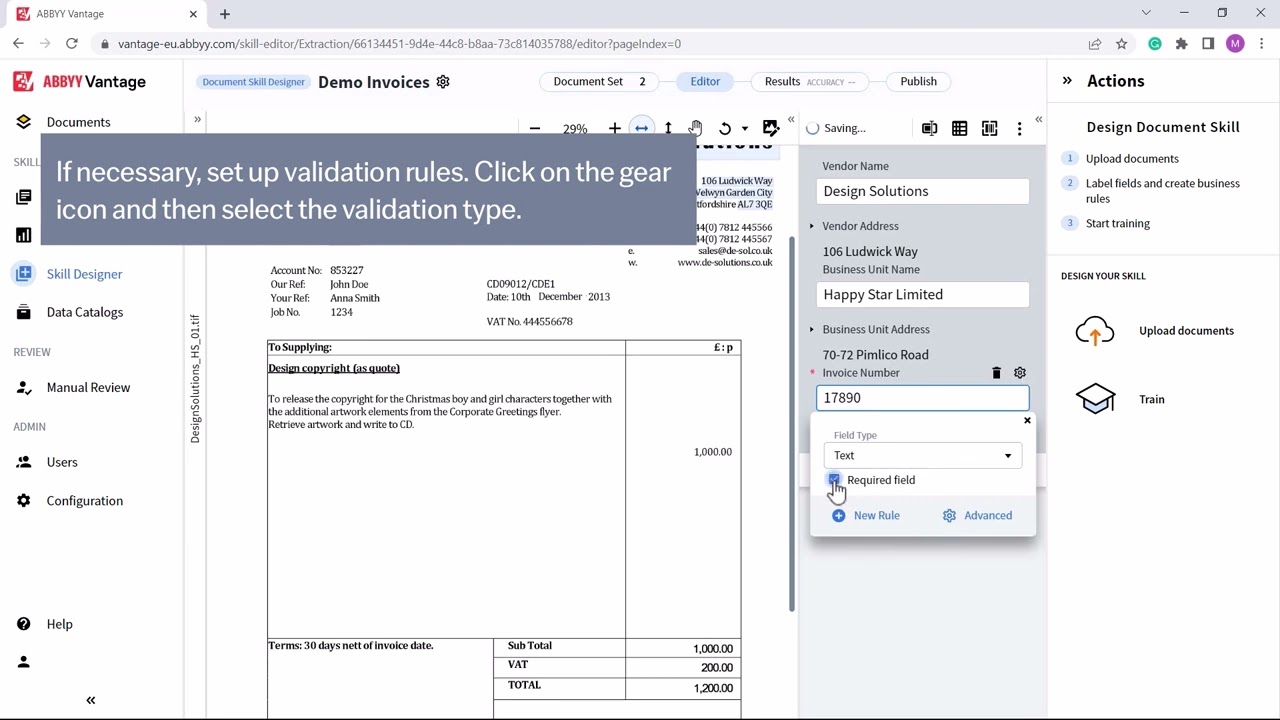
ABBYY Vantage, the company's cloud-native IDP platform, offers 150+ pre-trained skills through ABBYY Marketplace with claimed 90% accuracy out-of-the-box, across 200+ languages, processing up to 1 million pages daily according to enterprise users. The platform runs on containerized microservices with SOC2-certified cloud instances across Europe, the USA, and Australia.
OCR accuracy extends to 4-5 point fonts, finer than the 6-point threshold common among competitors. That matters for processing dense financial tables, footnotes, and legal fine print where character-level precision determines downstream data quality. The Document AI API exposes SDKs in Python, C#, TypeScript, and Java for developer integration.
The product portfolio spans three distinct tiers. Vantage is the cloud-native IDP platform with 150+ marketplace skills, containerized deployment, and agentic automation integration. FlexiCapture handles template-based document processing for structured and semi-structured forms at high volume. Timeline is the process intelligence platform for mining and monitoring document-driven workflows, which distinguishes ABBYY from pure-play extraction vendors by connecting document accuracy to operational bottleneck analysis.
Vantage 3.0.3: LLM extraction and compliance hardening
The Vantage 3.0.3 release adds prompt-based LLM extraction in Advanced Designer, routing documents to external LLMs via Azure OpenAI within Document Skills. LLM output is validated against data catalogs to mitigate hallucinations, a design choice that keeps ABBYY's proprietary OCR as the accuracy foundation while layering LLM flexibility on top. VP of AI Strategy Max Vermeir explained the philosophy in ComputerWeekly: "With ABBYY Vantage, you can control exactly how data is sent to the LLM and choose between sending the document image or the structured, precise text output from ABBYY's highly acclaimed OCR." That auditability and data control positions Vantage for regulated industries where black-box LLM extraction raises compliance concerns.
Other 3.0.3 additions strengthen the compliance story. Field-level redaction in Process Skills renders sensitive data as irrecoverable blacked-out areas on exported images. New FIPS and STIG certifications target US government deployments. Deep learning model training now requires as few as 10 documents, down from larger datasets previously, with predefined weights offsetting low document counts. This lower training threshold is a direct competitive response to zero-shot approaches from vendors like Reducto AI and LlamaParse.
Five new built-in document skills were added: Certificate of Analysis, Denial, Form 1099-C, Mortgage Note, and Riders. Chinese and Thai OCR quality improved via new end-to-end models in Technology Core 3.0, and handwritten Japanese receipt recognition was added. A new Analytics GUI delivers transaction summaries with graphs and donut charts, while the Business Process Reporting API gains time-period filtering and async large report downloads.
One notable regression: the Arrival Notice skill dropped French and German support, limiting it to English only. Language coverage gaps in specific skills could matter for European enterprise evaluations. Browser-direct API access has also been deprecated in favor of a backend proxy pattern, meaning client credentials must no longer be embedded in frontend code. Teams integrating with RPA platforms should note that Blue Prism and UiPath connectivity issues appear in user feedback as a recurring concern.
Vantage 3.0.3 deprecates browser-direct API access. Client credentials must now route through a backend proxy. Review your integration architecture before upgrading.
Use cases
Financial services
ABBYY's strongest documented vertical is finance and banking, where accuracy requirements create demand that generic automation tools struggle to meet. The IBM partnership specifically targets KYC compliance automation in regulated industries, combining ABBYY document extraction with IBM watsonx.ai reasoning. Clients Bapcor and Norco each achieved 50% labor cost reductions in invoice processing, results CFO Brian Unruh describes as typical for the sector. The Vantage 3.0.3 additions of FIPS/STIG certification and field-level redaction further harden the platform for financial services deployments where data sovereignty and audit trails are non-negotiable.
Financial services teams evaluating ABBYY alongside specialist alternatives may also want to review Hyarchis, a Dutch fintech focused on KYC automation with documented deployments at ABN AMRO, ING, and PwC. Teams evaluating open-source alternatives for structured extraction may also want to review LangExtract, Google's Python library for LLM-powered structured extraction with source grounding, which represents a different architectural approach to the same extraction problem.
See the invoice processing automation guide and KYC document verification guide for implementation patterns.
Healthcare process intelligence
ABBYY's process intelligence capabilities apply to hospital operational workflows, where Timeline maps document-driven processes to identify bottlenecks in claims, referrals, and patient records. The Ascend 2026 event series confirms healthcare as an active go-to-market vertical, with the Nashville conference on April 16 expected to feature healthcare-specific use cases alongside agentic workflow demonstrations.
For implementation context, see the medical document processing guide and healthcare claims automation guide.
Academic and historical research
Norwegian researchers used ABBYY FineReader to digitize historical mental health records spanning 1872-1929 across 29 facilities. That use case illustrates FineReader's continued relevance for archival digitization where document age and degradation defeat modern OCR engines trained on clean digital inputs. Teams processing scientific literature at scale may find PaperQA Nemotron relevant as a complementary open-source option, combining retrieval-augmented generation with NVIDIA models for research document workflows. Organizations with large-scale video evidence or multimedia document workflows alongside text-based IDP may also find VIDIZMO worth evaluating, given its focus on government and enterprise redaction across document and video formats.
Technical specifications
| Component | Details |
|---|---|
| OCR accuracy | 4-5 point font recognition |
| Deployment | Cloud, on-premises, APIs/SDKs |
| Processing capacity | Up to 1 million pages daily |
| Language support | 200+ languages |
| Pre-trained skills | 150+ via ABBYY Marketplace (5 added in 3.0.3) |
| API/SDKs | Python, C#, TypeScript, Java |
| Mobile apps | iOS and Android FineReader |
| Hardware integration | Bundled with Ricoh ScanSnap scanners |
| Enterprise integration | IBM watsonx.ai, Azure OpenAI (LLM extraction), Microsoft 365 |
| Cloud infrastructure | SOC2, FIPS, STIG certified; instances across Europe, USA, and Australia |
| LLM integration | Prompt-based extraction via Azure OpenAI with data catalog validation |
| Deep learning training | Minimum 10 documents with predefined weights |
| Open source | No |
Resources
- Website
- ABBYY Vantage product page
- Vantage 3.0.3 release notes
- Document AI API
- ABBYY FlexiCapture SDK
- ABBYY Innovation Hub
- ABBYY Ascend 2026 Hackathon
- ABBYY FineReader Review
Company information
Austin, Texas, United States
Email: office@abbyy.com
Tel: (408) 457-9777