Paperbox - Insurance Mailroom IDP Platform
On This Page
Belgium-based IDP vendor specializing in insurance mailroom automation with AI-powered email triage, document classification, and workflow triggers.
Overview
Founded in 2021 in Gent, Belgium, Paperbox operates as an insurance-vertical intelligent document processing (IDP) specialist. The company serves over 30 insurance companies through its Smart Mailroom platform and won the 2021 InsurTech Startup Award by MOI in Vienna and the 2022 Startup of the Year by UNIZO Oost-Vlaanderen.
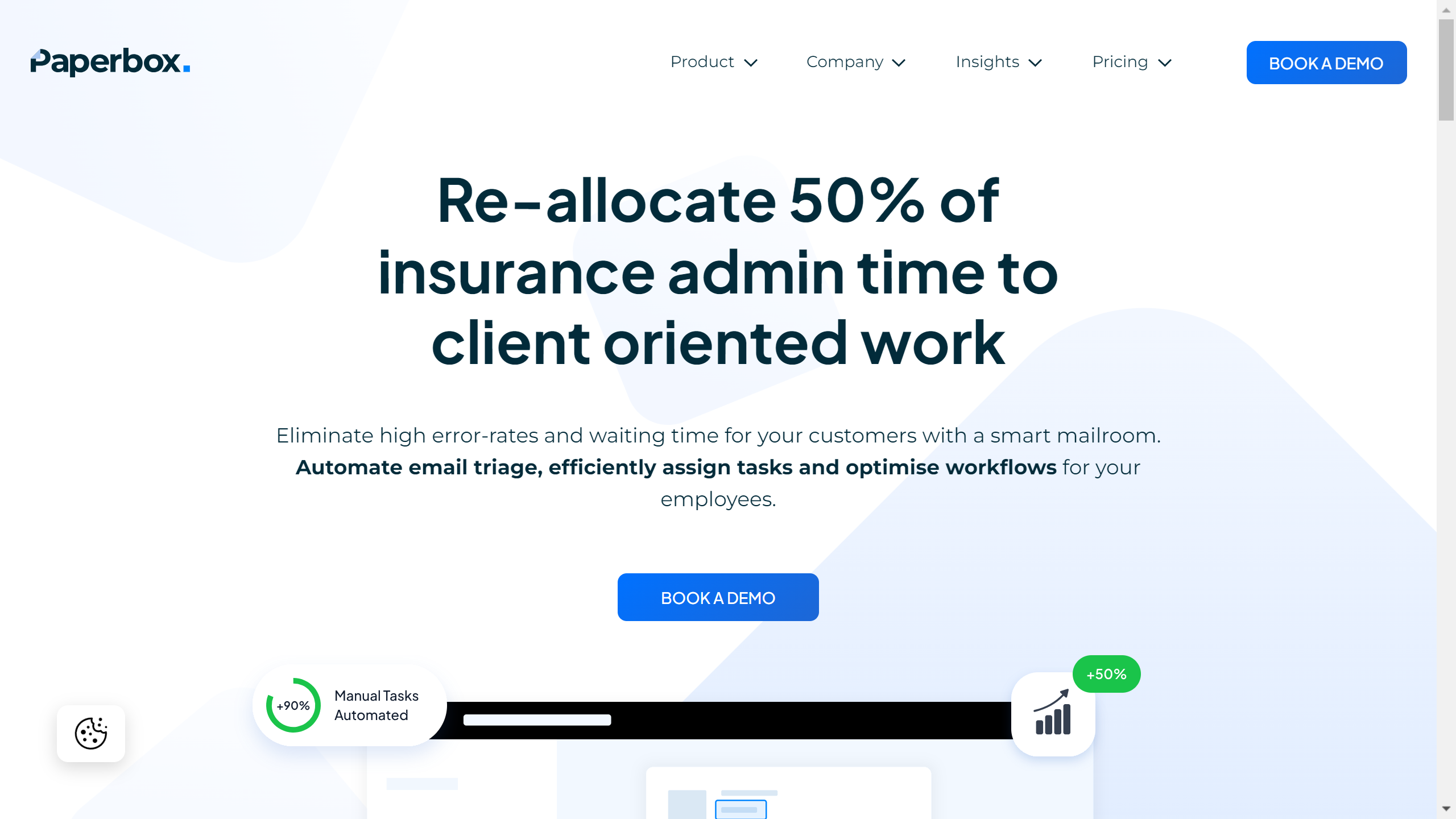
Paperbox differentiates from horizontal IDP vendors through insurance-specific integrations with Guidewire and Keylane, alongside standard enterprise connectors for Salesforce and Microsoft 365. The platform claims 90% workflow automation and 50% efficiency gains for insurance operations.
The platform is fully cloud-based with an API-first architecture: customers submit documents via API and receive structured results, with uncertain extractions routed to a web UI for human review. This human-in-the-loop design reflects insurance industry requirements, where regulatory compliance and audit trails require documented human sign-off on extracted data rather than unchecked straight-through processing.
The company operates through a three-phase implementation approach. Phase 1 covers mailroom triage and file linking. Phase 2 handles document completion and intention detection. Phase 3 provides automated workflow triggers. This structured methodology targets comprehensive workflow transformation rather than point solutions, suggesting a consultative sales model. For teams evaluating broader digital mailroom automation strategies, the three-phase model reflects a common pattern among insurance-vertical IDP vendors.
How Paperbox handles insurance documents
Paperbox uses proprietary machine learning models trained on insurance correspondence, claims, and policy documents. When a document enters the platform via API, the system classifies it, extracts structured data fields, and attempts to link it to an existing claim or policy ID in the connected system of record. Documents where the model confidence falls below a defined threshold route to a human reviewer through the validation UI rather than proceeding automatically.
This architecture means Paperbox does not position itself as a zero-touch processing platform. Instead, the human-in-the-loop layer is a deliberate design choice for regulated environments where insurers cannot rely solely on AI confidence scores for compliance purposes.
The seven-language support covering Dutch, English, French, German, Irish, Italian, and Portuguese reflects a deliberate focus on Western European insurance operations. Paperbox does not appear to target North American or Asia-Pacific markets, which reduces competitive pressure from larger generalist platforms but also caps the addressable market.
Unlike cloud-only competitors such as ABBYY or UiPath, Paperbox does not offer on-premise deployment. This limits its reach to insurers with strict data residency requirements that prohibit cloud processing, though the EU-based hosting may satisfy many European regulatory frameworks.
Use cases
Insurance claims processing
Claims teams process incoming documentation including photos, police reports, and medical records through Paperbox's API. The system automatically links documents to existing claim IDs, extracts relevant data points, and triggers appropriate departmental workflows based on document classification and content analysis. Vendors such as Ondox take a comparable approach to insurance document processing, combining multiple OCR engines with LLM integration for similar triage scenarios.
Policy administration automation
Insurance carriers route policy applications, endorsements, and renewal documents through the Smart Mailroom platform. Paperbox extracts policyholder information, coverage details, and effective dates, then automatically triggers underwriting or renewal workflows within existing insurance management systems like Guidewire. Teams evaluating this use case may also want to review Cytora, which targets commercial insurance submission digitization through a comparable generative AI approach.
Mailroom digitization
Insurance companies eliminate manual mail sorting by routing all physical and digital correspondence through Paperbox's triage system. The platform categorizes communications into claims, policy inquiries, renewals, and general correspondence, then routes each to appropriate departments with extracted metadata for faster processing.
Technical specifications
| Feature | Specification |
|---|---|
| Platform type | Insurance mailroom automation |
| Deployment | Cloud only |
| Core technology | Proprietary ML models for insurance documents |
| Integration method | API-based document submission and retrieval |
| Industry connectors | Guidewire, Keylane, Salesforce, Microsoft 365 |
| Language support | Dutch, English, French, German, Irish, Italian, Portuguese |
| Validation | Human-in-the-loop UI for uncertain results |
| Pricing | Usage-based subscription from €500/month |
| Support | 24/7 live chat, phone, email, and knowledge base |
Pricing
Paperbox uses a usage-based subscription model starting at €500 per month, with variable costs tied to document volume. This consumption-based structure aligns with how insurance operations scale: high-throughput periods such as catastrophe claims events drive volume spikes that would penalize fixed-seat licensing models. The pricing positions Paperbox above general-purpose AI tools while remaining accessible to mid-market insurers that cannot justify enterprise IDP contracts.
Resources
- Website
- Documentation
- GetApp profile
- Capterra listing
Company information
Paperbox is headquartered in Gent, Belgium, and was founded in 2021. The company holds two early-stage awards: the 2021 InsurTech Startup Award from MOI Vienna and the 2022 Startup of the Year from UNIZO Oost-Vlaanderen. No funding disclosures or employee count figures are publicly available as of April 2026.
The EU headquarters and Western European language focus suggest Paperbox is built for the European insurance market rather than global scale. This geographic specialization reduces direct competition from larger horizontal IDP vendors but also means the platform has not been validated against North American or Asia-Pacific insurance workflows.
:::recent 3 :::