Skwiz: IDP Software Vendor
On This Page
Brussels-based intelligent document processing (IDP) platform by Sagacify, combining Azure OpenAI large language model (LLM) technology with custom machine learning models for template-free document extraction, EU data residency, and usage-based pricing from €0.03 per page.
Overview
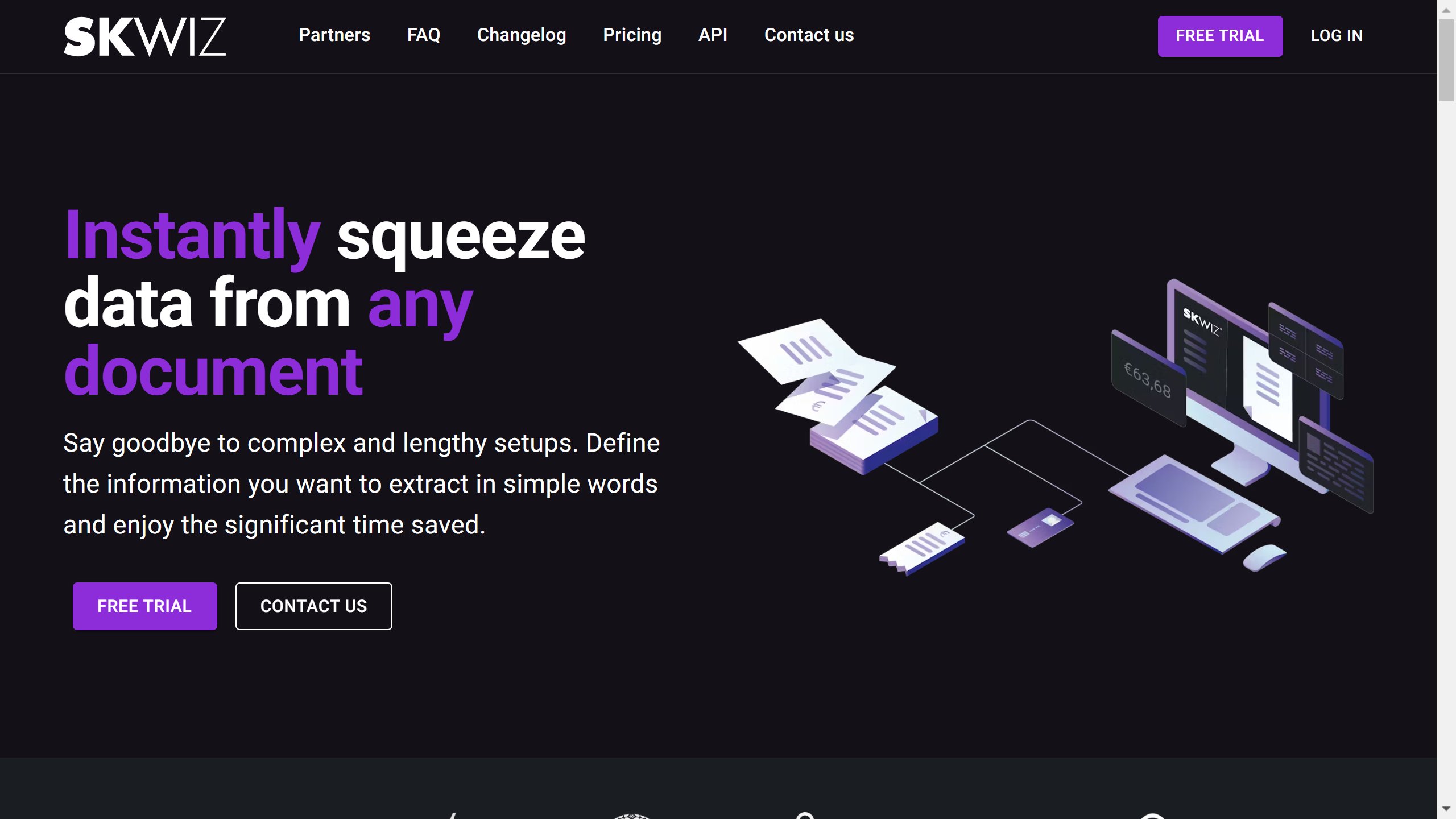
Skwiz is a document extraction platform developed by Sagacify, a Brussels-based AI company. Originally launched in 2020 as a machine learning invoice extraction API, the platform was rebuilt around generative AI and relaunched in July 2023 after Sagacify encountered an invoice processing problem that a competing IDP vendor failed to solve. That founding constraint shaped the product's core thesis: LLMs alone cannot meet the accuracy requirements of regulated business processes, so complex and variable documents require a combination of LLM and ML models.
Deep Analysis covered Skwiz's GenAI pivot in February 2024, noting the platform runs Azure OpenAI under the hood and positions the hybrid approach as a pragmatic middle ground between pure template-based OCR and LLM-only extraction. As Skwiz states directly: "LLMs can be used alone for some simple document use cases; but more complex and variable documents require a combination of LLM and ML models to achieve the rigorous accuracy requirements of a business process."
The primary differentiator for European buyers is EU data residency with full GDPR compliance, backed by Azure OpenAI's EU deployment regions. This makes Skwiz viable for financial services and healthcare organizations subject to data localization requirements, where cloud-only competitors without EU infrastructure cannot compete. The platform supports over 100 document types and processes documents in any language without retraining.
No independent benchmark accuracy data, analyst placement, or named customer references are publicly available. Market traction relative to other document processing vendors cannot be independently assessed from current sources.
In Zelros's 2021 OCR comparison, Skwiz ranked #5, noted for easy integration and strong after-sale support, though with limited insurance document coverage. No public sources since then confirm whether this gap has been addressed.
Comparable IDP vendors include Parseur.
How Skwiz processes documents
Skwiz's hybrid architecture separates it from both legacy OCR tools and pure LLM wrappers. Users define extraction fields in natural language through ChatGPT integration, describing what they need rather than mapping template coordinates. For example, a user specifies "invoice line items" or "passport expiry date" in plain language, and the platform builds the extraction logic from that description.
The platform then automatically classifies incoming document types, routes them to the appropriate extraction logic, and splits large multi-document PDFs into components before processing. Azure OpenAI handles the language understanding layer, while custom ML models enforce the accuracy and consistency requirements that pure LLM approaches struggle to maintain across high-volume, regulated workflows.
Outputs are delivered via REST API or web platform. Additional recognition capabilities include signature detection and barcode decoding. Mobile access is available on Android and iOS.
A 200-page free trial requires no credit card and covers unlimited document types, allowing buyers to validate extraction quality on their own documents before committing. Paid plans start at €0.15/month; no permanent free tier exists. Per-page consumption billing applies within paid plans rather than flat seat fees. Exact volume thresholds per tier are not publicly documented and should be confirmed directly with Sagacify before trialing.
Define fields in natural language
Describe what to extract using plain text instructions. No template mapping or coordinate configuration required.
Automatic classification and routing
The platform identifies the incoming document type and routes it to the appropriate extraction model.
Hybrid LLM and ML extraction
Azure OpenAI handles variable document structures; custom ML models enforce accuracy for regulated business processes.
Structured output via API or web
Results are delivered as structured data through REST API or the web platform, ready for downstream workflows.
Use cases
Accounts payable and finance
Accounting departments use Skwiz to extract data from invoices across multiple languages and formats. The platform classifies invoice types, extracts line items and totals, and exports structured data to accounting systems via API. The Automation Anywhere integration enables downstream RPA workflows for payment processing. Bank statements are also a supported document type, extending coverage to reconciliation workflows.
HR and identity verification
HR teams and KYC workflows use Skwiz to process identity documents including passports, national ID cards, and driver's licenses across international formats. The generative AI layer extracts personal information without requiring training data for each document variant, which matters for organizations onboarding customers or employees across multiple countries. EU data residency makes this use case viable for organizations subject to GDPR data transfer restrictions, where sending identity documents to non-EU infrastructure would create compliance exposure.
Insurance claims management
Insurance companies can automate claims processing by extracting data from claims forms and medical certificates. However, Zelros noted in 2021 limited insurance document coverage compared to specialized competitors. No public sources since then confirm whether this gap has been addressed, making Skwiz a lower-confidence choice for insurance-specific deployments relative to vertical specialists.
Technical specifications
| Feature | Specification |
|---|---|
| AI technology | Azure OpenAI LLM, custom ML models, hybrid architecture |
| Document types | Invoices, passports, ID cards, driver's licenses, claims forms, medical certificates, purchase orders, delivery notes, bank statements |
| Recognition capabilities | Text extraction, signature detection, barcode recognition, batch processing |
| Classification | Automated document type identification |
| PDF processing | Multi-document splitting |
| Language support | Language-agnostic; any language without retraining |
| Interfaces | Web platform, REST API, Android and iOS mobile apps |
| Data storage | EU-based infrastructure (Azure OpenAI EU regions) |
| Compliance | GDPR compliant |
| Pricing | €0.03-€0.15 per page; paid plans from €0.15/month; 200-page free trial, no permanent free tier |
| Integrations | Automation Anywhere RPA |
| Target markets | Accounting, HR, construction, insurance; self-employed to midsize |
| Benchmark data | Not publicly available |
Company information
Skwiz is developed by Sagacify, headquartered in Sint-Pieters-Woluwe, Brussels, Belgium. The product launched in 2020 as a machine learning invoice API and was relaunched in July 2023 as a generative AI platform built on Azure OpenAI. Sagacify is a member of FinTech Belgium, signaling focus on the Belgian and broader European financial services market.
The company's EU-only infrastructure is both a competitive advantage for European regulated industries and a constraint on addressability in North America and Asia-Pacific, where competitors offer global infrastructure. No funding disclosures, headcount figures, or revenue data are publicly available.
Deep Analysis's 2024 IDP market analysis included Skwiz among startups using generative AI for IDP, noting the name itself reflects the product's purpose: "squeeze the data out of the document like you squeeze the juice from an orange."