super.AI: IDP Software Vendor
On This Page
Unstructured data processing platform combining intelligent document processing, human-in-the-loop workflows, and multi-format redaction for documents, images, audio, and video.
Overview
super.AI provides the Unstructured Data Processing (UDP) Platform, processing documents, images, audio, video, and text through combined AI models and human validation workflows. Founded in 2018 as Canotic and based in San Francisco, the company raised $30.13M in Series B funding from Mosaic Ventures, Pioneer Square Labs Ventures, HV Capital, NFX, and East Ventures. The platform integrates GPT-4 and other AI models while routing uncertain cases to human experts for validation.
The platform's core argument is that fragmentation is the primary obstacle to enterprise AI adoption. super.AI's State of Unstructured Data Processing Survey found 84% of businesses identify combining different AI and ML models as a key challenge, and 60% have failed to scale AI adoption beyond single functions. Brad Cordova, Founder and CEO, described the platform's intent directly: "To process unstructured data businesses have turned to different solutions for documents, emails, and sensitive information redaction. We have built a unified, modern platform for processing unstructured data and paired it with a rich marketplace of pre-configured AI applications."
Named customers include SSI, Takeda, and Balfour Beatty, with the most detailed public evidence coming from Lano's 2023 deployment.
What Users Say
Practitioners who have evaluated or deployed super.AI consistently point to two strengths: the platform's ability to handle document complexity that defeats rule-based systems, and the responsiveness of the implementation team during onboarding. Maxence Levasseur, Director of Operations at Lano, noted: "The fact that the team wanted to understand our specific needs. We deal with complex documents that require a high-degree of accuracy. If salaries do not get paid in the right amount, that's a problem."
The 3-week sales-to-contract cycle at Lano suggests the platform is positioned for rapid deployment rather than lengthy enterprise procurement cycles. Teams evaluating super.AI for back-office automation report that the human-in-the-loop routing reduces the risk of deploying AI on high-stakes documents, though the 40-person headcount raises questions about long-term support capacity for large enterprise rollouts.
Key Features
super.AI's UDP Platform is built around the premise that documents, images, audio, and video should move through a single processing pipeline rather than separate point tools. The platform breaks extraction tasks into discrete work units, routing each to the most appropriate processor: software automation for structured inputs, AI models for pattern recognition, and human experts for edge cases requiring judgment.
The multi-model AI layer combines GPT-4 with other models to improve accuracy across document types. Rather than committing to a single model, the platform selects the best available option per task, which matters most for diverse document portfolios where no single model dominates. Over 150 built-in quality control mechanisms enforce SLA guarantees, giving operations teams a contractual accuracy floor rather than a best-effort estimate.
Redaction runs across all supported media types: documents, images, audio, and video. Each redaction action generates a full audit trail, which is the compliance requirement that makes this feature relevant to financial institutions and healthcare organizations rather than a convenience feature. The platform holds SOC 2 and GDPR certifications, and integrates natively with Workday, Oracle, SAP, Salesforce, IBM, SAS, and Zapier.
Use Cases
Shared services document processing
High-volume processing environments benefit from super.AI's balanced approach to automation and human oversight. The platform enables rapid extraction of data from large document batches while maintaining quality standards through AI-assisted validation. Organizations can configure SLA-based quality controls to ensure consistency and compliance with internal standards, making it practical for shared services centers processing invoices, contracts, and claims at scale.
International payroll and invoice automation
The most detailed public evidence of super.AI in production comes from Lano's June 2023 deployment. Lano, a Berlin-based global payroll platform serving 2,000+ customers, needed to automate pay slip and invoice processing across 170+ countries. Before super.AI, pay slip processing was entirely manual due to document complexity and format diversity. The in-house automation solution for invoices carried high maintenance overhead and error rates.
Post-implementation, Lano achieved full automation with "dramatically shorter" process times and "continually increasing" accuracy. Levasseur summarized the business dependency directly: "Super.AI enables us to deliver our core functionality to customers." The 3-week implementation cycle from initial contact to contract is the most concrete deployment timeline in super.AI's public record.
Regulatory compliance and redaction
Financial institutions, government agencies, and legal departments require redaction across multiple media types. super.AI's audit-trail-enabled redaction covers documents, images, audio, and video, supporting compliance with GDPR, CCPA, and sector-specific mandates. This is particularly relevant for organizations handling personally identifiable information (PII), protected health information (PHI), and financial data where demonstrating compliance during regulatory review requires documented evidence of every redaction action.
Complex document extraction
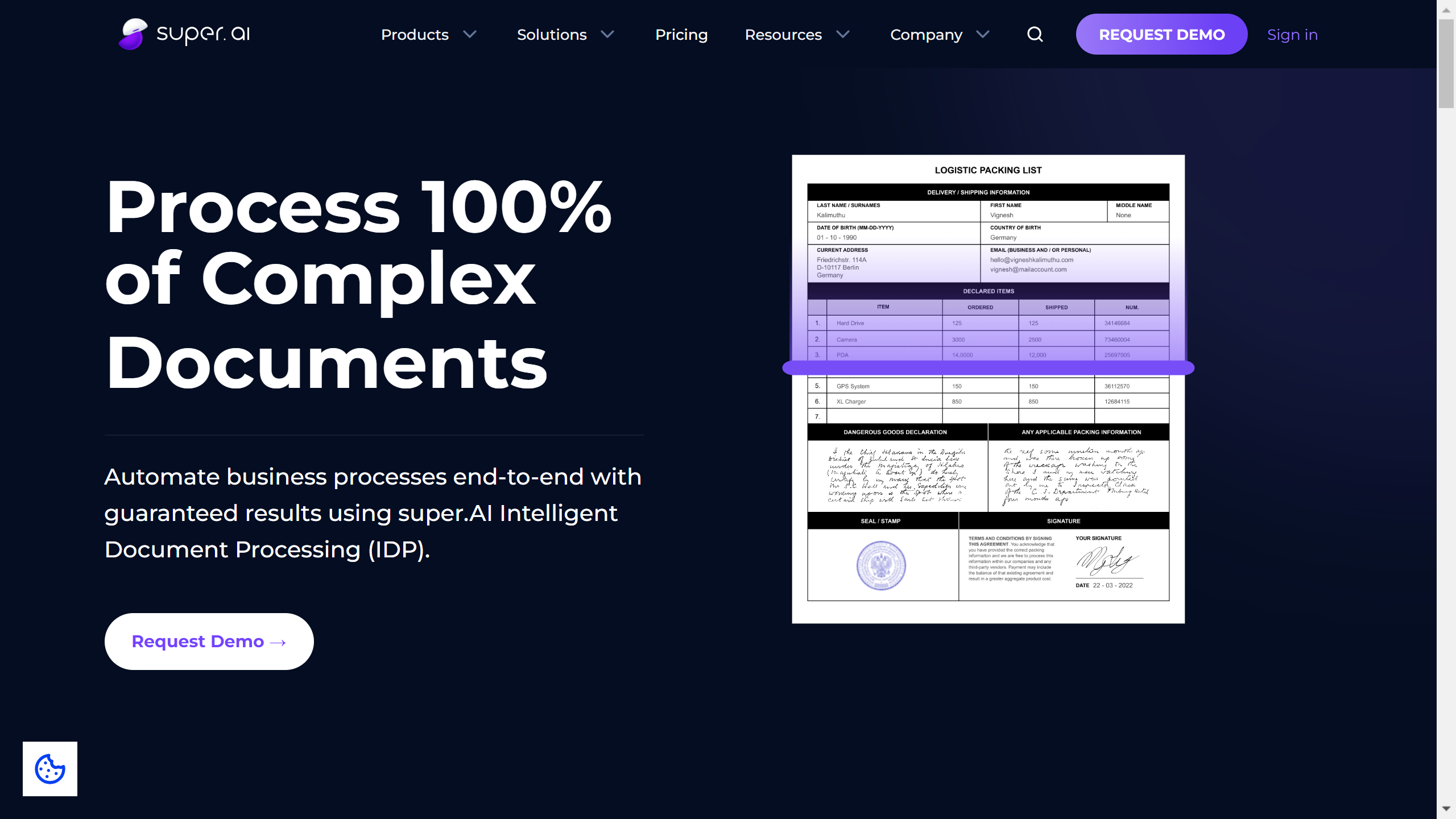
Unstructured and semi-structured documents with handwritten notes, signatures, and stamps present significant extraction challenges. Like specialized solutions from ABBYY, super.AI's multi-model AI approach processes these complex documents through multiple recognition engines, with domain expert validation available for final verification. This approach suits mortgage documents, medical records, and legal contracts where accuracy is non-negotiable and human oversight is required for high-stakes decisions.
Technical Specifications
| Feature | Specification |
|---|---|
| Core platform | Unstructured Data Processing (UDP) Platform |
| Processing capabilities | IDP, HITL, multi-format redaction |
| Data types | Documents, images, audio, video, text |
| Document support | Structured, semi-structured, unstructured, handwritten |
| Recognition | Handwriting, signatures, logos, stamped approvals |
| AI models | GPT-4 integration, multiple AI model support |
| Quality controls | 150+ mechanisms with SLA guarantees |
| Redaction | Document, image, audio, video with audit trails |
| Certifications | SOC 2, GDPR |
| Integrations | Workday, Oracle, SAP, Salesforce, IBM, SAS, Zapier |
Resources
- Website
- Lano case study: international payroll automation
- UDP Platform announcement
- Product overview on SoftwareFinder
Company Information
Headquarters: San Francisco, California, United States (2193 Fillmore Street)
Founded: 2018
Former name: Canotic
Employees: 40
Funding: $30.13M Series B (Mosaic Ventures, Pioneer Square Labs Ventures, HV Capital, NFX, East Ventures)
A 40-person San Francisco team competing against enterprises with hundreds of engineers, super.AI bets that a unified platform for all unstructured data types beats the fragmented point-solution approach that 84% of businesses report struggling with. The Lano deployment demonstrates the model works at production scale for international payroll. Whether the company can sustain enterprise support commitments at current headcount is the open question for procurement teams evaluating long-term vendor stability.