MuleSoft: IDP Software, Agent Fabric & Integration
On This Page
Enterprise integration platform that evolved into AI agent orchestration and governance infrastructure within Salesforce's ecosystem.
Overview
MuleSoft, acquired by Salesforce for $6.5 billion in 2018, has moved from a traditional integration platform into the control plane for Salesforce's agentic enterprise strategy. The platform's arc through 2025 and 2026 runs from API-led connectivity to AI agent governance, and now to native intelligent document processing (IDP).
The most significant product milestone in this period is the general availability of MuleSoft for Flow: Intelligent Document Processing on March 16, 2026. The Salesforce-native solution supports natural language prompts powered by OpenAI GPT-4o and Google Gemini 2.0/2.5 Flash, secured through the Einstein Trust layer. It includes human-in-the-loop validation with confidence scoring, multi-page document support across PDFs, images, and complex forms, and integration with 200+ pre-built connectors for downstream systems including NetSuite, QuickBooks, SAP, and Workday.
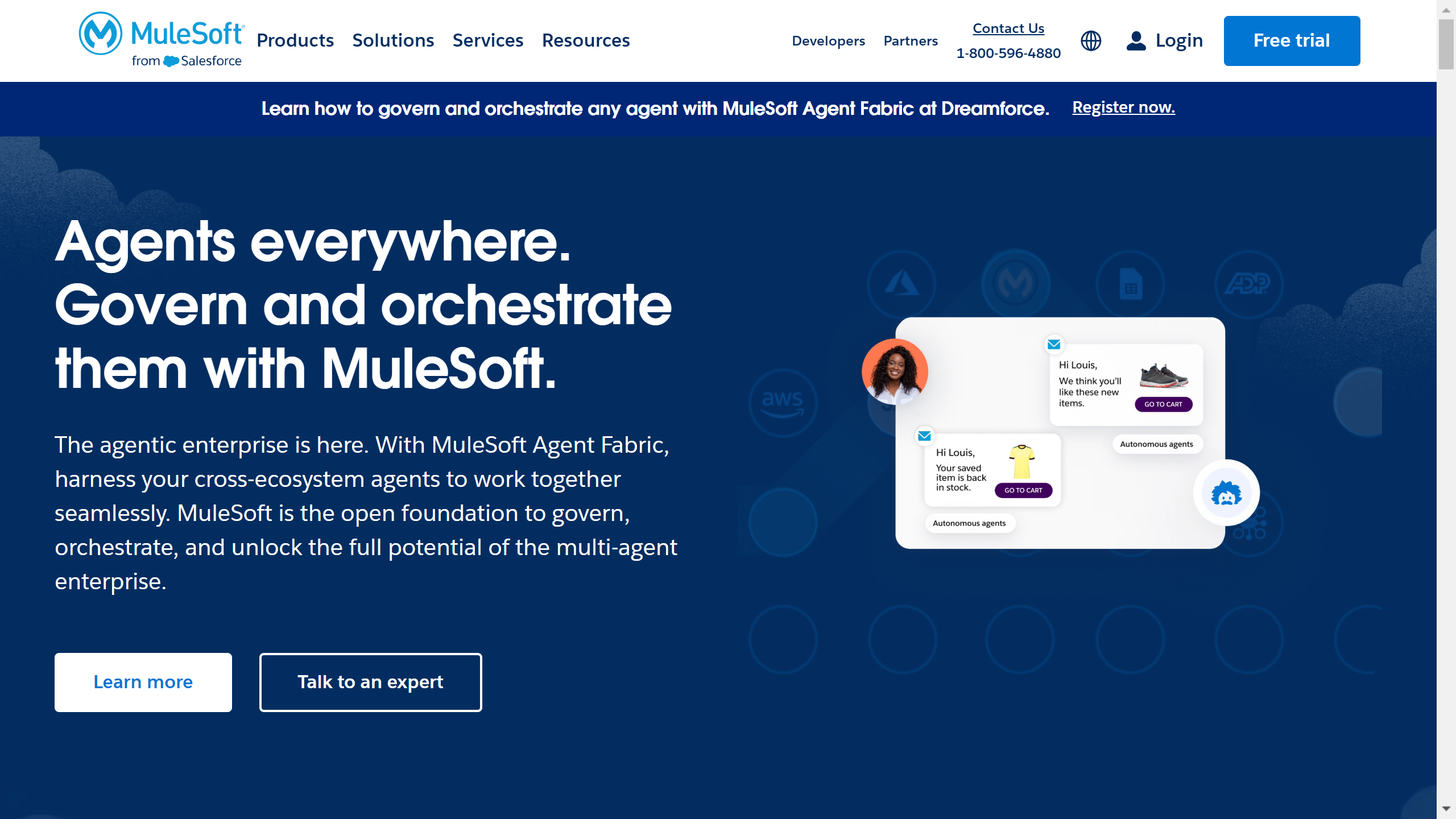
In parallel, Agent Fabric reached expanded general availability with Agent Registry, Agent Broker, Agent Visualizer, and Flex Gateway support for Model Context Protocol (MCP) and Agent-to-Agent (A2A) protocols. Agent Scanners automatically detect and register AI agents running on Amazon Bedrock, Google Vertex AI, and Microsoft Copilot Studio into the Agent Registry without manual inventory work. AT&T, Capita, and r.Potential are named early adopters.
The strategic rationale is grounded in documented market friction. Deloitte's 2026 Tech Trends report found only 11% of enterprises run agentic AI in production, with governance and observability cited as the primary barriers. Gartner projects 33% of enterprise software applications will include agentic AI by 2028, up from less than 1% today. MuleSoft's governance infrastructure is a direct response to that gap.
Following Salesforce's $8 billion Informatica acquisition, Rahul Auradkar clarified the division of labor: MuleSoft serves as the "real-time operational layer providing event-driven connections" while Informatica handles enterprise-wide data context. MuleSoft is infrastructure, not application.
Gartner named MuleSoft a Leader in the 2026 Magic Quadrant for Integration Platform-as-a-Service for the 10th consecutive year. One credibility note: the Agent Fabric GA announcement rests primarily on first-party Salesforce sources. Enterprise customer quotes from AT&T and Capita add corroboration, but no independent analyst assessment of Agent Fabric's governance capabilities from Gartner, Forrester, or IDC appears in available material.
How MuleSoft processes documents
MuleSoft approaches document processing as an integration and orchestration problem, not a pure extraction problem. Unlike specialized extraction vendors such as ABBYY, MuleSoft focuses on connecting document workflows across enterprise systems. The Anypoint Platform's three-tier API architecture, System APIs connecting to source repositories, Process APIs applying business logic and transformation, and Experience APIs delivering formatted output, provides the connective tissue for document workflows spanning multiple enterprise systems.
MuleSoft for Flow: IDP extends this into AI-native document pipelines. Within the Salesforce-native environment, users configure document actions using natural language prompts. The platform calls LLMs for extraction and classification, applies confidence scoring to flag uncertain fields, routes low-confidence results to human reviewers, and publishes results as APIs for consumption by RPA tools, Mule applications, and other systems without requiring external service subscriptions.
The platform does not provide its own OCR or extraction models. Instead, it orchestrates supported LLMs through the Einstein Trust layer. Einstein does not use customer data to train models for document analysis, which addresses a common enterprise concern about data privacy in AI-assisted extraction. Generic document actions allow custom schema definition with user-defined fields and tables, while pretrained models for invoices, receipts, and contracts reduce the development-to-production timeline by avoiding custom training.
Agent Fabric adds a governance layer on top of these pipelines. Agent Scanners continuously patrol linked cloud environments, extracting per-agent metadata including specific capabilities, the LLMs powering each agent, and data access permissions, normalizing that metadata to Google Cloud's A2A protocol card specification. The Agent Registry then makes discovered agents, MCP servers, and AI tools searchable by developers or by other agents. This A2A normalization is the interoperability bet: by aligning with an emerging cross-vendor standard rather than a proprietary schema, Agent Fabric is designed to remain the connective layer regardless of which cloud platform wins more agent workloads.
The boundary of what MuleSoft does not yet do matters here. Bespoke agent registration via URL, the capability that would extend Agent Scanners beyond the four named platforms to custom-built agents, is not shipping until Q1 FY2027. Until then, automated discovery is bounded to Agentforce, Bedrock, Vertex AI, and Copilot Studio. Enterprises running document agents on other infrastructure still face manual cataloging.
Use cases
Healthcare automation
The Healthcare Accelerator achieved 95% accuracy rates in pilot programs for prior authorization, pharmacovigilance reporting, and clinical trial scheduling, with a 70% reduction in prior authorization processing times. Deployments run through partners including Deloitte, Accenture, and PwC. The accelerator's pre-built APIs reduce the integration work that typically delays healthcare document automation projects. MuleSoft for Flow: IDP extends this pattern to unstructured clinical documents, routing extraction results directly into Salesforce Health Cloud workflows.
AI agent governance
Agent Fabric addresses agent sprawl directly. Capita's use case is the clearest articulation of the immediate pain point: replacing manual agent inventory management with automated scanning. As Jonathan Harvey, Head of AI Operations at Capita, described it: "Agent Scanners will let us focus on innovation instead of inventory management. Knowing that every agent is automatically discovered and catalogued allows our teams to collaborate, reuse work, and build smarter multi-agent solutions." AT&T uses Agent Fabric to orchestrate agents and MCP servers across customer support, chat, and voice interactions. The governance and reuse arguments, centered on avoiding duplicate agent builds and enabling cross-team collaboration, follow from that automated inventory foundation. See agentic document processing for broader context on this capability category.
B2B workflow modernization
Anypoint Partner Manager v2.26.0 (March 2026) introduces centralized translation maps allowing single-point management of DataWeave mappings with instant activation across all message flows. Salesforce Einstein AI now generates plain-language summaries of EDI (X12/EDIFACT) and non-EDI payloads directly in Partner Manager's payload view, with PDF export capability. MuleSoft Vibes enables AI-powered generation of production-ready DataWeave code from natural language mapping requirements. The March 2026 blog post framed the problem directly: "Purchase orders arrive over EDI. Fulfillment updates come through APIs. Invoices land as PDF attachments in email inboxes. And increasingly, AI agents need to interact with all of it." MuleSoft for Flow: IDP addresses the PDF invoice leg of that workflow, feeding extraction results into the same Partner Manager pipeline that handles EDI and API transactions.
Telecommunications integration
Implementations in telecom achieved 40% faster service activation and 30% reduction in customer churn through API-led connectivity replacing legacy point-to-point integrations. The pattern of System APIs abstracting legacy systems, Process APIs applying business logic, and Experience APIs delivering CRM-ready data represents the same architecture applied to document workflows in other verticals.
Government deployment
The U.S. Transportation Department deployed MuleSoft for interstate data exchange at the Federal Motor Carrier Safety Administration, with plans to expand into agentic AI capabilities. Government deployments benefit from MuleSoft's hybrid deployment support and mutual Transport Layer Security (mTLS) authentication, which satisfy federal data residency and authentication requirements.
Technical specifications
| Component | Capability |
|---|---|
| MuleSoft for Flow: IDP | GA March 16, 2026; natural language prompts, multimodal LLMs, confidence scoring, human-in-the-loop review, 200+ downstream connectors |
| Supported LLMs | OpenAI GPT-4o, GPT-4o Mini, Google Gemini 2.0 Flash, Google Gemini 2.5 Flash via Einstein Trust layer |
| Document types | PDFs, images, checkboxes, handwriting, invoices, receipts, contracts, generic custom schemas |
| Confidence scoring | Per-field accuracy probability; documents below threshold routed to human reviewers automatically |
| Pricing unit | Automation Credits per document processed |
| Agent Scanners | Automatic AI agent discovery across Agentforce, Amazon Bedrock, Google Cloud Vertex AI, and Microsoft Copilot Studio; GA January 2026 |
| Agent Registry | Central catalog for discovered agents, MCP servers, and AI tools; MCP server registration via URL GA January 2026; bespoke agent registration via URL planned Q1 FY2027 |
| Agent Broker | Intelligent routing service for multi-agent orchestration; GA October 2025 |
| Agent Policies | Governance via Flex Gateway for MCP and A2A protocols; GA alongside API Manager |
| Agent Visualizer | Real-time agent network mapping with performance metrics and per-platform filtering; GA October 2025 |
| Protocol support | A2A protocol card specification (Google Cloud standard), Model Context Protocol (MCP) |
| MuleSoft AI Gateway | Semantic routing, load balancing, cost controls, and policy enforcement across OpenAI, Anthropic, and Gemini |
| Trusted Agent Identity | GA January 2026; agents assume user identity for access-based responses, zero trust authorization rules |
| MuleSoft Vibes | AI development assistant; 60% quality improvement over direct LLM prompting (internal benchmark); MUnit Tests, Custom Connector Support, Exchange Reuse, Template Support all GA Q1 2026; Global Rules Support GA April 2026 |
| Anypoint Platform | Three-tier API architecture: System, Process, Experience APIs |
| MAC Project | Open-source framework for LLM connectors, vector database integration, and API orchestration within Anypoint Studio |
| Security | mTLS authentication, Einstein Trust layer (no customer data used for model training) |
| Deployment | Cloud-native, hybrid; Microsoft Azure, Amazon Bedrock, Google Cloud Vertex AI supported |
Resources
- Official Website
- Anypoint Platform Documentation
- MuleSoft IDP Documentation
- MuleSoft for Flow: IDP GA Announcement
- MuleSoft AI Chain Project
- Agent Fabric Overview
- Agent Fabric Launch Coverage
- Agent Scanners and Agent Sprawl on SiliconAngle
- MuleSoft and Informatica Role Clarification
- U.S. Transportation Department Deployment
- Q1 2026 Product Roadmap
- Gartner iPaaS Magic Quadrant 2026
Company information
MuleSoft is a wholly owned subsidiary of Salesforce, headquartered in San Francisco, United States. Salesforce acquired MuleSoft in 2018 for $6.5 billion. MuleSoft's Anypoint Platform, MuleSoft for Flow: IDP, and Agent Fabric products are developed and sold as part of Salesforce's enterprise platform portfolio. Salesforce internally uses MuleSoft to integrate employee data across 90+ internal and external systems and has implemented Agentforce with these integrations, positioning the platform as both a reference architecture and proof point for its own customers.
Web: https://www.mulesoft.com Parent: Salesforce Address: San Francisco, United States Founded: 2006