LumoDoc: IDP Software for Freight Forwarding
On This Page
Page contributed by Osman Demirel.
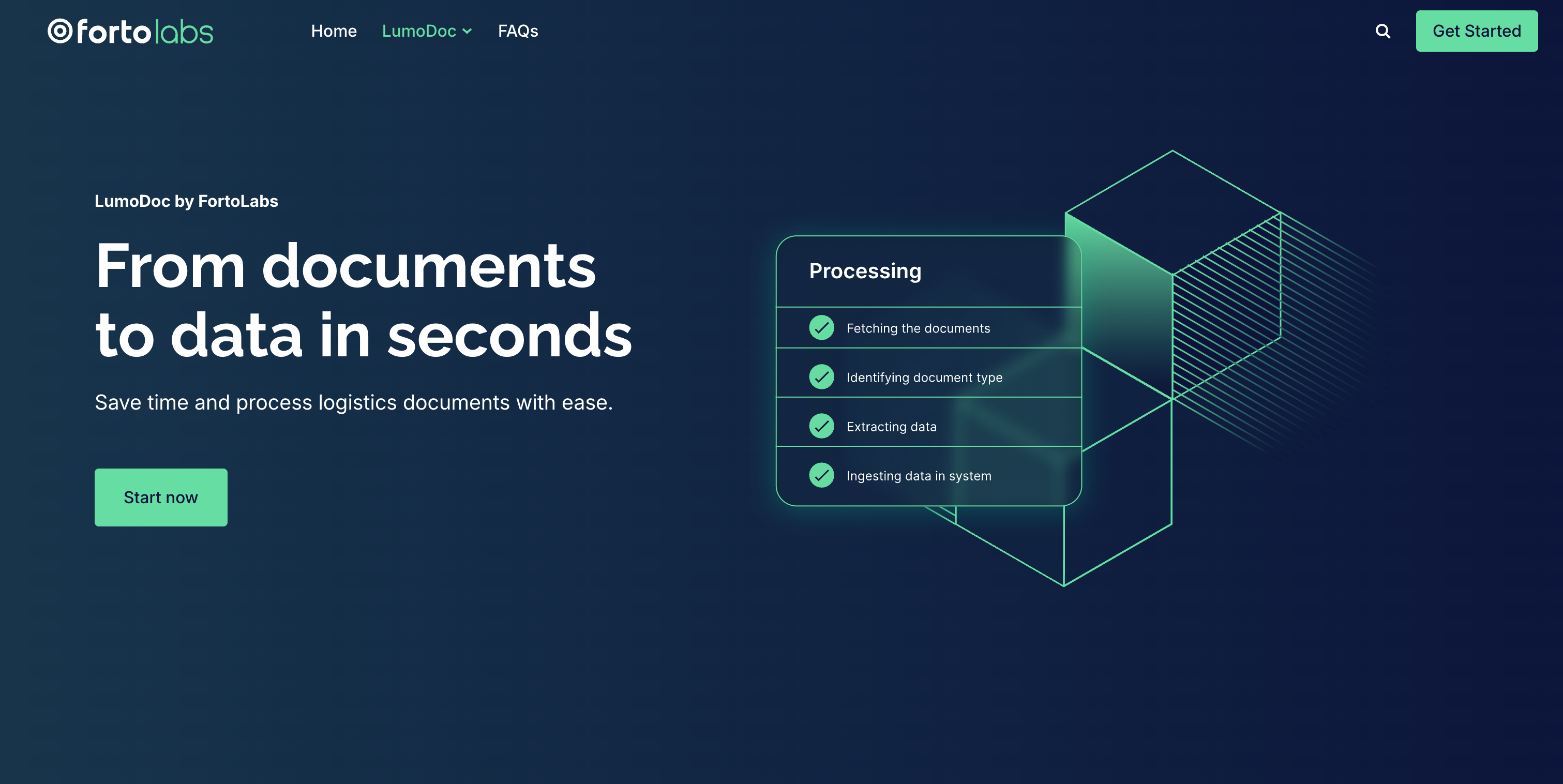
LumoDoc launched on October 20, 2025 as the first commercial product from FortoLabs, Forto's AI-native SaaS division. The platform automates categorization, data extraction, and system synchronization for logistics documents, processing bills of lading, packing lists, customs declarations, commercial invoices, and booking confirmations without manual intervention. Forto reports 53 minutes of time savings per shipment in its own internal operations, alongside claims of up to 90% efficiency gains depending on use case.
Vertical-first strategy
Unlike horizontal document processing vendors such as ABBYY and UiPath that compete across all document types, LumoDoc focuses exclusively on logistics documentation. The platform trains on proprietary logistics-specific datasets built from Forto's own freight operations and those of 100+ logistics partners, betting that domain depth delivers better out-of-the-box performance than general-purpose solutions requiring extensive configuration.
FortoLabs commercializes AI capabilities Forto developed internally since its founding in 2016 as FreightHub in Berlin. Guillaume Petit-Perrin, CEO of Forto, framed the strategy directly: "FortoLabs is our innovation engine for the logistics industry. We have developed agentic AI solutions that deliver tremendous efficiency gains in our own operations. Our vision is to make shipping goods as easy as sending an email."
This approach mirrors how Docsumo specializes in financial services and Cogent Labs focuses on Japanese document processing. Each pursues vertical specialization rather than horizontal scale. Amsterdam-based Send AI, which uses custom open-source AI models for logistics document automation, represents the closest direct comparable in the freight-specific intelligent document processing (IDP) segment.
Document processing architecture
LumoDoc handles the full pipeline from document ingestion to downstream system synchronization. The platform analyzes incoming emails, detects attachments, classifies document types including handwritten formats, extracts structured data, and pushes output directly into operational systems without human intervention.
The system integrates via RESTful APIs with Transport Management Systems (TMS), ERP platforms, and Warehouse Management Systems (WMS). Documents reach the platform through API submission, direct database connection, or SMTP email forwarding. This contrasts with template-based approaches used by traditional OCR platforms, where each new document layout requires manual configuration. For teams evaluating open-source alternatives in logistics workflows, Unstract offers a no-code LLM platform with production-grade extraction that can be self-hosted.
Forto's broader Flash AI agent, which shares the same operational foundation, handled 65% of requests with minimal human touch and accuracy above 95% as of late 2025. LumoDoc applies the same underlying approach to document-specific workflows.
Technical implementation
LumoDoc deploys as cloud-native SaaS. The architecture includes multi-tier validation that checks extracted data against customer records and global logistics datasets, similar to approaches used by Hypatos and Rossum for financial document validation. Human-in-the-loop workflows handle exceptions that fall below confidence thresholds. GDPR compliance addresses European regulatory requirements for logistics data.
The platform claims over 95% accuracy across 15+ logistics document types. These figures are self-reported by Forto and carry no independent third-party verification as of April 2026.
Free sandbox for evaluation
In March 2026, FortoLabs launched Explore LumoDoc, a free browser-based sandbox that lets prospects test the platform on their own documents without a sales demo or contract. Users upload PDFs or images and receive extraction results in under one minute. The sandbox includes a Pick-to-Review feature that lets users validate each extracted data point against the original document side-by-side.
Tamer Cagatay, Director of FortoLabs, described the intent: "With Explore, we are radically simplifying access to LumoDoc AI: instead of long demos and complex setups, companies can now test the solution in just a few moments using their own documents." The sandbox directly addresses a common IDP adoption barrier: procurement teams hesitate to commit to pilots without seeing results on their own document types first.
Submit documents
Upload PDFs or images via browser, email, or API. No template configuration required before first use.
Automatic classification
LumoDoc identifies document type, including handwritten formats, using logistics-specific training data from Forto's freight operations.
Data extraction and validation
Structured data is extracted and checked against customer records and global datasets. Exceptions route to human review via Pick-to-Review.
System synchronization
Validated output pushes directly to TMS, ERP, or WMS via RESTful API without manual re-entry.
Market positioning
LumoDoc targets transport management software providers, customs agencies and brokers, freight forwarders, carriers, and shippers across all company sizes. Petit-Perrin has stated that "document-based processes remain one of the biggest bottlenecks in global supply chains today" and positioned LumoDoc as a direct response through generative AI.
The platform sits in a growing cohort of freight-specific IDP tools that prioritize domain training over horizontal scale. KlearNow targets customs clearance specifically, while Convr applies vertical specialization to insurance underwriting. Both report performance improvements comparable to LumoDoc's claims through industry focus. For supply chain teams assessing automation across procurement and shipping workflows, DOConvert offers a no-code alternative targeting purchase orders and ERP integration.
Forto's operational credibility distinguishes it from pure-software IDP vendors. The company processes millions of shipments annually and can demonstrate LumoDoc's performance on its own freight workflows before asking customers to commit. This is a meaningful differentiator against horizontal platforms like Hyperscience or Instabase, which require customers to supply their own training data and domain expertise.
FortoLabs has indicated that LumoDoc is the first of multiple planned SaaS products. The division functions as Forto's mechanism for monetizing AI capabilities beyond its own freight forwarding operations.
Company background
Forto was founded in 2016 in Berlin as FreightHub and rebranded to Forto in 2020. The company raised $250 million in Series D funding in March 2022 at a $2.1 billion valuation, with backers including SoftBank Vision Fund 2, Northzone, and A.P. Moller Holding. Forto's platform covers automated documentation and AI-powered predictive insights across a network of 100+ logistics partners. FortoLabs operates as the company's dedicated AI-native innovation and commercialization arm, with LumoDoc as its first external product.
Teams evaluating the broader logistics document processing landscape will find LumoDoc positioned as a freight operator's answer to a problem it has already solved internally, now packaged for the wider market.
Company information
Jorge Jungclaus
- Senior Sales Manager
- Email: jorge.jungclaus@fortolabs.com
- Phone: +49 40 808117830
Siddhant Verma
- Sales Development Representative
- Email: siddhant.verma@fortolabs.com
- Phone: +49 40 808134244
Website: fortolabs.com