natif.ai: IDP Software Vendor and DocuWare AI Unit
On This Page
German AI startup and IDP software vendor specializing in intelligent document processing through proprietary Deep-OCR technology, acquired by DocuWare in 2024.
Overview
natif.ai, founded in 2019 as a spin-off from the German Research Institute for Artificial Intelligence (DFKI), developed proprietary Deep-OCR technology for template-free document processing before being acquired by DocuWare on April 19, 2024. Dr. Michael Berger, DocuWare's President, stated: "This acquisition enables us to provide our customers worldwide with state-of-the-art AI technology that is essential for the growth and advancement of businesses." The deal gave DocuWare in-house AI capability rather than continued dependence on third-party OCR providers, addressing a documented gap where DocuWare's prior zonal OCR-based Capture technology struggled with unstructured data extraction.
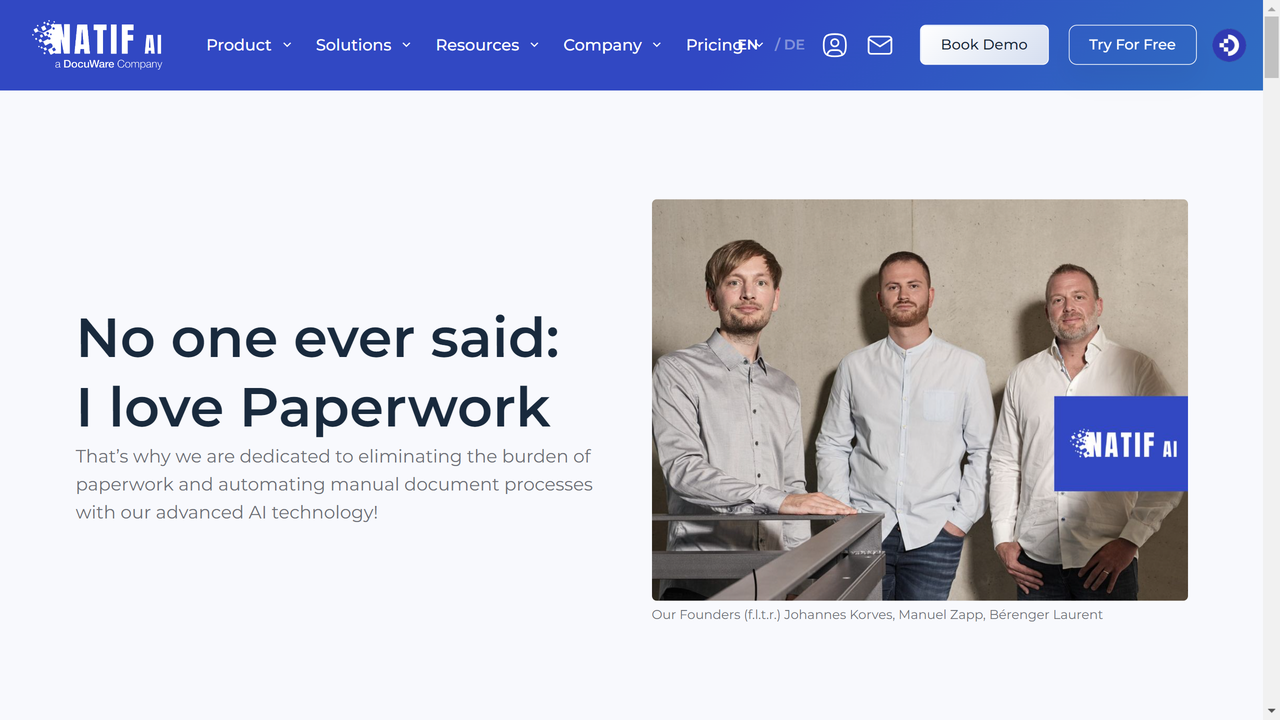
natif.ai remains an independent legal entity in Saarbrücken while its team operates within DocuWare. The founding team included Manuel Zapp, Johannes Korves, Christophe Hocquet, and Berenger Laurent, with Matthias Hoefler joining in 2023. Post-acquisition, Zapp moved to Vice President AI and Executive Advisor of AI Strategy at DocuWare, and Korves joined DocuWare's leadership, meaning natif.ai's founders are shaping DocuWare's AI direction rather than simply contributing a product.
By October 2025, DocuWare formalized that direction by opening the DocuWare AI Hub, a dedicated R&D facility consolidating natif.ai's expertise to build proprietary foundational AI models and specialized large language models (LLMs) for enterprise content management. The clearest external validation of the technology came from Kazuhiro Tsuruta, Director of Process Automation Business Promotion at Ricoh, who noted: "In Japan, handwritten documents such as purchase orders are often still the norm. This technology significantly increases the accuracy of handwritten text recognition."
How natif.ai processes documents
natif.ai's core contribution to DocuWare is Deep-OCR: a proprietary optical character recognition (OCR) engine built on deep learning rather than template matching. Where conventional OCR requires predefined layouts for each document type, Deep-OCR adapts to new document structures automatically, enabling extraction from unstructured documents that fall outside standard invoice or form formats. Marion Kurtz of DocuWare describes the practical difference: "Its advanced recognition capabilities help to automatically identify and extract data from low-quality scans, complex and handwritten documents."
The system covers four core intelligent document processing (IDP) application areas, announced at DocuWare's Partner Conference in Berlin in June 2024:
Classification and categorization
Documents are automatically assigned to types based on content and visual properties, without manual rule configuration.
Separation
Multi-document batches are split into individual records using both visual and textual signals.
Extraction
Structured and unstructured data is pulled from invoices, contracts, HR documents, and paper mail using self-learning models that improve with processing volume.
Integration
Extracted data flows into DocuWare's ECM platform via APIs and enterprise connectors, completing the automation pipeline.
Handwriting recognition is a specific technical strength. natif.ai claims up to 99% accuracy for handwriting OCR with complex scripts, including cursive and printed text. The system also handles degraded documents, delivering accurate results from wrinkled or stained scans that defeat template-based approaches. A key differentiator noted by Tsuruta is that "unlike conventional AI OCR solutions that require pre-registration of specific document sections, DocuWare's AI continuously learns from real-world usage, gradually improving its accuracy over time."
Since the DocuWare AI Hub opened in October 2025, natif.ai's Deep-OCR is being extended with specialized LLMs for agentic AI workflows and enhanced OCR tuned for generative AI applications, moving the technology beyond extraction toward reasoning over document content.
Use cases
Handwritten document processing
natif.ai's technology addresses markets where handwritten documents remain standard business practice. Ricoh's deployment demonstrates the use case concretely: Japanese enterprises still issue handwritten purchase orders, and the system processes these with accuracy that prior OCR approaches could not achieve. Hayato Aoki, Manager of Process Automation Promotion at Ricoh, frames the strategic importance: "Bringing a company with advanced AI technology into the Ricoh group was a milestone for our process automation business. With natif.ai under our umbrella, we can integrate its AI development capabilities and ideas into our operations. I believe this will drive Ricoh's transformation from a hardware provider into a digital services company." The same handwriting capability applies to forms, notes, and records in European administrative and healthcare contexts.
Unstructured document automation
Beyond structured invoices and forms, natif.ai handles documents that lack consistent layouts: contracts, correspondence, and mixed-format reports. The no-code custom AI model training interface lets teams configure extraction for new document types without developer involvement. According to natif.ai, the platform can be implemented in minutes and supports white-label deployment for software providers and consulting firms building branded document automation products. Open-source platforms such as Unstract take a comparable no-code approach to LLM-powered extraction from unstructured documents, offering a reference point for teams evaluating build-versus-buy options alongside natif.ai's integrated path.
Enterprise content management
Integrated within DocuWare's ECM platform, natif.ai provides intelligent capture that reduces document processing times across DocuWare's 19,000+ customers in 100+ countries. The HVVG case study, a German logistics company, demonstrated 70% time savings overall: invoice processing dropped from 30 minutes to 10 minutes per document, with 90% recognition accuracy for complex and variable document formats. Industry benchmarks cited by natif.ai indicate businesses using IDP report up to 70% faster document processing, 30% average reduction in operational costs, and up to 90% fewer errors versus manual entry. German mid-market enterprises evaluating on-premises alternatives may also consider IPA-Suite, a BITMi-certified platform with a comparable microservices architecture targeting similar regulated enterprise workflows.
German IDP specialists such as Insiders Technologies have pursued similar accuracy targets for challenging handwritten documents, providing a useful comparison point for evaluators assessing natif.ai's claims in the European market.
Technical specifications
| Feature | Specification |
|---|---|
| Deployment | Integrated within DocuWare ECM platform |
| Core technology | Proprietary Deep-OCR with deep learning |
| Document processing | Template-free, self-adapting models |
| Handwriting recognition | Up to 99% accuracy claimed; supports complex scripts including Japanese |
| Degraded document handling | Accurate results from wrinkled, stained, or low-quality scans |
| Custom model training | No-code interface for new document types |
| Integration | DocuWare APIs and enterprise connectors |
| AI models | Proprietary foundational models and specialized LLMs (via DocuWare AI Hub, from Oct 2025) |
| Document classification | Automatic grouping, splitting, categorization |
| Data extraction | Structured and unstructured document support |
| Self-learning | Continuous model improvement through processing volume |
| White-label | Available for software providers and consulting firms |
| Geographic development | Saarbrücken, Germany (DFKI spin-off) |
Resources
- DocuWare Website
- Original natif.ai Website
- DocuWare AI Hub Announcement
- Acquisition Details
- Ricoh Case Study: Japanese Handwriting Recognition
- Clipperton Transaction Note
- natif.ai IDP-101 Product Overview
Company information
- Parent company: DocuWare (wholly owned by Ricoh since 2019)
- natif.ai operations: Saarbrücken, Germany (independent legal entity)
- DocuWare headquarters: Germany
- Origin: Spin-off from the German Research Institute for Artificial Intelligence (DFKI), founded 2019
- Acquisition completed: April 19, 2024
- Investors (pre-acquisition): redalpine, High-Tech Gründerfonds, 468 Capital, F-LOG Ventures, Premius GmbH, Bold Ventures
- Leadership: Manuel Zapp (VP AI and Executive Advisor AI Strategy, DocuWare); Johannes Korves (DocuWare leadership); Christophe Hocquet, Berenger Laurent, Matthias Hoefler (founding and early team)