Captova: IDP Software Vendor
On This Page
Vancouver-based intelligent document processing (IDP) vendor claiming 100+ pages per second on-premises processing, targeting government agencies and defense contractors that cannot route documents through cloud infrastructure.
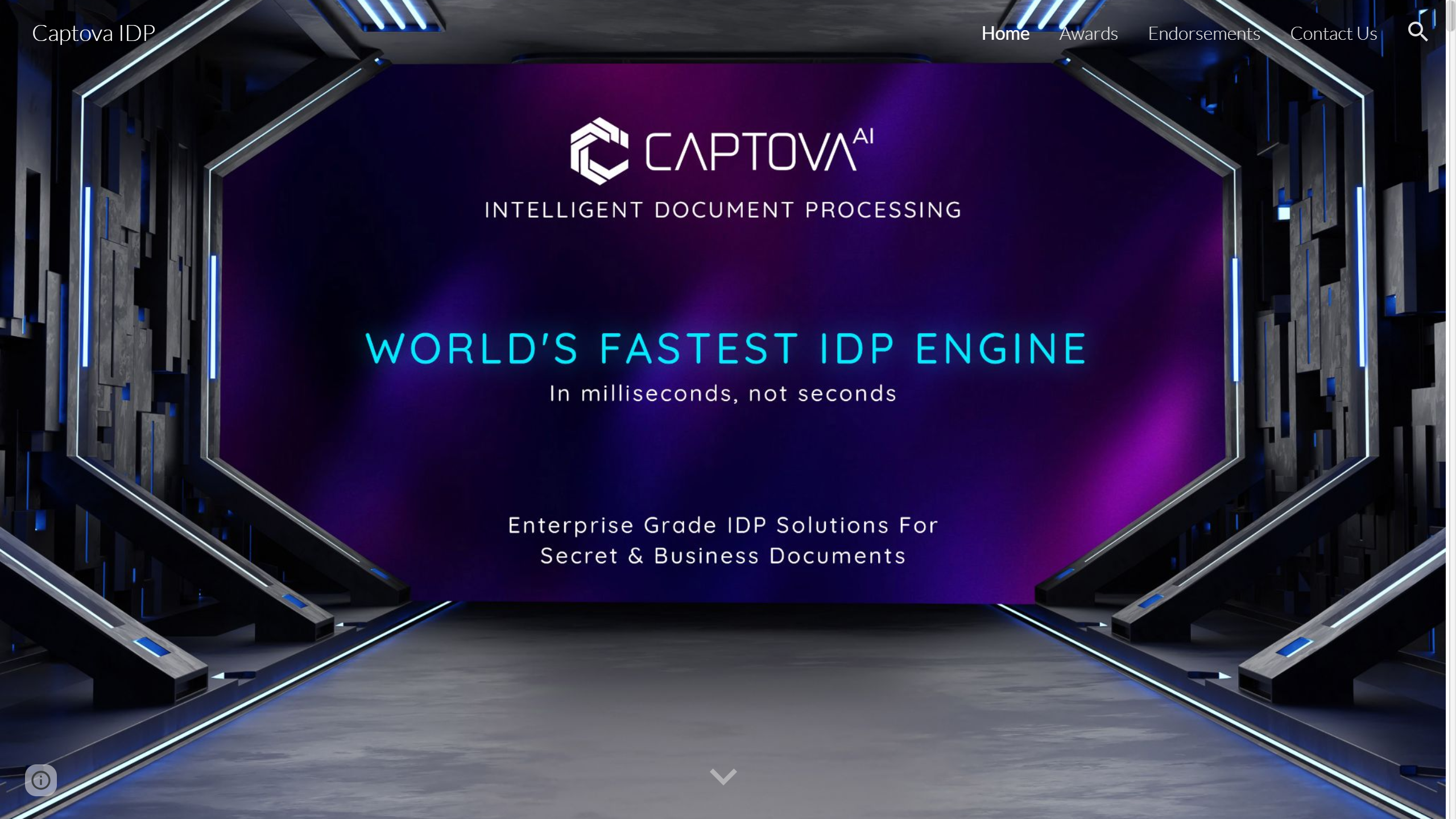
How Captova processes documents
Mohamed Talib, founder and CEO, built Captova after a costly lesson in cloud dependency. His earlier product, Scanov, was an accounts payable SaaS platform that won the Accounting Technology User Favorite Award for OCR/Data Entry at Accountex Boston in September 2017. In April 2021, an AWS infrastructure failure wiped out Scanov's entire customer base. Captova sued AWS for breach of contract and won, but AWS's liability caps limited the compensation. Talib then rebuilt around a different premise: on-premises deployment, flat-rate pricing, and raw processing speed as the primary differentiator.
The company received "One to Watch: Product" recognition at the Document Manager Awards 2023 for its Captova AI IDP platform, and was named a finalist for Document Manager Magazine's Data Capture/Recognition Product of the Year 2024 among 18 competitors including Hyland and DocuWare. The AWS litigation outcome and subsequent infrastructure migration to Google Cloud Platform signal a deliberate positioning against vendor lock-in risk, which resonates with risk-averse government buyers.
The pivot from Scanov's SMB accounting focus to enterprise government and defense reflects a broader market reality: consumer-grade document processing margins compress quickly, while enterprise IDP commands higher contract values and longer sales cycles. Captova now targets Sensitive Compartmented Information Facilities (SCIFs) and Special Access Program Facilities (SAPFs) where outbound network connections are prohibited.
Processing speed and accuracy claims
Talib states: "A single user on a Captova IDP Engine can process more than 80 pages per second. This translates to 4,800 pages per minute; or 288,000 pages per hour; or 2,304,000 pages in an 8-hour day. There is no question it is a disruptive technology."
The company's published figures show 100+ pages per second at the system level, with 95% accuracy and real-time error detection. Tony McKinley, an OCR expert cited in company materials, validated these speeds using output metadata on modest consumer hardware: an AMD Ryzen-5 CPU paired with an NVIDIA RTX-4060 GPU. That hardware profile matters because it suggests the throughput does not require specialized server infrastructure, lowering the barrier for agencies with constrained procurement budgets.
Independent verification beyond McKinley's assessment is not available in public sources. The 95% accuracy figure is self-reported. Buyers evaluating Captova against established competitors like ABBYY or Hyperscience should request benchmark results on their own document types before committing.
Key capabilities
Captova's architecture prioritizes hardware efficiency and minimal external dependencies over the ML-heavy pipelines common in cloud-native IDP platforms.
Single-document training is the most operationally significant differentiator. Where competitors typically require 5 to 20 labeled samples to train an extraction model for a new document type, Captova claims one sample is sufficient. For government agencies processing novel document formats during operational surges, this reduces deployment time from days to hours.
Air-gapped operation means the platform functions without any network connectivity. Documents never leave the processing server, which is a hard requirement for classified environments. The Scanov QuickBooks integration that defined the SMB era is gone; the current platform outputs JSON, CSV, and XML for integration with ERP systems, contract management platforms, and intelligence analysis tools.
Flat-rate server-based pricing eliminates per-page fees. At 360,000 pages per hour, per-page pricing from cloud providers would generate costs that scale linearly with volume. Captova's model makes high-volume processing economically predictable, which matters for agencies processing millions of documents per month under fixed budget allocations.
Real-time error detection surfaces confidence scores and flagged documents during ingestion rather than in post-processing batch reviews. Operators see problematic documents immediately, which reduces the time between ingestion and exception handling.
Use cases
Captova organizes its value proposition around four principles: Privacy, Accuracy, Speed, and Security (P.A.S.S.). In practice, this translates to two deployment scenarios where those properties create a genuine competitive advantage over cloud-native alternatives.
Government agencies deploy the platform in SCIFs and SAPFs to process intelligence documents offline. The system runs on bare-metal servers, trains models on-site, and processes classified materials at claimed speeds of 6,000 pages per minute. Intelligence analysts receive structured output for threat assessment and decision support without documents transiting any external network.
High-volume enterprise finance teams use the platform for invoice processing and contract analysis where throughput requirements exceed what cloud APIs can deliver cost-effectively. A single on-premises server handling 360,000 pages per hour replaces distributed cloud processing infrastructure, reducing both latency and per-document cost at scale. The real-time error detection surfaces problematic invoices immediately for exception handling.
Technical specifications
| Feature | Specification |
|---|---|
| Processing speed | 100+ pages/second, ~10ms per page |
| Throughput | 6,000 pages/minute, 360,000 pages/hour |
| AI training requirement | Single document sample |
| Document types | Structured, semi-structured, unstructured |
| Output formats | JSON, CSV, XML |
| Accuracy | ~95% with real-time error detection |
| Deployment | On-premise, bare-metal, air-gapped capable |
| Pricing model | Server-based maintenance fees (no per-page charges) |
| Reference hardware | AMD Ryzen-5 CPU, NVIDIA RTX-4060 GPU |
Company information
Captova Technologies is headquartered in Vancouver, British Columbia, Canada. Mohamed Talib is founder and CEO. The company migrated its infrastructure from AWS to Google Cloud Platform following the 2021 Scanov incident, though the on-premises IDP Engine itself runs on customer hardware without cloud dependency.
Public information on employee count, total funding, and enterprise customer references is not available. The vendor's profile remains limited compared to established IDP competitors, and no recent analyst coverage or partnership announcements appear in available sources.
Resources
- Captova website
- Document Manager Awards 2023 winners
- Mohamed Talib profile, The Top 100 Magazine