OCR.space: Free Cloud OCR API by a9t9 Software
On This Page
OCR.space is a freemium cloud OCR API operated by a9t9 software GmbH, built around a four-engine architecture and EU-server options for GDPR-compliant document processing.
Overview
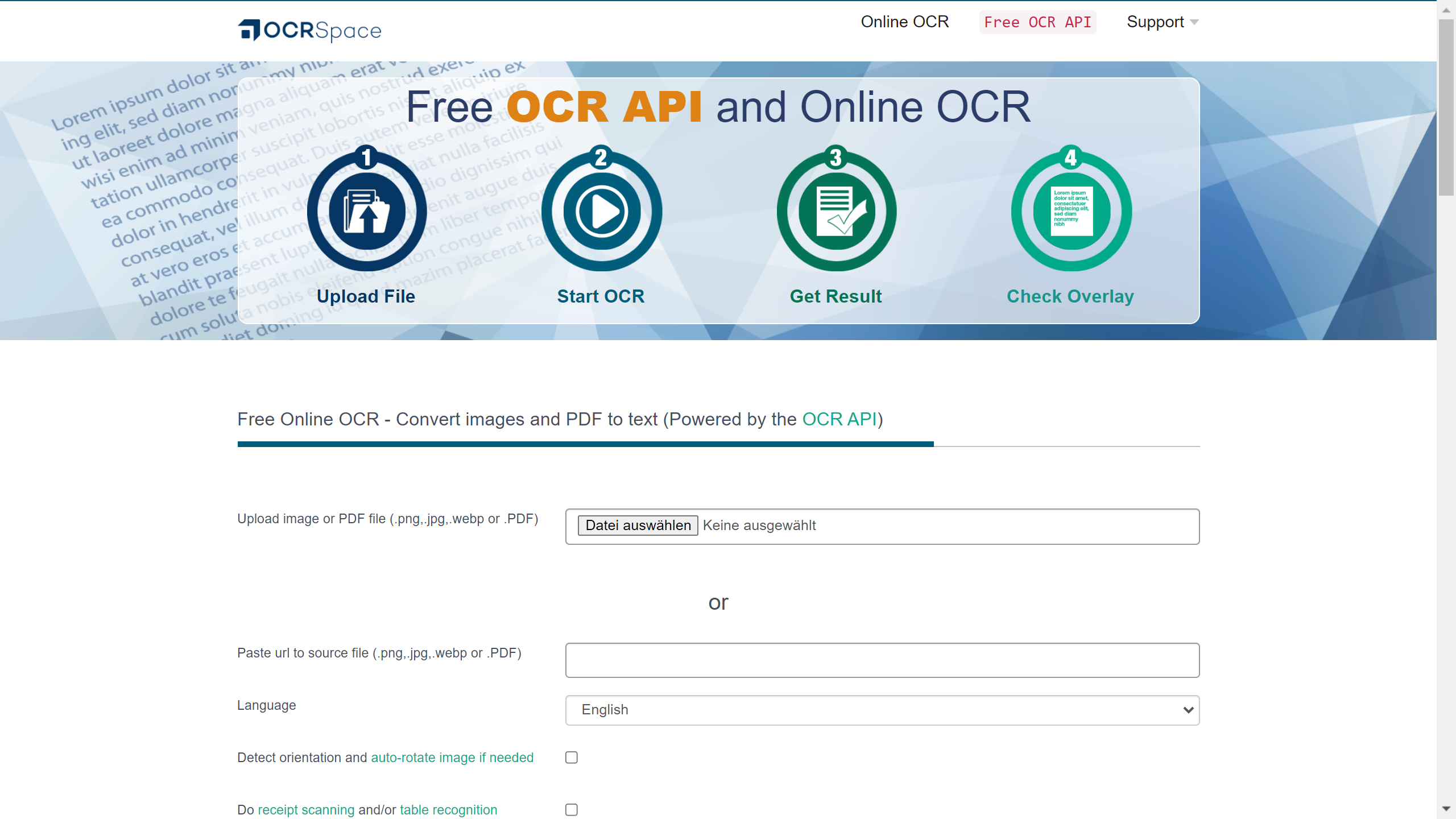
OCR.space is an API-first service designed for embedding into third-party applications rather than direct end-user use. Operated by a9t9 software GmbH, the platform differentiates on two axes: a four-engine architecture that routes documents to specialized models based on content type, and server-region selection that enables GDPR-compliant processing for paid customers.
Independent testing by Koncile.ai in January 2026 confirms 99% accuracy on well-scanned, clearly aligned printed text, with processing completing in seconds for standard documents. The same evaluation flags meaningful gaps: no structured field-by-field extraction, degraded performance on handwritten or stylized text, and no layout or formatting preservation in plain text or JSON output. Klippa's 2026 OCR software comparison ranks OCR.space 9th of 10 tools, positioning it as suitable for occasional use and simple documents rather than enterprise intelligent document processing (IDP) workflows.
The free tier provides 25,000 API requests per month with a 1MB file size ceiling per image, requiring no registration. The web interface allows 5MB uploads on the free tier. Paid plans raise limits and unlock EU or Asian server routing. For buyers evaluating API-based OCR vendors, Cloudmersive offers 600 free monthly API calls under a comparable freemium model.
What users say
Practitioners consistently cite OCR.space's zero-friction onboarding as its primary advantage: no registration, no credit card, and a working API key within minutes. Developers building prototypes or low-volume document pipelines find the free tier sufficient for testing and light production use.
The friction points cluster around output format and document complexity. Teams report that JSON-only output requires additional parsing work before data reaches downstream systems, and that table recognition aligns rows visually without delivering spreadsheet-ready structured data. Users processing invoices, contracts, or forms with variable layouts consistently find the template-based extraction model insufficient and migrate toward platforms with field-level validation. Koncile.ai's January 2026 evaluation summarizes the consensus: OCR.space is "suitable for occasional use and simple documents" but lacks the semantic understanding required for enterprise IDP workflows.
For organizations that outgrow OCR.space's extraction capabilities, Rossum, Klippa, and Nanonets are the most frequently cited alternatives in independent comparisons.
How OCR.space processes documents
OCR.space routes each document through one of four engines depending on the processing requirement. Engine 1 is optimized for speed and broad language coverage, suited to standard documents where throughput matters. Engine 2 handles auto-detection and special characters, useful for mixed-content or symbol-heavy documents. Engine 3 is the primary engine for 200+ language support, covering major global scripts and regional dialects. Engine 4 targets complex backgrounds and low-contrast text where standard engines degrade.
Automatic engine selection is available, or callers can specify an engine via the REST API. The service returns plain text or searchable PDF output, with visible and invisible text layer options for the PDF format. Receipt recognition and table recognition operate as specialized processing modes rather than separate products.
The platform uses a stateless processing model: files are analyzed in memory and immediately deleted after each job, with no data retention or secondary processing. The free tier routes through US-based servers. Paid plans unlock EU servers (Finland, France, Germany), Asian servers, or on-premise deployment for organizations with data residency requirements.
API access uses a REST interface with client libraries for Python, Java, and .NET. The ScanPapyrus integration illustrates the embedding pattern: scanning software calls the OCR.space API directly, compresses files automatically, and falls back to a secondary engine for difficult documents, without the end user switching applications.
OCR.space pricing and free tier limits
Free
- 25,000 requests/month
- 1MB file limit per image (API)
- 5MB file limit (web interface)
- US-based servers
- No registration required
- PNG, JPG, WEBP, PDF input
PRO
- 300,000 requests/month
- 5MB file limit
- EU, Asian, or US server selection
- Bulk processing
PRO PDF {primary}
- 300,000 requests/month
- 100MB+ file limit
- EU, Asian, or US server selection
- Large PDF document support
Enterprise
- Unlimited conversions
- Custom OCR solutions
- On-premise deployment
- On-site consulting and training
Pricing data sourced from Klippa's 2026 OCR comparison and Koncile.ai's January 2026 evaluation. Payment processing is handled by FastSpring; a9t9 does not manage payment data directly.
The free tier's 1MB API limit is the most common friction point for developers. Files exceeding 1MB via API require a paid plan, while the web interface allows 5MB on the free tier. Bulk processing is unavailable on the free plan.
Use cases
Privacy-compliant document digitization
Regulated organizations in financial services, healthcare, and public administration use OCR.space's paid EU server options for sensitive document digitization where data residency is a contractual or regulatory requirement. The stateless processing model removes data retention risk. The free tier, however, routes through US servers, which disqualifies it for strict GDPR use cases without a paid plan. See the document processing compliance guide for a broader framework on evaluating OCR vendors against GDPR obligations. Organizations with stricter on-premises requirements may also evaluate Captova, which offers 100+ pages/second processing with on-premises deployment for government and defense markets.
Third-party application embedding
Software vendors integrate OCR.space to add OCR capabilities without building or maintaining in-house engines. The ScanPapyrus integration is the clearest public example of this pattern, and it suits ISVs and SaaS platforms that need OCR as a feature rather than a product. Developers building similar integrations can reference the OCR for developers guide and the building document processing APIs guide. Teams that need LLM-based extraction on top of OCR output may also evaluate Unstract, an open-source no-code platform that adds hallucination mitigation and structured output to document pipelines.
Multi-language document processing
International organizations processing documents across diverse scripts use Engine 3's 200+ language coverage with automatic language detection. The engine selection logic handles script identification before extraction, reducing configuration burden for multilingual pipelines. For implementation patterns across mixed-language document workflows, see the multi-language OCR guide. Teams processing documents across European languages with sovereignty requirements may also consider Retarus, a Munich-based provider offering intelligent document processing on European AI infrastructure.
Technical specifications
| Feature | Specification |
|---|---|
| Operator | a9t9 software GmbH |
| Headquarters | Heidelberg and Walldorf, Germany |
| Founded | 2020 |
| OCR engines | 4: speed-optimized (E1), auto-detection/special chars (E2), 200+ languages (E3), complex backgrounds (E4) |
| Language support | 200+ languages with automatic detection |
| Input formats | JPG, PNG, GIF, WEBP, PDF |
| Output formats | Plain text, searchable PDF (visible and invisible text layers), JSON |
| Free tier | 25,000 requests/month; 1MB file limit (API); 5MB (web interface); no registration |
| PRO tier | $30/month; 300,000 requests; 5MB file limit |
| PRO PDF tier | $60/month; 300,000 requests; 100MB+ file limit |
| Enterprise tier | $999/month; unlimited conversions; custom solutions |
| Server regions | US (free); EU (Finland, France, Germany), Asia, on-premise (paid) |
| Data retention | None; stateless processing with immediate post-job deletion |
| API | REST with Python, Java, .NET client libraries |
| Special modes | Receipt recognition, table recognition, auto-rotation |
| GDPR | EU server routing on paid plans; stateless processing on all tiers |
| Accuracy | ~99% on well-scanned printed text (Koncile.ai, January 2026) |
| Competitive rank | 9th of 10 tools (Klippa 2026 OCR comparison) |
Resources
- OCR.space website
- Free OCR API
- API documentation
- OCR API comparison guide
- Multi-language OCR guide
- OCR for developers guide
- Document processing compliance guide
Company information
OCR.space is operated by a9t9 software GmbH, headquartered in Heidelberg and Walldorf, Germany. The company was founded in 2020 by two veterans of iOpus Software, the team behind iMacros, which maintains over 1,000,000 active daily users. The a9t9 numeronym stands for "Automation Technology." OCR.space operates alongside Ui.Vision RPA software as the company's two flagship products, with a9t9's stated goal being to "convert the recent advances in computer vision into usable automation products."
The company takes an API-first, embedding-oriented approach to the OCR market, growing through integration partnerships rather than direct enterprise sales. Enterprise services include custom OCR software development, on-site consulting, and training for Ui.Vision RPA customers. No employee count has been disclosed publicly.
OCR.space occupies a specific market segment: free or low-cost OCR for developers, occasional users, and simple document types. For organizations requiring structured data extraction, field-level validation, or semantic document understanding, OCR.space functions as a baseline OCR engine rather than a complete IDP platform. The 9th-place ranking in Klippa's 2026 comparison reflects this positioning: competitive on price and ease of use, constrained on accuracy depth and output flexibility.