VIDIZMO Redactor: IDP Software Vendor
On This Page
- Overview
- How VIDIZMO Redactor processes content
- Use cases
- Law enforcement and FOIA compliance
- Healthcare and clinical trial document processing
- Legal multimedia evidence
- Enterprise training content
- Consulting and screen recording workflows
- Technical specifications
- Competitive position
- Audit trail and defensibility
- Resources
- Company information
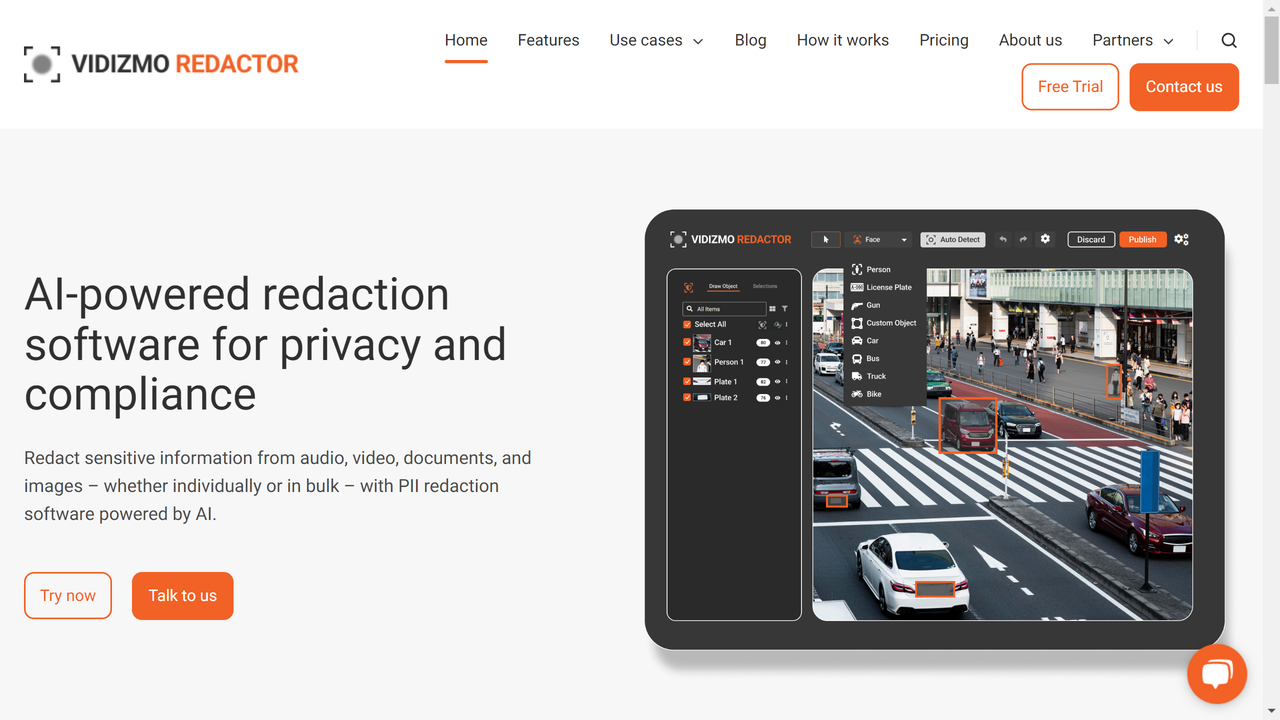
VIDIZMO Redactor is an AI-powered redaction platform, part of the broader intelligent document processing category, for protecting sensitive information in audio, video, images, and documents across regulated industries.
Overview
VIDIZMO Redactor is developed by VIDIZMO LLC, a software company founded in 2009 with 51-200 employees. The platform handles video, audio, images, and documents in a single interface, competing against single-modality tools like Veritone (video and audio only), CaseGuard (desktop-only), and document-focused tools like iDox and ReadyRedact.
The competitive differentiation is measurable. In a UK Department for Work and Pensions evaluation scoped for 5,000 users processing 4 million pages annually, VIDIZMO Redactor scored 86.1% compared to iDox at 32.8% and ReadyRedact at 30.7%. The evaluation covered a document-heavy enterprise deployment, which reflects the platform's strength in bulk processing rather than typical mid-market workloads.
The core operational problem VIDIZMO addresses is throughput. Manual redaction of one hour of video requires 4 to 8 analyst hours, according to VIDIZMO's own documentation. For healthcare compliance teams, a 4,200-page records request represents 140 to 210 hours of manual work. At that volume, meeting regulatory deadlines without automation is not feasible for most teams.
All sources in this profile are first-party VIDIZMO blog content unless otherwise noted. Independent third-party benchmarks are not currently available for this vendor.
Comparable IDP vendors include Konfuzio and OpenText.
How VIDIZMO Redactor processes content
VIDIZMO Redactor detects 40+ personally identifiable information (PII) categories across visual, audio, and text modalities. The platform supports 255+ file formats, including proprietary CCTV files that are automatically converted from H.264 to standard MP4 during ingestion. Audio redaction processes speech in 82 languages across 33+ spoken PII categories. Text detection combines pattern matching with natural language processing for contextual Named Entity Recognition (NER) classification, which allows the system to distinguish between a name used as a reference and a name that identifies a protected individual.
Three redaction modes give operators control over automation depth. Fully automated mode requires no human review. Semi-automated mode presents AI suggestions for a reviewer to accept or reject. Manual mode uses AI detection as an assist layer while keeping a human in control of every decision. VIDIZMO's own guidance recommends starting with semi-automated mode for any new recording type before switching to full automation.
Confidence thresholds are configurable from 25% to 90%. For screen recording workflows, VIDIZMO recommends a threshold between 50 and 65 to balance detection completeness against false positives. Known limitations in OCR-based redaction include low-resolution text at small font sizes, stylized or decorative fonts, fast-scrolling interfaces, and partially obscured text.
The selective redaction capability addresses a specific failure mode of blanket redaction. As Ali Rind, a VIDIZMO blog author, wrote in March 2026: "Blanket redaction, which removes all detected PII regardless of type, solves the privacy problem but creates a new one: over-redaction. Content becomes unusable for its intended purpose when critical identifiers, reference numbers, and contextual data are buried under black boxes alongside genuinely sensitive information." Per-entity-type rules let organizations preserve policy IDs while redacting Social Security numbers, or remove the 18 HIPAA protected health information (PHI) identifiers while keeping clinical data intact.
Use cases
Law enforcement and FOIA compliance
Every body camera recording, dashcam clip, and 911 call released under public records laws must be scrubbed of protected information before it reaches the requester. State deadlines are tight and penalties for violations are concrete. Ohio FOIA violations carry fines of $2,500 to $5,000 per violation. Texas Public Information Act violations carry criminal misdemeanor charges and fines up to $1,000. Virginia FOIA violations carry civil penalties of $500 to $2,000 per violation plus attorney fees.
VIDIZMO documents state-by-state open records requirements across nine states, including Georgia (3 business days), California (45 days for critical incidents), Illinois (5 business days with a 5-day extension), Texas (10 business days), Florida (prompt response), New York (5 business days to acknowledge, then reasonable time), and Washington (5 business days with daily penalties of $5 to $100). The platform identifies faces of minors, victims, and witnesses, obscures license plates, and removes spoken names and addresses from audio.
Healthcare and clinical trial document processing
VIDIZMO Redactor detects all 18 HIPAA PHI identifiers, including patient names, dates of birth, Social Security numbers, diagnosis codes, provider identifiers, and insurance information. Handwritten content is processed through intelligent character recognition (ICR). DICOM medical imaging files are supported. The platform also detects UK NHS numbers and other country-specific identifiers for clinical research workflows governed by ICH GCP E6(R2), GDPR, and UK GDPR.
The throughput case is direct: manual redaction averages 2 to 4 minutes per page. A 4,200-page request represents 140 to 210 hours of manual work. VIDIZMO's batch processing has been tested with 1.1 million files and supports queue-based automation for overnight processing. The platform also documents a human accuracy problem: manual redaction error rates increase with volume and fatigue, with reviewers missing more PHI in afternoon hours and on Fridays than in mornings or earlier in the week.
Legal multimedia evidence
Law firms handling multimedia evidence face a fragmentation problem that single-format tools cannot solve. As VIDIZMO's positioning states: "If your redaction tool only handles PDFs, you'll be forced to juggle multiple applications, utilizing one for text, another for video, and possibly a third for audio. That's not just inefficient. It increases the risk that something slips through the cracks."
The platform includes role-based access controls: paralegals can redact but not publish, litigation support managers can approve and export, and partners can view logs only. Real-time redaction preview is available for video and audio before export. VIDIZMO positions Redactor as best suited for mid-sized law firms handling large volumes of multimedia evidence. One acknowledged limitation: the platform lacks integration with Relativity, the dominant eDiscovery platform, which may limit adoption in firms where Relativity is the standard workflow.
Enterprise training content
Organizations redact sensitive information from training videos while preserving instructional context, enabling secure knowledge sharing across departments. Object detection identifies and redacts content displayed on monitors and application interfaces visible in recordings, combined with OCR-based text detection. This is particularly relevant for manufacturing, finance, and healthcare companies sharing training materials globally while protecting trade secrets and customer data.
Consulting and screen recording workflows
Consulting videos are often distributed broadly across internal teams, client stakeholders, and partner organizations, making PII exposure a persistent risk. VIDIZMO Redactor supports bulk redaction across hundreds of files simultaneously with queue-based automation for overnight processing. Split-screen review allows side-by-side comparison of original and redacted versions for quality assurance. Custom regex patterns support organization-specific identifiers beyond standard PII models.
Technical specifications
| Feature | Specification |
|---|---|
| Deployment options | SaaS, Azure Government Cloud, on-premises, hybrid |
| Supported formats | 255+ including MP4, MOV, AVI, WAV, MP3, JPEG, PNG, PDF, DOCX, XLSX, DICOM, proprietary CCTV |
| AI technologies | Computer vision, NLP, speech recognition, OCR, ICR, pattern matching, NER |
| Audio languages | 82 languages, 33+ spoken PII categories |
| PII entity types | 40+ across visual, audio, and text modalities |
| Security | AES 256 encryption, SSO/SAML/SCIM, MFA, immutable audit logs |
| Integrations | AWS, Microsoft Azure, SharePoint, VMware Cloud, Wowza |
| AI processing | Server-side only; no client-side GPU required |
| Compliance frameworks | FOIA, HIPAA, GDPR, FERPA, COPPA, PCI DSS, CJIS, FAA, ISPS, NHS Data Security Standards, ICH GCP E6(R2) |
| HIPAA deployment | BAA/DPA available |
| Pricing | Starting at $89/month |
Competitive position
VIDIZMO competes in the specialized redaction segment, distinct from broader IDP platforms. Its primary competitors, as identified by VIDIZMO itself, are Veritone (video and audio only, cloud-only), CaseGuard (desktop application, no cloud deployment), iDox (documents focus, cloud-only), and Redactable (documents focus). The multi-format capability is the central differentiator: none of these competitors handle all four modalities in a single platform.
The UK DWP evaluation score (86.1% versus iDox at 32.8%) is the strongest third-party signal available, though it comes from VIDIZMO's own blog rather than an independent analyst report. The evaluation scope, 5,000 users processing 4 million pages annually, reflects enterprise government operations and may not translate directly to smaller deployments.
The Relativity integration gap is a real constraint for legal teams. Relativity is the standard platform in eDiscovery, and the absence of a native connector means law firms using Relativity as their primary workflow tool will face manual handoffs between systems.
All AI processing runs server-side, which removes the GPU requirement from client machines and simplifies deployment in regulated environments with strict endpoint controls.
Audit trail and defensibility
VIDIZMO consistently emphasizes audit trail completeness across all use cases. Every detection, redaction, and review decision is logged automatically, including identifier category, document reference, timestamp, and reviewer name. This matters for two distinct legal requirements: FOIA responses must be defensible against challenges, and Federal Rules of Evidence 502(b) requires demonstrating reasonable precautions against inadvertent disclosure in litigation.
Multi-layer redaction supports independent visibility controls, naming, permissions, and export settings for FOIA exemption code management, allowing agencies to document which legal exemption applies to each redacted element.
Resources
- Company website
- Feature overview
- Pricing plans
- AI redaction software guide
- Selective PII redaction
- Healthcare document redaction
- State open records compliance guide
Company information
- Website: redactor.ai
- Parent company: VIDIZMO LLC
- Founded: 2009
- Company size: 51-200 employees