Expert.ai: IDP Software Vendor
On This Page
- How Expert.ai processes documents
- Industry positioning and strategic partnerships
- EidenAI Suite and platform architecture
- Natural Language API and developer tools
- Use cases and applications
- Intelligent document processing
- Risk assessment and underwriting
- Knowledge discovery and research
- Technical specifications
- Context and market position
- Notable quotes
- Resources
Expert.ai operates the EidenAI Suite, an enterprise AI platform that combines symbolic AI with machine learning for document processing across regulated industries. Unlike pure machine learning competitors such as OpenAI and Google Cloud, Expert.ai's approach provides explainable results through knowledge graphs, a compliance requirement in finance and insurance. The company secured strategic partnerships with S&P Global and Springer Nature in 2025 and was included in the InsurTech100 list for AI excellence in insurance solutions.
How Expert.ai processes documents
Expert.ai's platform starts with deep linguistic analysis, parsing documents into tokens, lemmas, and syntactic relationships before routing content through industry-specific models. The hybrid symbolic-ML architecture combines neuro-symbolic AI, knowledge graphs, large language models (LLMs), generative models, and agentic AI. Rather than applying a single generative model to every task, the platform selects the appropriate AI method per use case to optimize both accuracy and inference cost. As Nick Carter, Senior Sales Director at Expert.ai, explained in fintech.global's October 2025 coverage: "Every time you use a highly complex generative model or a large language model, there's a cost associated with it. A hybrid AI approach leads to a lower overall cost for the customer."
Unlike statistical models, Expert.ai's symbolic layer provides explainable classification reasoning that regulators require for insurance claims decisions and financial compliance audits. The platform's writeprint extension performs stylometric analysis to identify authorship patterns, document authenticity, and readability levels. For insurance applications, this enables automated policy review across hundreds of pages, addressing what Expert.ai reports as close to 80% unstructured data within the industry.
Industry positioning and strategic partnerships
Expert.ai targets six primary verticals rather than competing horizontally against Microsoft Azure and Amazon Comprehend. The insurance focus is the most developed: the platform handles broker submission processing, near real-time document indexing for claims during catastrophe events, and legal demand routing. The legal demand routing capability addresses a documented operational gap where over 20% of legal demands are miscategorized by human indexing teams as "general legal correspondence," causing downstream delays in claims resolution.
The company's insurance strategy materialized through a strategic partnership with Patra to automate policy checking for agencies and carriers. Patra CEO John Simpson described the collaboration as addressing "one of the insurance industry's biggest challenges for decades." In 2025, Expert.ai extended its enterprise reach through partnerships with S&P Global Commodity Insights for AI-driven market insights and Springer Nature for clinical trials intelligence in the pharmaceutical sector. The company also launched EIX-Customer Screening for adverse news monitoring in financial services, competing directly with IBM Watson in compliance automation.
The 2025 partnerships signal a deliberate pivot toward embedded middleware rather than standalone platform competition. By integrating within S&P Global's commodity workflows and Springer Nature's clinical research pipelines, Expert.ai positions itself as specialized infrastructure for regulated industries where compliance requirements outweigh convenience.
EidenAI Suite and platform architecture
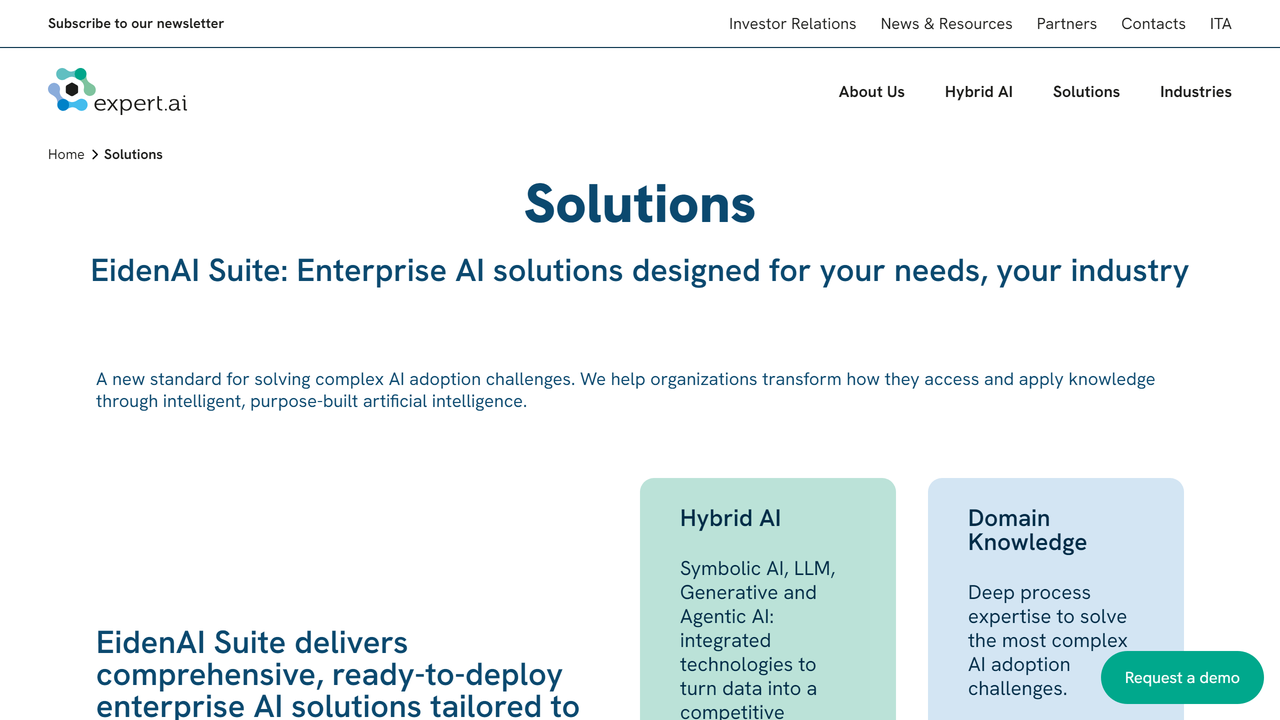
Expert.ai's EidenAI Suite combines four AI paradigms: LLMs, generative models, agentic models, and neuro-symbolic AI. The architecture is designed so each paradigm handles the tasks it performs most cost-effectively, rather than routing all workloads through the most capable but most expensive model. This matters in insurance, where high-volume, lower-complexity tasks such as document classification would generate unsustainable inference costs if processed by frontier LLMs.
Human-in-the-loop (HITL) workflows are built into the platform for model explainability and continuous learning. This design choice reflects insurance industry requirements: underwriting and claims decisions require audit trails that pure generative outputs cannot reliably provide. The platform's governance layer handles explainability, bias management, and compliance controls as native features rather than add-ons.
Industry-specific modules cover insurance, banking, publishing, and healthcare with pre-built extraction models and classification taxonomies for common document types in each sector. The roadmap includes real-time multimodal capabilities combining text, voice, and image data simultaneously for underwriting and claims workflows, responding to competitive pressure from vendors expanding beyond text-only extraction.
Natural Language API and developer tools
Expert.ai's Natural Language API provides developers with programmatic access to language understanding capabilities through REST endpoints with JSON responses. The API delivers natural language processing features including part-of-speech tagging, lemmatization, syntactic analysis, semantic disambiguation, entity recognition, and relationship extraction.
Multi-language support covers English, Spanish, French, Italian, German, and additional languages with consistent methodology across linguistic boundaries. Ready-to-use knowledge models provide pre-built understanding for general language and domain-specific content in finance, insurance, healthcare, and legal verticals. SDKs are available for Python, Java, .NET, and JavaScript. The company hosted a global hackathon with over 500 participants in 2022, awarding $10,000 in prizes for applications demonstrating hate speech detection, ESG analysis, and sentiment analysis.
Use cases and applications
Intelligent document processing
Organizations use Expert.ai to process contracts, policies, reports, and correspondence at scale. The system classifies incoming documents by type, purpose, and content, routing them to appropriate workflows without manual sorting. Extraction identifies entities, dates, amounts, clauses, and relationships from unstructured text, with context-aware understanding distinguishing between similar terms that carry different meanings across document types. For insurance specifically, the platform handles broker submissions end-to-end: extracting underwriting-critical information from submission packages and associated documents, then surfacing it in structured form for underwriter review.
Risk assessment and underwriting
Insurance companies and financial institutions use Expert.ai's natural language understanding to analyze applications, reports, news, social media, and internal documents for risk factors that structured data fields do not capture. Relationship identification surfaces connections between entities, events, and conditions buried in narrative text. Sentiment and tone analysis evaluates subjective signals in reports and communications that may indicate emerging risk conditions. The platform's on-demand scaling capability handles catastrophe event surges, where claims document volumes can spike unpredictably and near real-time indexing determines how quickly adjusters can begin processing.
Knowledge discovery and research
Research organizations and knowledge-intensive businesses use Expert.ai to find connections across large collections of unstructured content. The system processes research papers, reports, news articles, patents, and internal documents, building knowledge networks from extracted concepts, entities, and relationships. Cross-document relationship identification surfaces patterns across sources that manual review would miss. Semantic search returns results based on meaning and context rather than keyword matching, which is particularly relevant for pharmaceutical research workflows where terminology varies across publications.
Technical specifications
| Feature | Specification |
|---|---|
| Deployment options | Cloud, on-premises, hybrid |
| Architecture | Hybrid AI: symbolic + ML + LLMs + agentic |
| Languages supported | Multiple (English, Spanish, French, Italian, German, others) |
| API | REST API with JSON response format |
| SDKs | Python, Java, .NET, JavaScript |
| Integration | Webhooks, connectors for major platforms |
| Knowledge bases | General and domain-specific |
| Customization | Rules, taxonomies, entities, relationships |
| Security | Enterprise-grade data protection |
| Scalability | Horizontal scaling; on-demand surge capacity |
| Data formats | Text, HTML, PDF, Office documents |
| HITL | Custom human-in-the-loop workflows |
Context and market position
Expert.ai's symbolic AI approach positions it against the machine learning orthodoxy dominating enterprise natural language processing (NLP). While competitors scale horizontally with general-purpose models, Expert.ai bets that vertical specialization in regulated industries produces better unit economics. The knowledge graph foundation provides explainability that pure neural networks cannot match consistently, and that gap matters most in insurance claims and financial compliance where decisions require documented reasoning.
The platform does carry implementation overhead. Building and maintaining knowledge graphs requires subject matter experts, creating a steeper setup curve compared to plug-and-play alternatives. Enterprise pricing makes the platform a poor fit for smaller teams or organizations with straightforward document classification needs where the symbolic layer adds cost without proportional benefit.
The hybrid architecture argument gains credibility as inference costs for frontier LLMs become a line item in enterprise AI budgets. A 2025 Bank of England survey found that 75% of insurance firms already use AI, with foundation models accounting for 17% of all use cases. Expert.ai's selective LLM deployment model addresses the cost concern directly: apply expensive models only where they outperform cheaper alternatives, and use symbolic or lighter ML methods everywhere else. Carter summarized the customer-facing version of this logic: "everything we work on has to have immediate P&L impact for our customers."
Notable quotes
Working together to power language understanding in any application or process across the insurance value chain. Walt Mayo, CEO, Expert.ai, on the Patra partnership
Our extensive experience in successfully implementing real world solutions proves that depth, accuracy and quality make a huge difference in unlocking the full business potential of language. Marco Varone, CTO, Expert System, on the [expert.ai NL API launch](https://aithority.com/natural-language/expert-system-releases-expert-ai-natural-language-api/)
Every time you use a highly complex generative model or a large language model, there's a cost associated with it. A hybrid AI approach leads to a lower overall cost for the customer. Nick Carter, Senior Sales Director, Expert.ai, fintech.global, October 2025