Netfira: IDP Software Vendor
On This Page
German SaaS platform automating B2B transaction documents through a three-stage architecture covering extraction, deterministic workflow processing, and enterprise integration.
Overview
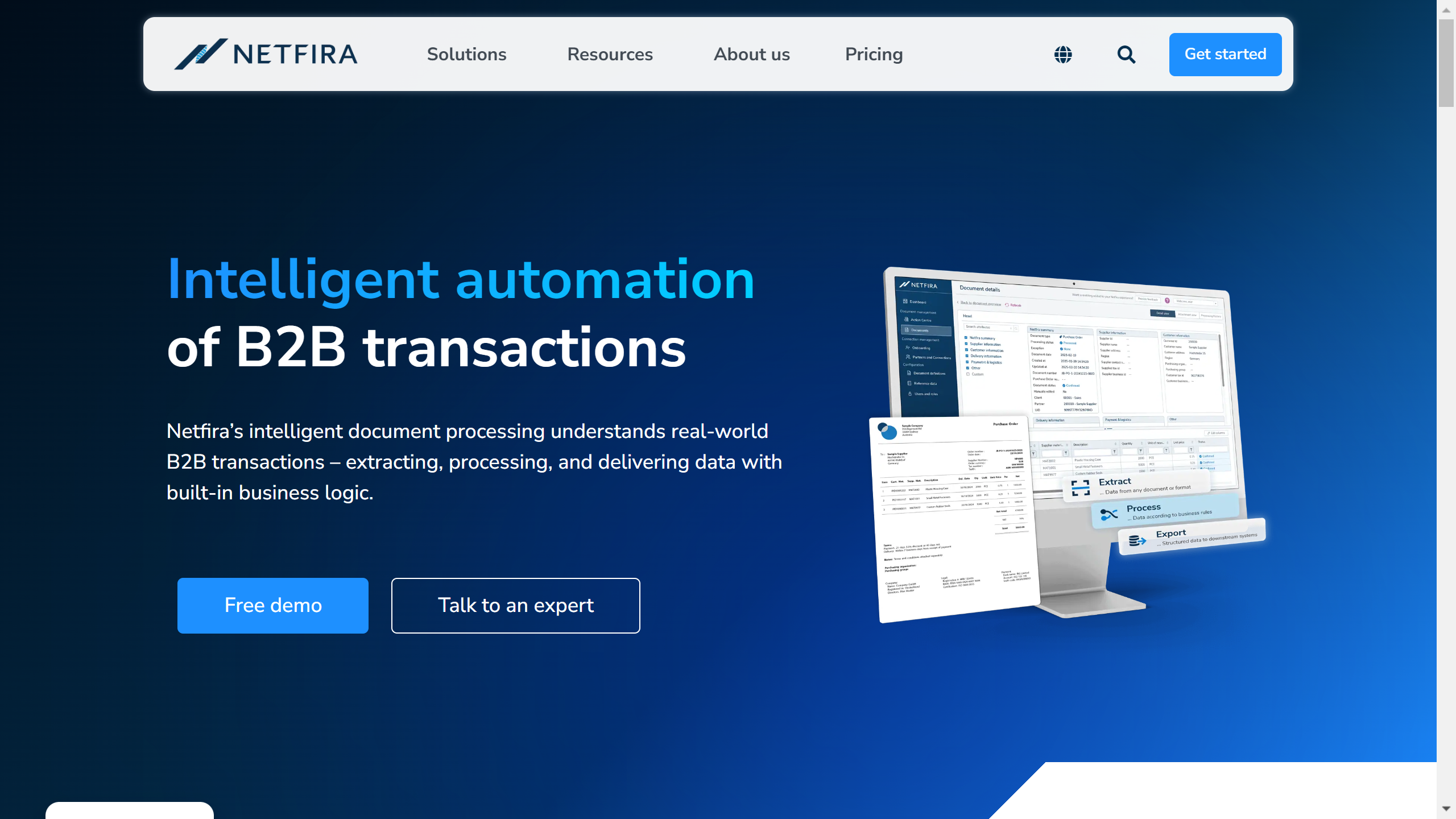
Netfira operates from Walldorf, Germany, providing intelligent document processing (IDP) specifically for B2B transaction workflows. The platform's three-stage architecture covers data extraction from invoices, orders, shipping notices, and quotes; processing via Netfira Workflows; and export to ERP, CRM, and financial systems.
Within the vendor ecosystem, Netfira positions itself differently than traditional IDP vendors like ABBYY, focusing on transaction document automation alongside procurement platforms rather than general-purpose document capture. As of early 2026, the company has published no independent customer case studies and carries zero user reviews on Capterra despite listing 16 technical capabilities, suggesting either recent market entry or limited public adoption compared to rated competitors in the procurement automation space.
Netfira's 2026 market positioning, articulated by Kim Bührle in January 2026 strategic guidance, frames the company's differentiation around governance rather than extraction accuracy: "The most successful document automation strategies will balance intelligence with control. They will combine AI-assisted understanding, human-defined logic and deterministic execution." This positions Netfira as a governance-first alternative to fully autonomous document AI systems.
Comparable IDP vendors include OpenText.
How Netfira handles document processing
Netfira's core design separates two concerns that many IDP platforms conflate: the intelligence layer and the execution layer. AI handles document understanding, extracting structured data from unstructured B2B transaction documents. Explicit, human-defined business rules then govern what happens with that data. The result is a processing pipeline where every decision is traceable back to a defined rule, not an opaque model inference.
This architecture matters most in regulated environments. Finance and procurement teams operating under audit requirements need to explain why an invoice was approved or flagged. A system that routes documents based on probabilistic AI outputs alone cannot provide that explanation. Netfira's deterministic execution layer can.
The human-in-the-loop component extends this logic. Rather than treating manual review as a failure mode, Netfira frames exception handling as a feedback mechanism. When a document falls outside defined rules, it routes to a human reviewer whose decision can inform updated logic. Bührle described this as turning "document processing challenges into opportunities for learning and improvement."
Extract
AI-assisted extraction pulls structured data from invoices, purchase orders, delivery notes, and sales documents across web, Android, and iPhone/iPad interfaces.
Process
Netfira Workflows applies human-defined business rules to validate, match, and route documents. Exceptions escalate to human reviewers rather than passing through unchecked.
Integrate
Validated data exports to ERP, CRM, accounting, and procurement platforms via API and EDI connections, completing the procure-to-pay or order-to-cash cycle.
Use cases
Procurement document automation
Organizations process purchase orders by extracting supplier information, line items, and pricing data, applying business rule validation, and routing exceptions to procurement teams before ERP integration. The deterministic processing layer means every routing decision is auditable, which matters for organizations subject to procurement compliance requirements.
Accounts payable processing
Finance departments automate supplier invoice processing through header and line-item extraction, purchase order matching, and discrepancy flagging before accounting system integration. The separation between AI extraction and rule-based validation allows finance teams to define their own matching tolerances and approval thresholds without requiring developer involvement each time rules change.
Sales fulfillment workflows
Companies handle sales orders and delivery notes by extracting customer information and product details, applying validation logic, and exporting to fulfillment and CRM systems. This reduces order entry errors and improves visibility into fulfillment operations across the order-to-cash cycle.
Technical specifications
| Feature | Specification |
|---|---|
| Platform type | SaaS |
| Architecture | Three-stage: extraction, workflow, integration |
| Processing model | AI-assisted extraction plus deterministic rule execution |
| Document types | Invoices, purchase orders, delivery notes, sales documents, shipping notices, quotes |
| Deployment | Web, Android, iPhone/iPad |
| Integration | ERP, CRM, financial systems via API and EDI |
| Exception handling | Human-in-the-loop workflow routing |
| Target markets | Procurement, accounts payable, sales fulfillment |
| Industries | Healthcare, manufacturing, logistics, consumer goods, chemicals, energy |
Deployment and implementation
Netfira's SaaS deployment eliminates infrastructure requirements while API and EDI integration capabilities connect to existing enterprise systems. The multi-platform approach supports both web-based workflows and mobile exception handling, allowing procurement and finance teams to review and approve documents from any device.
Organizations evaluating Netfira should assess their tolerance for the governance-first trade-off: the deterministic architecture provides auditability and control, but requires upfront investment in rule definition. Teams expecting a zero-configuration, fully autonomous system will find the model requires more deliberate setup than black-box alternatives. For regulated industries where document decisions must be traceable, that setup cost is the point.
Netfira carries no independent user reviews as of April 2026. Evaluators should request reference customers directly from the vendor before committing to a procurement decision.
Resources
- Website
- Capterra Profile
- 2026 document automation positioning
Company information
Headquarters: Walldorf, Germany