OpenBots - Healthcare RPA and AI Automation
On This Page
Healthcare-focused automation platform with zero-bot licensing, AI agents for revenue cycle management, and high-volume document processing capabilities.
Overview
OpenBots started as a general robotic process automation (RPA) platform in 2020 and has since narrowed its focus to healthcare financial operations. After raising $15M in Series A funding and acquiring araZach and MyOfficeBot in 2021, the company pivoted to healthcare-specific agentic AI. In March 2025, it launched eight Autonomous Revenue Cycle Management AI Agents covering the full billing lifecycle from patient intake through payment posting.
Everest Group ranked OpenBots as a "Major Contender" in its 2022 RPA assessment alongside SAP and IBM. In January 2026, QKS Group included OpenBots in its SPARK Matrix for Intelligent Document Processing (Q4 2025), which evaluated 26 IDP vendors and identified a market shift toward AI-driven platforms with embedded ModelOps and governance. The company holds SOC 2 Type 1, HIPAA, and PCI DSS certifications, a prerequisite for selling into regulated healthcare and banking environments.
KMH Cardiology processes 55,000 fax pages monthly on the platform, demonstrating sustained throughput in a referral-heavy cardiology practice. CEO Zia Bhutta frames the value proposition around FTE savings, error reduction, and faster revenue collection rather than technology features alone.
Key features and benefits
OpenBots centers its differentiation on two decisions that separate it from traditional RPA vendors: eliminating per-bot licensing and building agents that target a single vertical rather than general-purpose automation.
The zero-bot license model removes the per-robot cost structure that enterprise RPA vendors like UiPath and Automation Anywhere use. Ashish Nangla, InsureTech leader at OpenBots, described the intent as "democratizing enterprise RPA and making automation and the benefits that come with it more accessible to all." For healthcare providers operating on thin margins, this pricing structure reduces the barrier to scaling automation across multiple workflows without renegotiating license tiers.
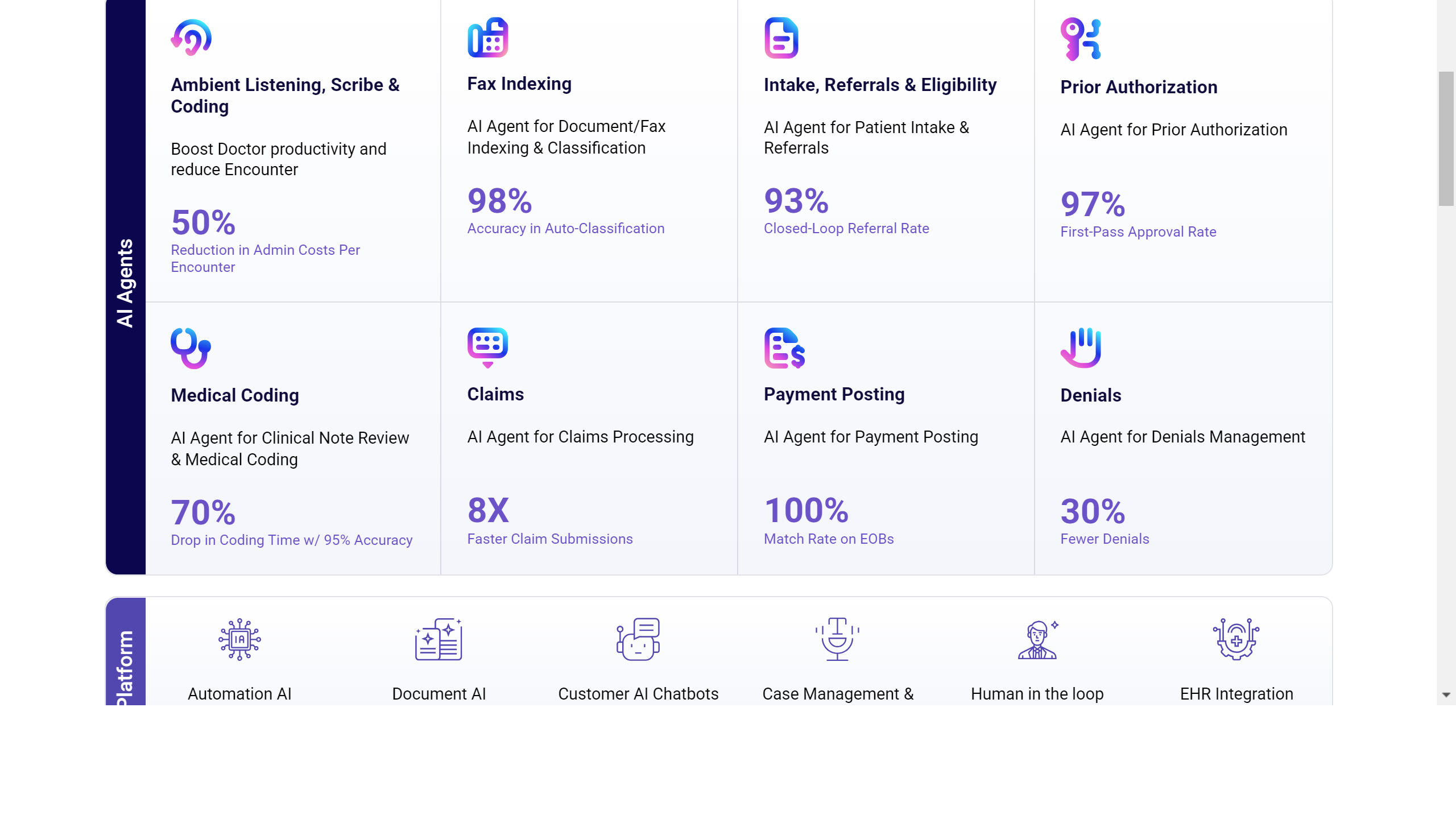
The eight RCM AI agents each handle a discrete stage of the revenue cycle. The eligibility verification agent logs into payer portals and retrieves coverage details without manual intervention. The claims agent validates fields and applies payer-specific rules before submission. The denials agent scans remittance advice and routes items to work queues automatically. The prior authorization agent fetches clinical documentation and submits via portals or EDI. The payment posting agent parses ERA and EOB files and matches payments to open invoices. Together, these agents cover the full billing arc from first patient contact through cash reconciliation.
The platform also integrates generative AI for document understanding, uses auto-learning models that improve through validation feedback, and offers outcome-based contracts with 90-day ROI guarantees. HIPAA, SOC 2 Type 1, and PCI DSS certifications are built into the compliance posture rather than offered as add-ons.
Use cases
Healthcare revenue cycle management
Healthcare organizations use OpenBots' eight specialized RCM agents to automate end-to-end billing workflows. KMH Cardiology processes 55,000 fax pages monthly, with the platform handling referral coordination and patient intake while maintaining HIPAA compliance. CEO Zia Bhutta stated at the March 2025 launch: "By eliminating manual inefficiencies and enabling real-time data insights, our solutions help healthcare organizations enhance their revenue cycles while improving patient engagement. The ROI is multi-fold including FTE savings, significant reduction in error rates and overall reduced revenue collection cycles."
Deloitte analysis cited by OpenBots estimated that automating scheduling tasks alone saves 38 to 47% of time, equivalent to 700 to 870 hours per year per scheduler. That figure gives context for the scale of efficiency gains available in RCM workflows before touching claims or denials.
High-volume document processing
Healthcare systems implement OpenBots for processing large volumes of unstructured documents including faxes, medical records, and insurance forms. The platform claims 98% accuracy in auto-classification and a 50% reduction in administrative costs through AI-enhanced document understanding. These figures are vendor-reported and carry no independent verification.
Banking and financial services integration
Gabriel Skelton, OpenBots' Director of Banking, Mortgage, and Insurance, notes that banks running core systems like FIS, Fiserv, or Jack Henry use the platform to move data between sub-applications that do not share native integrations. The platform claims 100% accuracy in financial data processing for these workflows. OpenBots holds PCI DSS certification for this segment, positioning it alongside healthcare as a second regulated-industry vertical.
Technical specifications
| Feature | Specification |
|---|---|
| Platform type | Healthcare-focused agentic AI platform |
| Licensing model | Zero-bot license, consumption-based pricing |
| AI agents | 8 specialized healthcare RCM agents |
| Document volume | 55,000+ pages monthly (KMH Cardiology) |
| Accuracy claims | 98% auto-classification, 50% cost reduction (vendor-reported) |
| Compliance | HIPAA, SOC 2 Type 1, PCI DSS |
| Pricing model | Outcome-based with 90-day ROI guarantees |
| Target industries | Healthcare RCM, banking, regulated industries |
| Market recognition | Everest Group "Major Contender" (2022); QKS SPARK Matrix inclusion (Q4 2025) |
| AI integration | GPT-based generative AI for document understanding |
Resources
- Website
- AI Agents for Healthcare RCM
- Platform Overview
- PitchBook Company Profile
Company information
Headquarters: Edison, New Jersey, United States (505 Thornall St, Edison, NJ 08837)
Founded: 2020
Founder: Ashish Nangla
CEO: Zia Bhutta
Employees: approximately 51, across three continents
Funding: $20M total ($15M Series A in May 2022)