Checkbox AI: Legal Workflow Automation Platform
On This Page
Australian legal AI company that automates in-house workflows through its "AI Legal Front Door" platform, serving over 100 enterprise organizations.
Overview
Checkbox started as a general no-code automation platform and has since narrowed to a single thesis: in-house legal teams lack a unified intake layer, and that gap is large enough to build a category around. In January 2026, the company raised $23 million in Series A funding led by Touring Capital, with co-investment from Peak XV (formerly Sequoia Capital India), Conductive Ventures, Tidal Ventures, and Five V Capital, valuing the company at over $100 million. This follows a $6.3M pre-Series A in 2022 and a $1.77M angel round in 2018 after two years of bootstrapping. Note: SmartCompany reports $35M for the same round; Checkbox's own press release cites $23M. The discrepancy is unresolved and should be verified before publication.
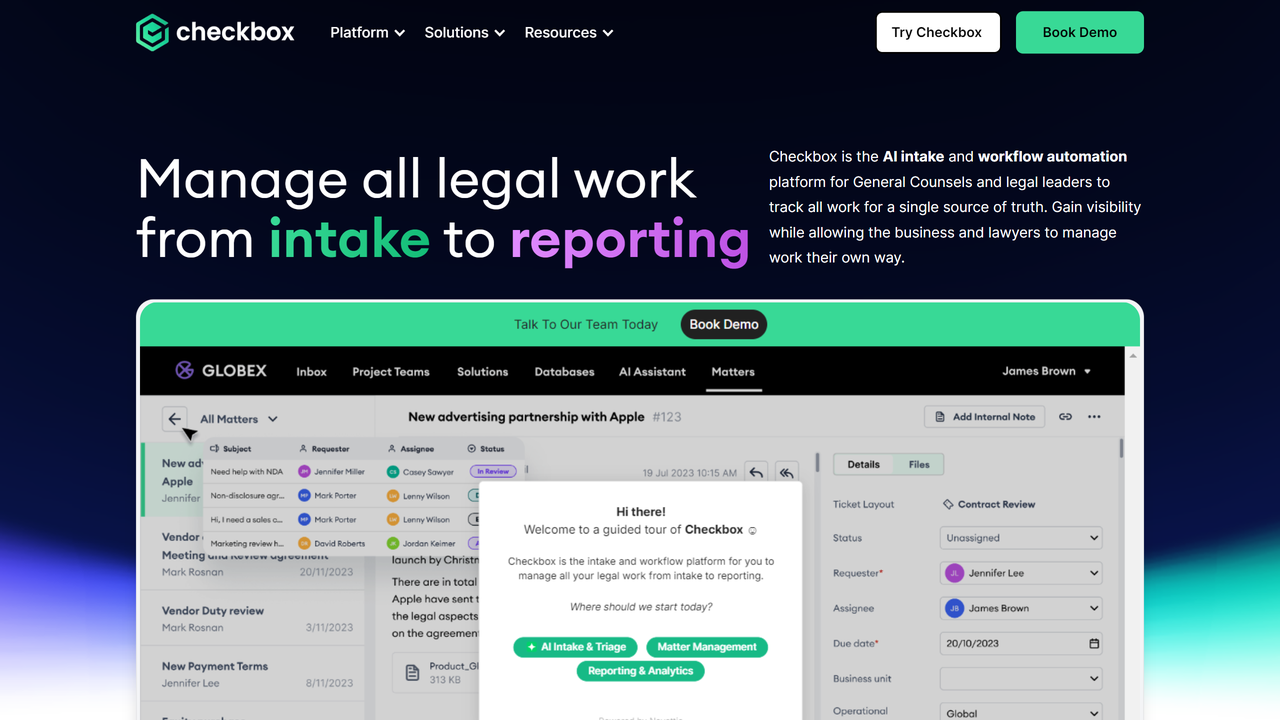
The AI Legal Front Door platform captures requests arriving through email, Slack, Microsoft Teams, Salesforce, and intranet portals, classifies them, routes routine work to AI-driven self-service, and escalates complex matters to legal team specialists. Evan Wong, Co-founder and CEO, frames the core problem as teams "operating in the dark," lacking visibility into demand, workload, or cycle times. James Han, Co-Founder and CPO, describes the platform's deeper goal as converting recurring expertise into reusable institutional knowledge that AI can then apply at scale, reducing dependency on outside counsel.
Checkbox serves over 100 enterprise organizations including SAP, PepsiCo, Hitachi, Telstra, Woolworths, Coca-Cola, Macquarie Group, Xero, and Invisalign. The company was named in Gartner's 2025 Hype Cycle for Legal Tech, though the specific positioning tier is not disclosed in any source reviewed. Evan Wijaya, Principal at Touring Capital, frames Checkbox as "a purpose-built orchestration layer that makes it possible to capture, manage, and automate legal work end-to-end," positioning it against general-purpose workflow tools rather than AI point solutions. Angel participation from Jerry Ting, VP Head of Agentic AI at Workday and former Co-Founder and CEO of Evisort (acquired by Workday in 2024), adds credibility within the legal AI consolidation trend.
Alongside the funding announcement, Checkbox launched a free tier allowing legal teams to build their first AI intake agent at no cost at checkbox.ai/ai-agent. This is a product-led growth move targeting operations teams who may lack budget authority for enterprise procurement.
IDP positioning note: Checkbox operates at the intake and triage layer of document-heavy workflows. This overlaps with document capture and routing capabilities, but the platform is primarily a workflow orchestrator. No source confirms a dedicated OCR, extraction, or document intelligence engine beneath the AI agents. Buyers evaluating Checkbox as an IDP replacement should verify what document processing capabilities sit below the intake layer.
How Checkbox AI processes documents
Checkbox does not publish a detailed technical architecture for its document processing layer. Based on available sources, the platform handles documents as part of a broader request workflow rather than as a standalone extraction engine.
Requests arrive through multiple intake channels: email, Slack, Microsoft Teams, Salesforce, and intranet portals. The AI Legal Front Door captures and classifies each incoming request, then routes it along one of two paths. Routine matters, including contract drafting, conflict-of-interest approvals, and standard compliance queries, go to AI-driven self-service workflows built on OpenAI GPT integration. Complex matters escalate to legal team review. A no-code workflow builder lets operations teams design and modify these routing rules without IT involvement.
The institutional knowledge layer is the platform's stated differentiator. Recurring decisions and expertise are encoded into reusable AI workflows, so the platform improves as more requests are processed. An analytics dashboard surfaces workload, demand, and cycle time metrics, providing the visibility layer that Wong identifies as the primary gap in current legal operations.
What the platform does not disclose: the OCR or extraction engine handling document content within workflows, accuracy metrics for document classification, or processing volume benchmarks. The 83% automation figure at Hitachi covers routine compliance requests broadly, not document extraction accuracy specifically. Buyers requiring document-level extraction performance data should request it directly from Checkbox.
Use cases
Enterprise legal operations
The clearest published outcome is Hitachi's deployment: 83% of routine compliance requests are now partially or fully automated, stood up in months with minimal IT support. Jeannine Moran, Director of Legal Operations at Hitachi, stated: "Tech implementations often fall short of expectations, but Checkbox really surprised us and exceeded our expectations. Usually, you're relying on IT and it would be a multi-year initiative to stand up something as robust as the legal front door but with Checkbox, we were able to do it in just months with minimal IT support."
No baseline automation rate before Checkbox is published, and no head-to-head comparison against competing platforms is available. The 83% figure is a single customer case study; buyers should request comparable data from their own industry segment before treating it as a benchmark.
Legal service management
Checkbox targets the structural problem of work volume growing faster than team headcount. The platform's intake layer consolidates requests that currently arrive fragmented across email, Slack, Teams, and portals, giving operations teams their first unified view of demand. Workflow automation covers contract drafting, conflict approval, and legal routing. The no-code builder is designed so operations staff, not IT, own the workflow configuration.
Unlike Kira Systems, which focuses on contract analysis and extraction, or iManage, which centers on document management and storage, Checkbox positions itself at the demand intake layer: capturing and triaging work before it reaches document review. This makes it a complement to extraction-focused tools rather than a direct replacement. Litera and Zuva address contract intelligence at the content level; Checkbox addresses the workflow layer above it.
The free tier at checkbox.ai/ai-agent targets operations teams who want to self-onboard without a procurement cycle, consistent with the no-code, minimal-IT-support positioning across the enterprise customer base.
"We've seen tremendous demand for the Legal Front Door and the market is really resonating with how we've uniquely solved this problem. Our customers go from operating in the dark and spending time on things they shouldn't be, to working on what matters and getting visibility into demand, workload, and cycle times." Evan Wong, Co-founder and CEO, Checkbox AI
Technical specifications
| Feature | Specification |
|---|---|
| Deployment options | Cloud (SaaS), Enterprise |
| AI integration | OpenAI GPT, custom AI agents |
| Request channels | Email, Slack, Microsoft Teams, Salesforce, intranet portals |
| Workflow automation | Contract drafting, conflict approval, legal routing |
| Implementation time | Months (vs. multi-year for traditional legal tech) |
| IT requirements | Minimal IT support needed |
| Enterprise scale | 100+ organizations including SAP, PepsiCo, Hitachi, Telstra, Woolworths |
| Market recognition | Gartner 2025 Legal Tech Hype Cycle (specific tier not disclosed) |
| Pricing | Free tier (first AI intake agent); enterprise pricing not published |
| OCR / extraction engine | Not disclosed in any source reviewed |
| Document processing benchmarks | Not published; 83% automation rate at Hitachi covers request routing, not extraction accuracy |
Resources
- Company website
- Series A announcement
- Free AI intake agent
- Artificial Lawyer coverage
- Axios enterprise software coverage
- Legal document automation guide
- Document workflow automation guide
- Integration and workflow capabilities
- Kira Systems
- iManage
- Litera
- Zuva
Company information
Checkbox AI Sydney, Australia (CEO Evan Wong based in New York) Founded: 2018 Website: checkbox.ai
Leadership: Evan Wong (Co-founder, CEO), James Han (Co-Founder, CPO)
Funding history:
- 2018: $1.77M angel round
- 2022: $6.3M pre-Series A (Tidal Ventures, Sequoia India Surge)
- January 2026: $23M Series A led by Touring Capital (co-investors: Peak XV, Conductive Ventures, Tidal Ventures, Five V Capital; angel: Jerry Ting, VP Agentic AI at Workday, former CEO of Evisort). Note: SmartCompany reports $35M for the same round; discrepancy unresolved.