Buildsimple: German IDP Platform for Insurers and Banks
On This Page
- Overview
- How Buildsimple processes documents
- Deployment and data location
- Security and compliance
- Use cases with customer-reported outcomes
- Credit document pipeline at DFKP
- Inbound mail at DMB Rechtsschutz
- Vendor-reported scale
- Technical specifications
- Resources
- How this profile was made
- Company information
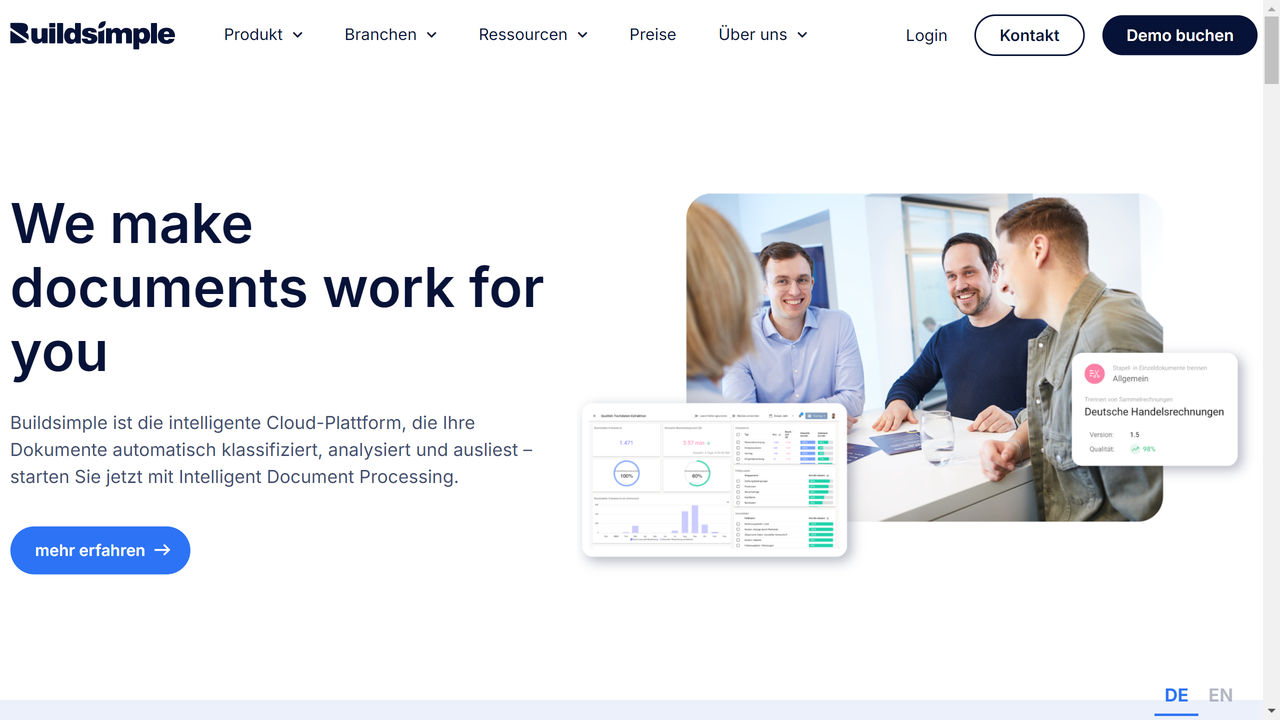
Buildsimple is a document processing platform built by ISR Information Products AG at its Münster site and used in regulated industries such as insurance and banking.
Overview
Buildsimple separates, classifies and extracts data from incoming documents and routes the results into downstream processes. It runs as a SaaS platform on Amazon Web Services or, with Edge, on customer infrastructure. The product has been developed since 2017 by a business unit of ISR Information Products AG, a German IT services company founded in 1993 and majority-owned by CENIT AG since 2022. In July 2026, CENIT announced it would raise its stake from 74.9 % to 100 %. The company page names the Münster site at Am Mittelhafen 14 as where the platform is developed. In a July 2025 talk, Buildsimple said 34 people worked on the product. Asked for a current headcount in October 2026, Buildsimple gave 250 for ISR as a whole and no figure for the product team.
buildsimple.com names insurance, banking and public administration as its main sectors, with industry, logistics, healthcare and retail as further fields. In February 2025, d.velop announced an integration of Buildsimple's models into its content services platform, and UMT AG uses Buildsimple as the extraction stage of its UMS Vision AI pipeline.
Other IDP vendors based in Germany include inovoo, Insiders Technologies and Konfuzio.
Three-minute product tour, published by ISR in August 2025:
 Click to load video from YouTube
How Buildsimple processes documents
The platform combines page separation, classification, data extraction, validators, master data matching, anonymisation and human-in-the-loop review. Pipelines connect these steps and can pull documents directly from e-mail inboxes. Dashboards track quality per document class.
Buildsimple trains its own machine learning models first and adds large language models where those models fall short. In a July 2026 post, the company described a target split of roughly 80 to 20 between small specialised models for bulk documents and LLMs for difficult cases. In the July 2025 talk, Buildsimple said it does not train its own LLM; the AWS case study lists Amazon Bedrock among the services used.
In the same talk, Buildsimple said it trains customer models from 20 examples per document class. According to Buildsimple's written answers, customers can train models on their own documents, buy models pretrained by Buildsimple or by other customers and train them further, start from openly available foundation models, or use LLMs without training. Buildsimple did not name the LLMs. DMB said it needed about 100 examples for the class court ruling and had to pick them out of lawyers' e-mails by hand.
Deployment and data location
| Option | What runs where (vendor description) |
|---|---|
| SaaS, standard | AWS Frankfurt (eu-central-1) |
| AWS European Sovereign Cloud | AWS region in Brandenburg; Buildsimple announced itself as launch partner in June 2026 |
| Buildsimple-Edge | Documents processed and stored in the customer's data centre or a sovereign German cloud; model training, pipeline maintenance, release and versioning stay central at Buildsimple |
The platform page says a SaaS setup can be moved to Edge "per Knopfdruck" (at the push of a button). Its FAQ adds that the concrete architecture is checked against each customer's requirements. In the June 2026 DFKP webinar, Buildsimple described the platform as SaaS only at that point, with Edge to follow later in the year. As of October 2026, the platform page lists Edge without a launch date; asked when Edge became generally available, Buildsimple said Edge has been generally available since around the middle of the year, without naming a month or the number of customers running it in production.
In written answers to idp-software.com, Buildsimple described the Edge data flows as follows. In production, documents, images, texts and extracted values stay on the customer side; only metadata for billing and the quality and volume dashboards goes to Buildsimple. If a customer trains its own models in the Buildsimple cloud, Buildsimple stores anonymised documents and trained models move between Buildsimple and the customer installation. Edge ships as Docker containers on Kubernetes and is updated from a container registry. In the same answers, Buildsimple said that all its models run in AWS data centres in Frankfurt. The answer did not say whether this also applies to Edge installations. Buildsimple said the EU Cyber Resilience Act affects Edge the same way as the SaaS product, and that if it can demonstrate compliance for Buildsimple, compliance for Edge follows automatically.
Security and compliance
ISR holds an ISO/IEC 27001:2022 certificate (PDF) issued by infaz (Neuss). Its scope names the Buildsimple business unit explicitly, covering development, support, operation and hosting. The certificate is valid from 12 February 2025 to 6 March 2027; ISR was first certified in 2021. ISR's separate ISO 9001 certificate (PDF) covers application management and IT operations, not Buildsimple.
In July 2026 Buildsimple passed the AWS Foundational Technical Review and carries the AWS Qualified Software badge. According to Buildsimple's post, the review checks a subset of AWS Well-Architected practices for security, reliability and operational excellence.
The compliance page also lists BSI C3A and the Hiroshima AI Process. C3A (Criteria enabling Cloud Computing Autonomy) is a criteria catalogue published by Germany's Federal Office for Information Security (BSI); the page says Buildsimple summarised its implementation of the criteria in its own position paper for prospects. For the Hiroshima AI Process, the page says Buildsimple follows the framework and documents its handling of AI risks, information security and human review.
Buildsimple sent idp-software.com that paper (version 1.1, seven pages, issued by ISR). It is Buildsimple's own assessment of the SaaS offering, not of Edge; Buildsimple has not provided an audit report or attestation. The paper itself says providers can prove compliance through a (customer) audit. Buildsimple marks most criteria as met; the points below are the exceptions and qualifications.
- Control by an EU and German company is marked as met, with the note that this applies to Buildsimple, not to AWS.
- Data storage and processing: AWS eu-central-1, Frankfurt. Hardware inventory and hardware suppliers are marked as not applicable because AWS provides the hardware; export-control risks are referred to AWS.
- Not met (both are additional criteria): a stateless authentication model and granular log filtering, which has to happen on the customer side.
- Buildsimple says it runs its own security operations centre with staff in Germany and provides a software bill of materials (SBOM).
- Capacity management is described as following C5, the BSI cloud security catalogue; the paper does not claim a C5 attestation for Buildsimple.
The compliance page lists TLS 1.3 in transit, AES-256 at rest, client-side encryption, bring your own key, tenant isolation and deletion of documents immediately after processing. Training data is the exception: in the DMB talk, Buildsimple said it keeps customers' training data to train new model versions. AWS EMEA SARL is the listed subprocessor. According to Buildsimple, access to customer documents is limited to a few developers named in an authorisation concept and only when the customer asks, for example to fix a processing error. See also security and compliance capabilities.
Use cases with customer-reported outcomes
Credit document pipeline at DFKP
DFKP (Deutsche Firmenkredit Partner) is a German broker of business loans for mid-sized companies. In a June 2026 webinar on the Buildsimple channel, DFKP product manager Maximilian Dassler described the project. Before Buildsimple, a case with many documents took 30 to 40 minutes in the median; after the rollout it took about 2 minutes.
Dassler summarised the results as over 85 % straight-through processing for individual document types, 70 % time saved compared with the manual process, staffing for the task down from two to three full-time employees to between half and one, about 60 % fewer errors, and three times the document volume with the same team. He did not say how the 70 % relates to the drop in median handling time. These are DFKP's own figures; the webinar was hosted by Buildsimple.
Inbound mail at DMB Rechtsschutz
In a July 2025 talk on the d.velop channel, Mario Dederichs, IT lead at DMB Rechtsschutz-Versicherung, described a project covering about 160,000 documents a year, archived in d.velop. DMB signed with Buildsimple in January 2025 after its previous IDP vendor went bankrupt. The project grew from 51 to about 70 document classes. At the time of the talk, DMB's target of over 90 % classification accuracy was "close" but not yet reached.
Vendor-reported scale
In an AWS case study, Buildsimple reports more than 400 customers, peaks of 2 million documents a day and more than 3,500 models in production. AWS publishes these figures as supplied by the vendor; they have not been independently verified. In its written answers in October 2026, Buildsimple gave 400 customers. In July 2025, it had spoken of more than 200 customers.
Technical specifications
| Feature | Specification |
|---|---|
| Deployment | SaaS on AWS (Frankfurt), AWS European Sovereign Cloud (Brandenburg), Buildsimple-Edge (processing on customer infrastructure, training at Buildsimple) |
| Pricing | Price on request; monthly, annual or multi-year contracts |
| Core functions | Page separation, classification, extraction, validators, master data matching, anonymisation, human-in-the-loop |
| AI approach | Own ML models first, LLMs for difficult cases |
| Integrations | API, e-mail inboxes, d.velop, UMT UMS Vision AI |
| Sectors | Insurance, banking, public administration; also industry, logistics, healthcare, retail |
| Certifications | ISO/IEC 27001:2022 (ISR, scope includes Buildsimple), AWS Qualified Software |
| Vendor-listed frameworks | BSI C3A (Buildsimple's own position paper on the SaaS offering; no third-party audit report provided), Hiroshima AI Process |
| Languages | German, English |
Resources
- Buildsimple platform and Edge
- Buildsimple security and compliance page
- ISR ISO/IEC 27001:2022 certificate (PDF)
- Webinar with DFKP
- DMB Rechtsschutz talk on the d.velop channel
- Seven-minute product demo on the Buildsimple channel
- AWS case study (vendor-supplied figures)
- d.velop partnership announcement
- UMT AG partnership announcement
How this profile was made
Christopher Helm wrote this profile from public sources and, where marked, from written answers and a position paper supplied by Buildsimple. Buildsimple asked for corrections to an earlier version in October 2026 and answered follow-up questions in writing. Buildsimple has not approved this version. Corrections were applied where a source supported them. Statements that only Buildsimple can make are marked as Buildsimple's; open questions went back to the company.
Company information
Buildsimple, Am Mittelhafen 14, 48155 Münster, Germany
Legal entity: ISR Information Products AG, Hintern Brüdern 23, 38100 Braunschweig (HRB 5191, Registergericht Braunschweig)
Board of ISR: André Vogt (spokesman), Manfred Merßmann
Senior Executive Manager Buildsimple: René Weseler
Phone: +49 (531) 1208-0
Email: info@buildsimple.de
Web: buildsimple.com