Docsumo: IDP Platform for Financial Services
On This Page
Docsumo is a cloud-based intelligent document processing (IDP) platform built for financial services, lending, healthcare, and logistics teams that need validation-heavy workflows, not just extraction. Founded in 2019 in Mumbai by Bikram Dahal and Rushabh Sheth, the platform combines AI extraction, cross-document validation, case management, and workflow orchestration in a single system.
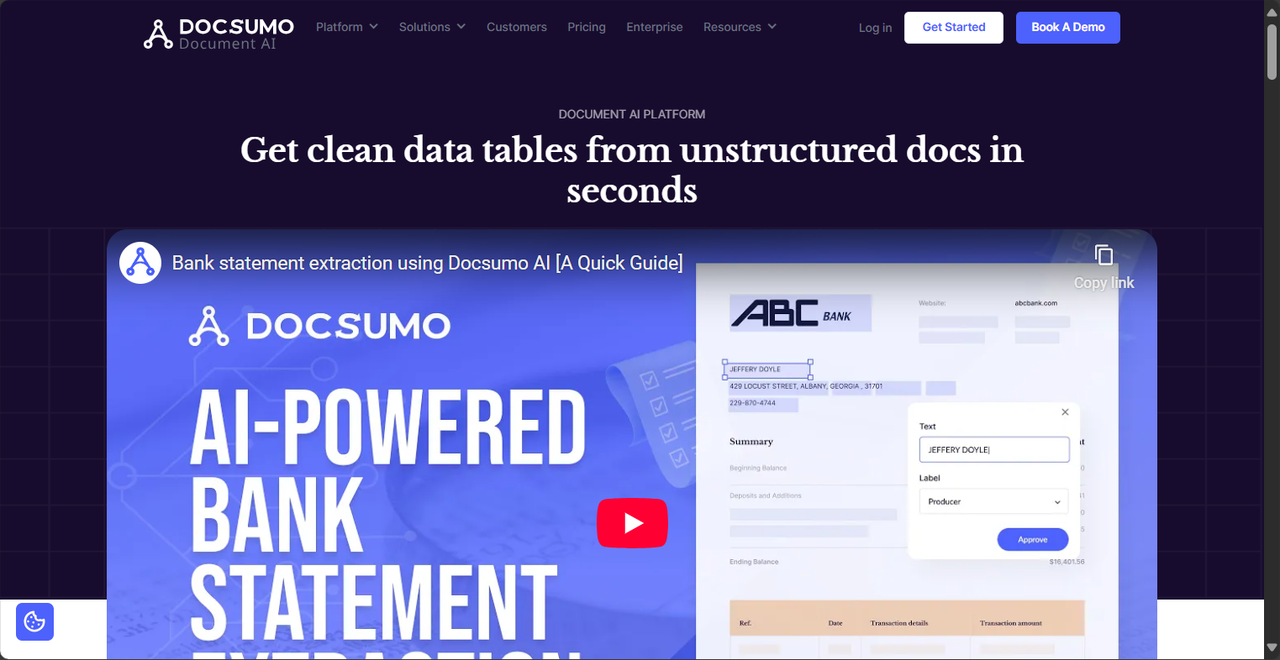
How Docsumo intelligent document processing works
Docsumo's pipeline starts with multi-channel document intake (email, API, cloud drives, direct upload) and routes each document through a combination of traditional OCR and large language model (LLM) layers. The OCR layer handles text extraction and layout preservation; the LLM layer resolves contextual ambiguity, classifies document sections, and validates field relationships across multiple documents in a single transaction.
The result is processing times under 20 seconds for complex documents that previously required 20 or more minutes of manual review. Lido.app reports Docsumo achieves 98.5% accuracy on its supported financial document types: bank statements, invoices, pay stubs, tax returns, and loan applications. V7Labs groups Docsumo with Hyperscience, Rossum, and V7 Go in the 95-99% accuracy band for complex enterprise documents, though neither figure carries independent verification.
Where Docsumo differentiates from extraction-only tools is in exception handling. Third-party analyst Sagnik Chakraborty noted in March 2026: "We have seen teams deploy a 99%-accurate OCR engine, only to discover that extracted data still required manual review." Docsumo's case management layer routes exceptions to human reviewers with structured queues, validation rules, and audit trails. The math matters: a 15% exception rate on 10,000 monthly documents equals roughly 100 hours of manual work per month at four minutes per review. Faster exception routing directly reduces that burden.
As of March 2025, Docsumo reported ₹8.14 crores ($963K) in annual revenue with 34 employees, ranking 56th among 1,220 document automation competitors. The $3.5 million seed round raised in January 2023, led by Common Ocean with participation from Fifth Wall and Arbor Realty Trust, signals deliberate vertical focus on real estate and financial services rather than horizontal expansion.
What users say
User satisfaction metrics are consistently positive. Docsumo holds a 95% satisfaction rating on SelectHub (ranked 33rd in accounts payable software) and a 4.3/5 on GetApp. Infoseemedia.com noted in March 2026 that Docsumo, alongside Rossum and Nanonets, "often lead on ease of setup, API-first usage, and high accuracy out of the box for invoices and financial documents."
Practitioners consistently flag two limitations. First, Docsumo requires configuration when implementing document types outside its core financial set. Second, pricing transparency lags some competitors, though Lido.app confirmed a $25/month entry point with a free tier for testing. Teams with lightweight, low-volume use cases report the platform feels overpowered for their needs. The platform is built for validation-heavy, high-volume operations; teams without that complexity may find simpler tools sufficient.
How Docsumo handles workflows
Docsumo's workflow layer handles the full document lifecycle from intake to structured output. Pre-built connectors cover ERP systems and loan origination systems (LOS), reducing integration time for lending and financial services teams. The human-in-the-loop review interface surfaces exceptions with field-level confidence scores and validation rule failures, so reviewers act on flagged items rather than re-reading entire documents.
Cross-document validation is the capability that separates Docsumo from single-document extraction tools. A mortgage application, for example, involves a loan application form, bank statements, pay stubs, and a property appraisal. Docsumo validates field consistency across all four documents in a single workflow pass, flagging discrepancies before the file reaches an underwriter. This is the core use case for Arbor Realty Trust, one of Docsumo's seed investors and a production customer.
Sagnik Chakraborty summarized the positioning in March 2026: "Docsumo combines AI extraction, cross-document validation, case management, and workflow automation to support both mid-market and enterprise teams handling high-volume document operations." The caveat he added is equally important: "The real question is whether the tool fits your workflow complexity."
Use cases
Mortgage and lending automation
Real estate lenders process loan applications, income verification documents, bank statements, and property appraisals through a single Docsumo workflow. The platform extracts borrower data, validates income figures across pay stubs and bank statements, and flags discrepancies before underwriting review. Arbor Realty Trust's participation in Docsumo's seed round reflects production use in this segment. For teams evaluating alternatives with comparable focus on variable document structures in regulated industries, Acodis is a Swiss vendor worth comparing.
Complex letter and correspondence processing
National Debt Relief automated processing of complex letters that previously required over 20 minutes of manual review per document. With Docsumo, the same documents process in under 20 seconds with AI extraction, achieving 90%+ touchless automation on that document type.
Invoice and accounts payable automation
Finance teams extract vendor details, line items, tax amounts, and payment terms from supplier invoices, with automatic validation against purchase orders before export to accounting systems. Infoseemedia.com reports that invoice processing delivers the highest ROI of any IDP use case, with organizations reporting 60-80% cost reduction and 70-90% turnaround time reduction on mature implementations, and a 4-9 month payback window. Teams building LLM-native extraction pipelines for similar financial workflows may also evaluate Unstract, an open-source no-code LLM platform with hallucination mitigation. Financial services teams requiring outcome-based pricing may consider AmyGB, which targets similar BFSI document automation use cases.
Competitive position
Docsumo competes in the API-first SaaS segment of the IDP market alongside Nanonets and Rossum. Lido.app characterizes Docsumo as "narrower than competitors like ABBYY or Nanonets, but that focus means better accuracy on the document types they do cover." That trade-off is explicit: 98.5% accuracy on supported financial document types, but configuration required for documents outside that set.
V7Labs places Docsumo in the second-generation IDP category alongside Kofax, Hyperscience, and UiPath Document Understanding, distinguishing this generation from emerging agentic AI systems that use LLMs to handle unstructured documents without retraining. Docsumo's own marketing positions the platform as an agentic document workflow platform, though third-party evaluators consistently describe its core strength as validation workflow orchestration rather than zero-shot document understanding.
In April 2025, Docsumo published a self-authored OCR benchmark comparing its proprietary engine against Mistral OCR and Landing AI's Agentic Document Extraction, claiming sub-10-second processing per page and superior structure preservation. CEO Rushabh Sheth stated: "Our benchmark report validates our commitment to delivering a document processing solution that meets real-world needs. We are proud to lead with a product that not only extracts text accurately but also preserves the essence and structure of every document." The benchmark is vendor self-published with no independent verification; the Global Tech Times covered the release without independent testing.
For teams with limited budgets and developer-heavy implementation teams, Infoseemedia.com positions Docsumo and Nanonets as the most accessible entry points in the IDP market, more approachable than enterprise-focused platforms like UiPath or Automation Anywhere but with narrower feature depth than horizontal IDP suites like ABBYY.
Technical specifications
| Feature | Specification |
|---|---|
| Deployment | Cloud-based SaaS |
| Automation rate | 90%+ touchless processing |
| Processing speed | Under 20 seconds per complex document |
| Accuracy | 98.5% on supported financial document types (Lido.app, April 2026) |
| Supported formats | PDF, PNG, JPG, Excel, TIFF, TXT, email |
| API | RESTful API with webhooks |
| Security | SOC 2 Type 2, GDPR, HIPAA compliant |
| Authentication | SSO (SAML 2.0, OAuth 2.0) |
| Pricing | From $25/month; free tier available |
| Free trial | 14 days |
| User satisfaction | 95% on SelectHub, 4.3/5 on GetApp |
Resources
- Website
- API Documentation
- Integrations
- Lido.app IDP comparison
Company information
Headquarters: Mumbai, India (offices also in Kathmandu, Nepal) Founded: 2019 Founders: Bikram Dahal (CTO), Rushabh Sheth (CEO) Funding: $3.72 million total ($3.5M seed round, January 2023) Investors: Common Ocean (lead), Fifth Wall, Arbor Realty Trust, Better Capital, TechStars, Barclays Revenue: ₹8.14 crores ($963K) ARR as of March 2025 Employees: 34 Phone: +1 (929) 822-4166 Email: sales@docsumo.com
A 34-person Mumbai startup competing against enterprises with thousands of employees, Docsumo bets that vertical specialization in financial services document validation beats horizontal scale. The Arbor Realty Trust and Fifth Wall investor relationships are both strategic signals and production customer relationships, giving the company direct feedback loops from its primary target segment.