Holofin AI Financial Document Processing Platform
On This Page
Your document pipeline extracts the numbers, but nobody trusts them enough to stop cross-referencing the original PDF by hand.
Most IDP tools extract text. Few prove where each value came from. Holofin is a 2023 French startup combining fact grounding, a proprietary validation language called Hololang, and 70 forensic fraud detectors in a single platform. No analyst firm has evaluated them. Every accuracy number on this page is self-reported. The architecture is interesting; the question is whether an unproven vendor is worth the risk.
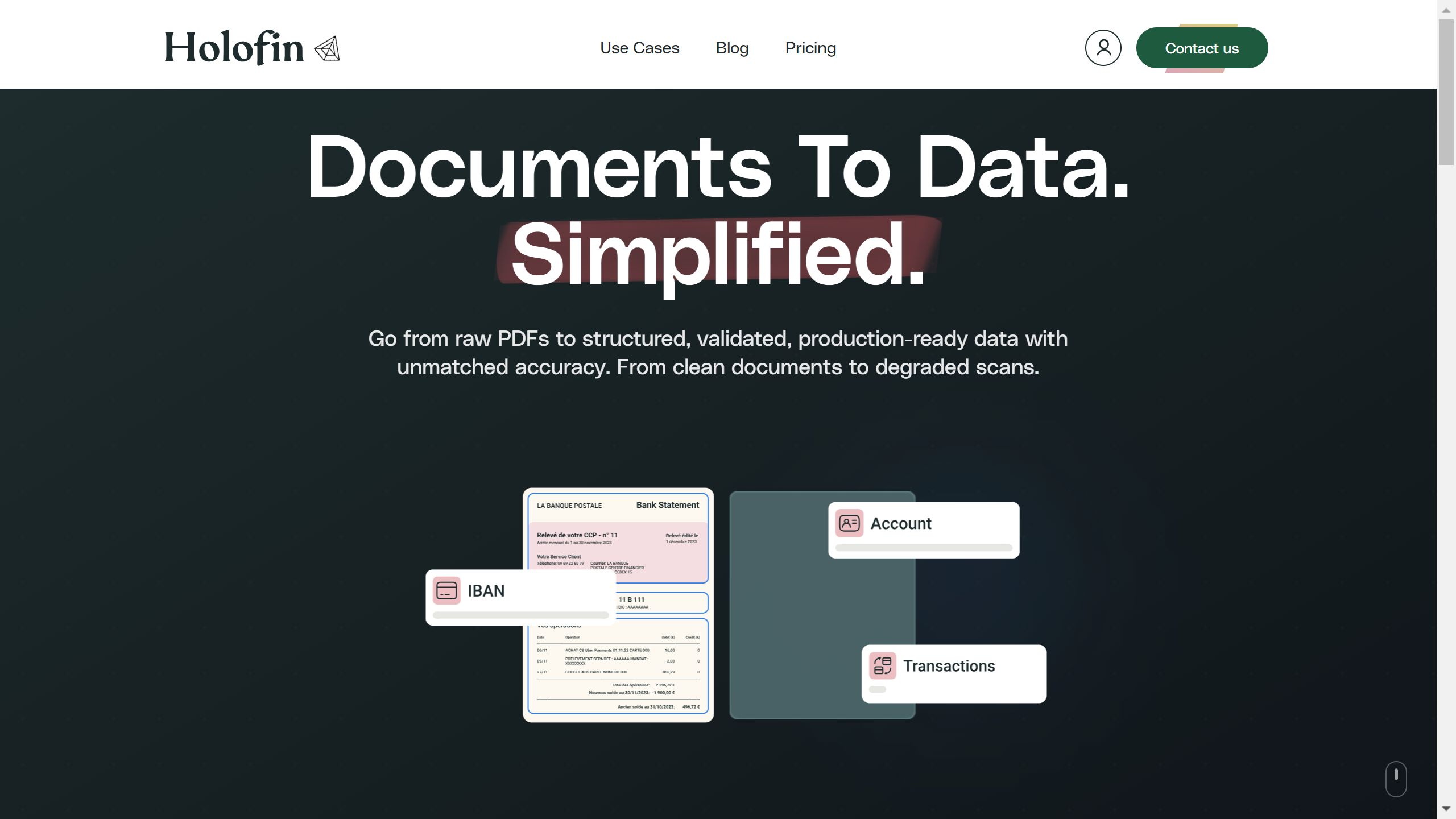
Holofin's core differentiator is "fact grounding": every extracted value maps to bounding box coordinates on the source page. An auditor clicks a number and sees exactly where it originated. The company also built Hololang, a DSL where validation rules written in plain English get converted to executable checks automatically. Both features are unusual in the IDP market. But no independent verification exists for any of the claimed capabilities.
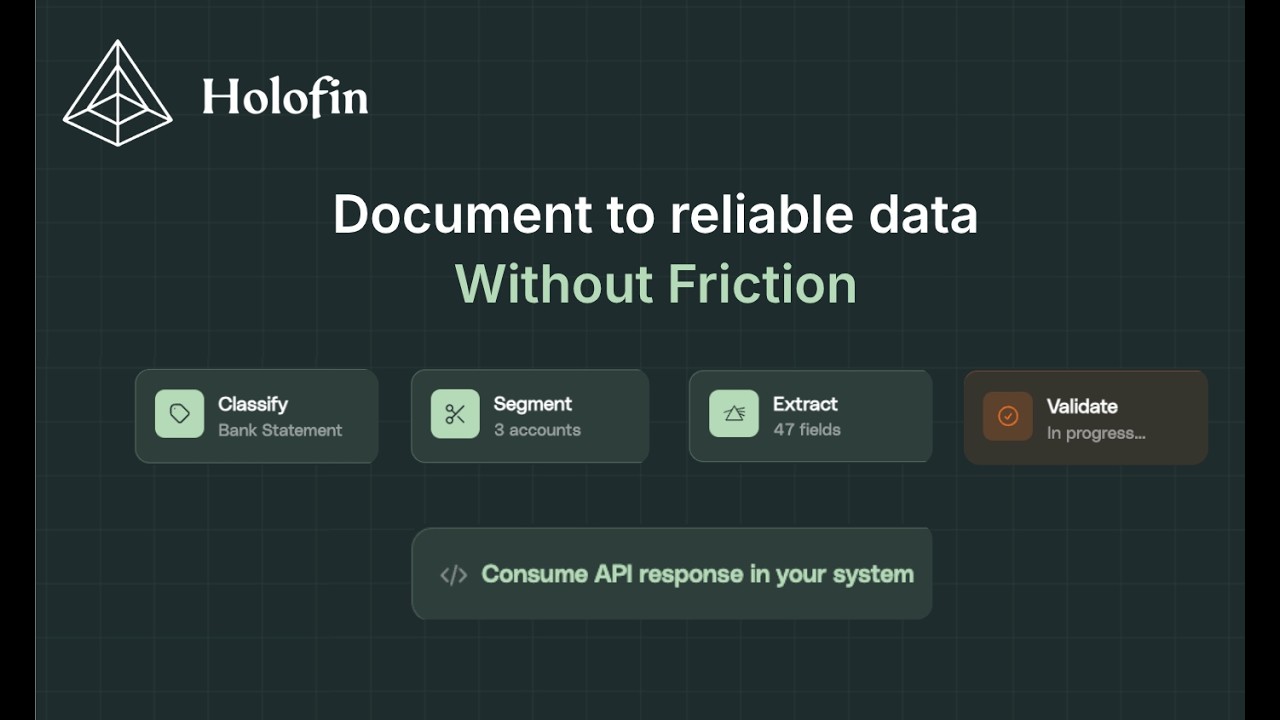
The pipeline runs four sequential passes: OCR, vision-language model layout analysis, fine-tuned structured extraction, then an agentic correction layer that retries failures autonomously. A 50-page bank statement gets split into parallel segments processed simultaneously, with results cross-validated after merging. The agentic layer is the newest component. Holofin's 97%+ accuracy claim for financial documents rests entirely on this four-stage architecture working as described.
Holofin targets five verticals: bank statement processing with balance equation validation, financial report analysis, healthcare workflows with HIPAA and HDS compliance, real estate lease extraction, and standalone PDF fraud detection using 70 forensic detectors. The fraud module runs before extraction, flagging tampered documents before bad data enters your system. Each vertical uses the same core pipeline. Whether one platform handles all five with equal depth is the open question.
Holofin claims 95%+ extraction accuracy zero-shot, 97%+ on financial documents, 98%+ classification across 100+ document types, ~40 second processing time, and 99.9% uptime. All self-reported. Exports to SAP, Oracle, Sage, QuickBooks, Xero, Snowflake, Salesforce, and Dynamics 365. GDPR, ISO27001, and HDS certified. Custom document types deploy via JSON schema without retraining. For a 2023 startup, the integration list is ambitious. No public customer references validate any of these numbers.
Holofin SAS, founded 2023, headquartered in France. No funding rounds, named customers, or revenue figures are public. No analyst firm has evaluated the company: not Gartner, not IDC, not Everest Group, not Forrester. The EU base and HDS certification address European data residency, but the company's track record is unverifiable from public sources. Buying Holofin today means betting on the technology before the market has validated the vendor.
Page contributed by Gregory Tappero.
Holofin combines fact grounding, visual classification, a proprietary validation language, and forensic fraud detection into a single IDP platform targeting financial services, healthcare, and real estate.
 Click to load video from YouTube
Overview
Holofin operates an IDP platform combining computer vision, vision-language models, and agentic AI for document processing. The company differentiates through three proprietary components: fact grounding that links every extracted value to its source location with bounding box precision, a "Hololang" validation DSL (domain-specific language) that converts plain-English rules into executable checks, and HoloRecall, a visual classification system that learns from validated examples rather than text descriptions alone.
The platform includes PDF fraud detection running 70 independent forensic detectors across 6 domains: content, typography, metadata, structure, media, and security. Cross-domain corroboration between detectors is claimed to reduce false positives compared to single-domain approaches. Each document receives a risk score with human-readable findings.
Holofin targets production-scale deployments processing 100K+ documents monthly with a 99.9% uptime SLA. It competes in the agentic document processing category alongside Reducto, Extend, and Klippa DocHorizon, where vendors are shifting from pure extraction toward end-to-end workflow automation. The focus on financial services, healthcare, and real estate addresses accuracy-critical sectors requiring traceability and audit trails for regulatory compliance.
All performance metrics on this page are vendor self-reported. As Lido's March 2026 analysis notes: "Any vendor claiming 100% accuracy on real-world documents is measuring on clean test sets." No independent benchmarks or analyst coverage from Gartner, IDC, or Everest Group existed as of April 2026.
How Holofin AI Financial Document Processing Platform Processes Documents
Holofin's multi-pass processing pipeline runs four sequential stages. Traditional OCR handles initial text extraction. Vision-language models then perform layout recognition, identifying text blocks, titles, and tables as semantic regions rather than raw character sequences. Fine-tuned models convert those regions into structured output. A final agentic correction pass deploys autonomous agents that reason about extracted data, detect inconsistencies, and automatically retry with adjusted strategies when validation fails.
The architecture supports parallel processing of multi-segment documents. Holofin's own example describes a 50-page bank statement split into 5 segments handled by five simultaneous extractors, with results merged and cross-validated after completion. This agentic document processing approach aligns with the broader industry shift toward autonomous pipeline orchestration. Three capabilities enabled the category's emergence: large vision models understanding spatial relationships, multi-step reasoning in language models for workflow planning, and tool use allowing agents to call different extraction methods, as documented in Lido's March 2026 analysis.
Fact grounding technology links every extracted data point to its exact source location on the page using bounding box coordinates. For regulatory workflows, this means an auditor can click any extracted value and see exactly where on the original document it originated, satisfying traceability requirements without manual cross-referencing.
The proprietary Hololang DSL enables financial validation rules written in natural language (for example, "Check that the SIRET number is valid"), which AI converts to executable validation code automatically. Hololang supports balance checks, format constraints, date assertions, and cross-field logic. A concrete syntax example from the vendor: ASSERT @start + SUM(@credits[]) - SUM(@debits[]) == @end WITHIN 0.01, verifying that opening balance plus credits minus debits equals the closing balance within a one-cent tolerance. This purpose-built validation language is unusual in the IDP market, where most competitors rely on generic business rules engines.
The system handles advanced document segmentation, splitting multi-document files by any field: IBAN, patient ID, property address, case number, tracking number. Intelligent boundary detection handles multiple sections on the same page. Custom extraction schemas support any document type using full JSON schema definitions (nested objects, arrays, conditionals), deployable without model retraining.
A full audit trail tracks every mutation. Corrections, additions, and deletions are recorded with user attribution, timestamps, before/after values, and source coordinates. This mutation history is available both in the UI and via API export.
One operational constraint worth noting: the multi-pass approach introduces 5-15 seconds of latency per page, compared to under 1 second for single-pass OCR. Per-document costs also scale with complexity and are difficult to predict in advance. Simple invoices may require 2 passes while complex multi-page contracts may require 6 passes with multiple verification loops, according to Lido's category analysis. This makes agentic processing unsuitable for real-time applications but well-suited to batch workflows where accuracy outweighs speed.
Use Cases
Bank statement processing
Financial institutions deploy Holofin for production-scale bank statement processing with 95%+ extraction accuracy through multi-pass validation. The platform's fact grounding capabilities provide audit trails linking extracted transaction data to source locations, meeting regulatory traceability requirements. Before extraction, optional PDF fraud analysis can flag tampered or AI-generated documents using 70 forensic detectors. Custom segmentation rules split combined multi-account statements by IBAN and period automatically, processing segments in parallel to reduce turnaround time. Hololang validation rules verify balance equations, date ranges, and format constraints (IBAN, SIRET) without code. Teams focused specifically on bank statement automation will find additional implementation context in the dedicated guide.
Financial report analysis
Holofin's table processing and Hololang validation DSL target complex financial reports where extraction errors compound across linked values. The system's agentic correction pass detects errors in extracted financial metrics while maintaining data lineage to source documents. Custom extraction schemas allow users to define any output structure via JSON schema and deploy instantly without retraining. HoloRecall visual classification achieves 98%+ accuracy across 100+ document types by learning from validated examples rather than relying solely on text-based class definitions. Acuity Knowledge Partners takes a comparable research-automation approach to financial document processing, serving 800+ institutions with agentic AI for structured data extraction from financial filings.
A key differentiator for multi-document financial workflows: agentic systems can process workflows spanning multiple documents, matching purchase orders to invoices to delivery receipts and flagging discrepancies, whereas traditional IDP processes each document independently. One accounts payable team reduced manual review rates from 40% to 4% after adopting an agentic approach, according to Lido's March 2026 analysis.
Healthcare document processing
Healthcare providers and payers use Holofin to automate patient intake, lab report extraction, claims processing, and prior authorization workflows. Manual handling of these document types creates bottlenecks in patient onboarding and claims adjudication cycles, where extraction errors carry compliance risk. The platform supports HIPAA compliance and holds HDS certification for hosting personal health data in EU datacenters.
Real estate document processing
Property managers and real estate professionals use Holofin for lease agreement extraction, tenant screening document processing, property record management, and maintenance tracking. These document types generate high volumes of repetitive extraction tasks where manual processing delays transaction closings. Teams evaluating purpose-built alternatives for this document type may also consider Evana.ai, which focuses specifically on AI-powered document management for real estate portfolios.
PDF fraud detection
Organizations use Holofin's forensic analysis to detect document tampering before extraction. 70 independent detectors scan across content, typography, metadata, structure, media, and security domains to identify white rectangle coverups, overlapping text blocks, AI-generated images, metadata inconsistencies, and structural anomalies. Cross-domain corroboration between detectors strengthens confidence in findings: a metadata anomaly that also triggers a typography flag carries more weight than either signal alone. Documents receive a risk score (Trusted / Normal / Warning / High Risk) with detailed findings. Vendors taking a comparable integrated approach to fraud detection alongside extraction include KlearStack, which combines forensic fraud detection with document processing for regulated industries.
Technical Specifications
| Feature | Specification |
|---|---|
| Document Types | Bank statements, invoices, financial reports, tax forms, medical records, insurance claims, lease agreements, ID documents, and any custom type via JSON schema |
| Input Formats | PDF, office documents, scanned images |
| Output Formats | JSON, CSV with fact grounding; exports to SAP, Oracle, Sage, QuickBooks, Xero, Excel, Google Sheets, Snowflake, Salesforce, Odoo, Dynamics 365 |
| Processing Pipeline | Multi-pass: OCR, VLM layout recognition, fine-tuned structured output, agentic correction with parallel processing and self-healing retries |
| Validation | Proprietary Hololang DSL with natural language rule authoring and AI-assisted conversion |
| Classification | HoloRecall visual fingerprinting with example-based learning; 98%+ accuracy across 100+ document types |
| Fraud Detection | 70 forensic detectors across 6 domains; cross-domain corroboration; risk scoring (Trusted/Normal/Warning/High Risk); AI-generated content detection |
| Segmentation | Custom split rules by any field (IBAN, patient ID, property address, etc.) with intelligent boundary detection; parallel segment processing |
| API | RESTful API with workflow builder |
| Scale | 100K+ documents monthly (self-reported) |
| Avg. Processing Time | ~40 seconds per document |
| Latency | 5-15 seconds per page (multi-pass); under 1 second for single-pass OCR |
| Uptime SLA | 99.9% |
| Claimed Accuracy | 95%+ extraction accuracy zero-shot (97%+ on common financial documents); all figures self-reported |
| Compliance | GDPR by design, ISO27001, HDS |
Resources
- Website
- PDFs Are For People, Not For Data, Why PDFs are drawing instructions, not structured data, and how Holofin's pipeline addresses the gap
- Your LLM Isn't a Document Pipeline, Why LLMs work best as arbitration components within deterministic pipelines, not end-to-end solutions
- HoloRecall: Show, Don't Tell, Visual fingerprint classification that learns from validated examples without retraining
- The Invisible Audit Trail, How mutation recording and spatial linking enable evidence-based verification
- Agentic Document Processing, Lido's March 2026 category analysis covering latency tradeoffs, cost unpredictability, and competitive landscape
Company Information
Holofin SAS (holofin.ai), founded 2023, headquartered in France. EU-based operations with HDS-certified infrastructure for hosting personal health data. No funding announcements, named customers, or independent analyst coverage have surfaced publicly as of April 2026.