Nanonets: IDP Software Vendor
On This Page
AI-powered document processing vendor offering OCR, workflow automation, and open-source tools for enterprise document operations. Named a Leader in Everest Group's 2026 IDP PEAK Matrix Assessment on April 15, 2026, alongside ABBYY, Hyperscience, Microsoft, and others. See the May 12, 2026 news brief for full context.
Overview
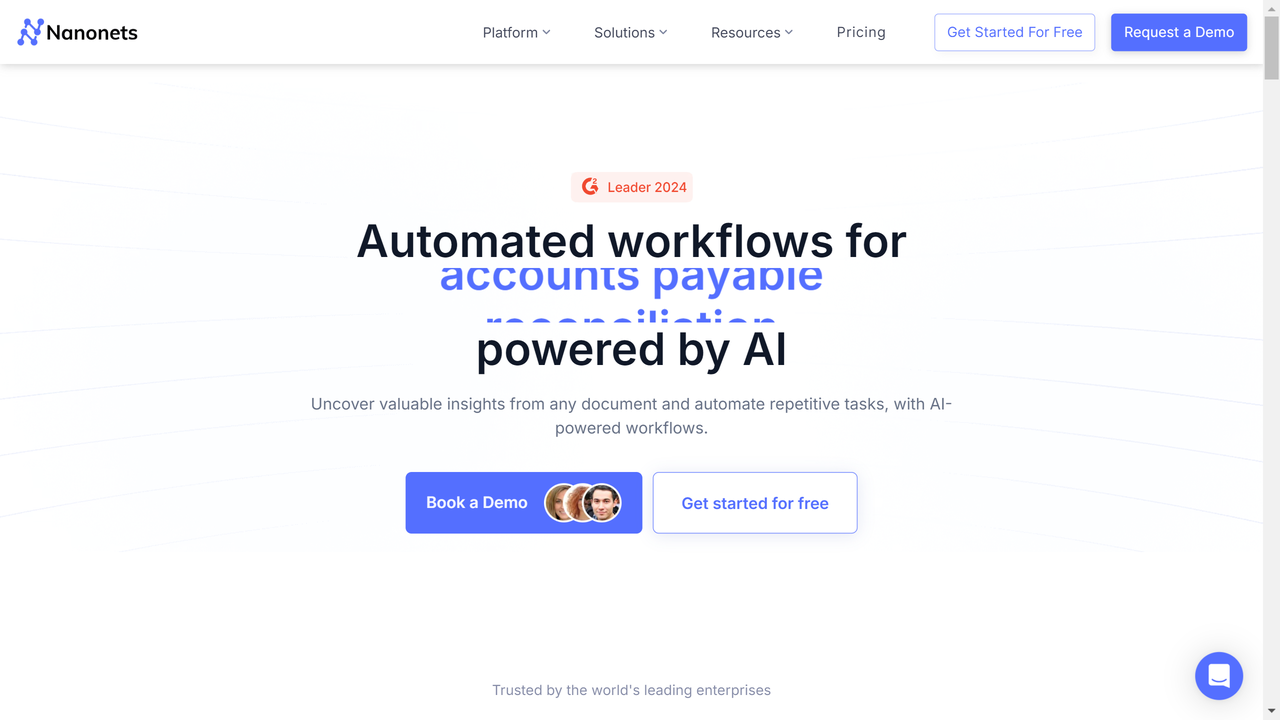
Nanonets, founded in 2017 by Sarthak Jain and Prathamesh Juvatkar and headquartered in San Francisco, builds cloud-based intelligent document processing (IDP) software combining OCR, machine learning, and workflow automation. The company raised $29 million in Series B funding in 2024 led by Accel and claims over 1,000 enterprise customers, including 34% of Global Fortune 500 companies. That Fortune 500 figure is vendor self-reported and carries no independent verification.
A March 2026 analysis by infoseemedia.com positions Nanonets among eight leading IDP platforms alongside UiPath, Automation Anywhere, Microsoft, ABBYY, Hyperscience, Rossum, and Docsumo, characterizing it as leading on "ease of setup, API-first usage, and high accuracy out of the box for invoices and financial documents" and as attractive for "teams with limited budgets and developer-heavy skill sets." Nanonets also appears in Gartner's Intelligent Document Processing Solutions directory alongside 19 competitors, updated December 2025, though without Magic Quadrant positioning or peer review scores.
The product strategy has shifted toward open-source distribution since mid-2025. Nanonets released the DocStrange MIT-licensed Python library in August 2025, followed by the Nanonets-OCR-s vision-language model on Hugging Face. The dual approach targets developer mindshare while maintaining commercial revenue through its SaaS platform. Teams evaluating open-source alternatives for self-hosted deployments may also want to compare Unstract, which offers a no-code LLM platform with hallucination mitigation for production-grade extraction.
What Users Say
User satisfaction data from SoftwareAdvice across 80 verified reviews gives Nanonets an overall 4.9/5 rating, with 4.8/5 for ease of use, 4.9/5 for customer support, 4.8/5 for functionality, and 4.6/5 for value for money. Practitioners in banking and finance consistently cite extraction speed as a primary strength. One verified reviewer from a 10,000-employee banking organization wrote: "Nanonets has a very precise data extraction software which has helped me complete my work faster and more efficiently. But the best thing was the speed with which data was extracted."
The value-for-money score of 4.6 is the lowest sub-rating, which aligns with the per-page billing model. Organizations processing high-volume, multi-page documents face unpredictable costs: a 12-page loan application counts as 12 billable pages at the Starter tier. This creates friction at scale and may drive migration to fixed-fee competitors as document volume grows.
Competitive analysis from Klippa notes that "many companies find that Nanonets may not fully meet their evolving needs" due to "high cost of scaling up, the need for faster deployment, or more advanced data extraction capabilities." Klippa specifically cites Docsumo as offering pre-trained APIs, custom models for new document types, auto-assignment of reviewers, and auto-applied learnings for new documents as features that Nanonets lacks. The same analysis positions Nanonets as lacking the "broader suite for document manipulation and format preservation" available in ABBYY FineReader, suggesting that extraction accuracy does not extend to the full document lifecycle.
How Nanonets Processes Documents
Nanonets IDP achieves 93-99% field-level accuracy and 70-90% straight-through processing (STP) on mature implementations, according to infoseemedia.com (March 2026). The platform scores 64.5 ± 1.1 on olmOCR-bench. Pre-trained models cover common document types including invoices, receipts, purchase orders, bank statements, and ID documents, enabling template-free data capture without pre-configured templates.
The no-code visual workflow builder handles document intake via email, mobile photo, scan, and API. Pre-built connectors integrate with NetSuite, QuickBooks, Sage, SAP, and Salesforce. For regulated industries, the platform is SOC 2, GDPR, and HIPAA compliant.
The AI Guidelines feature extends the template-free approach: users express extraction logic in plain language rather than configuring rules engines. Practical applications include applying different VAT handling rules by jurisdiction, extracting only invoice pages from mixed multi-page documents, and handling vendor-specific formatting exceptions, all without modifying the underlying model. A confirmed release date for this feature is not available from public sources.
Nanonets-OCR-s: Structured Markdown Output
The Nanonets-OCR-s model, built on Qwen2.5-VL-3B and trained on over 250,000 documents combining synthetic and real labeled data, converts documents to structured markdown rather than raw text. As Mehul Gupta noted on Medium in June 2025: "This new model doesn't just read documents, it understands them. It turns images into clean, organized markdown that keeps things like tables, checkboxes, images, and even math formulas in the right format."
Specific capabilities include converting printed mathematical equations into LaTeX syntax (distinguishing inline and display formats), detecting and isolating signatures within <signature> tags, extracting watermark text within <watermark> tags, converting form checkboxes and radio buttons into standardized Unicode symbols, and extracting complex tables in both markdown and HTML formats. The model does not yet support handwriting recognition. It reached 28,214 downloads in its first month on Hugging Face and is also available via Nanonets' docext tool.
This structured markdown output positions Nanonets to capture downstream LLM workflows, where document understanding feeds into reasoning and generation tasks. Developers building LLM pipelines around structured document output may also want to compare LangExtract, Google's open-source Python library applying a similar philosophy of LLM-driven extraction with precise source grounding.
DocStrange Open-Source Library
Released in August 2025 under the MIT license, DocStrange is a Python library featuring a 7B parameter model with both cloud API processing (10,000 free documents monthly) and complete local processing capabilities. The hybrid approach directly addresses enterprise privacy concerns while competing against cloud-only providers like Rossum. Teams requiring full data residency can run the model entirely on-premise.
IDP Leaderboard
Nanonets operates the IDP Leaderboard, a benchmark evaluating AI model performance across seven document processing tasks: OCR, key information extraction, visual question answering, document classification, long document processing, table extraction, and confidence scoring. The leaderboard was developed in collaboration with the Indian Institute of Technology Indore, as reported by intelligentdocumentprocessing.com in June 2025. Souvik Mandal, Deep Learning Engineer at Nanonets, described it as "the most comprehensive benchmark for Vision-Language models in the IDP domain."
Current top performers include Google Gemini 2.5 Flash Preview at 77.99% average accuracy on key information extraction and 69.08% on long document processing, and GPT-4.1 at 99.27% on document classification. All models score below 70% on long document processing, a gap Nanonets can address in future product iterations. The leaderboard's task definitions and proprietary datasets (Nanonets-KIE, Nanonets-Cls, Nanonets-LongDocBench) reflect Nanonets' view of what matters in IDP, which is a competitive consideration: competitors are evaluated against Nanonets-defined standards.
Use Cases
Accounts Payable Automation
Finance teams automate invoice processing from capture through payment with three-way matching against purchase orders and receiving documents, routing through approval workflows based on amount thresholds. The platform achieves 70-90% straight-through processing on mature AP implementations, according to infoseemedia.com (March 2026).
Healthcare Document Processing
Healthcare providers process patient intake forms, insurance cards, and medical records with HIPAA-compliant encrypted data handling and direct EHR system population. Vendors such as Concord Technologies take a comparable approach in healthcare, combining straight-through processing with cloud fax and AI automation for document-heavy clinical workflows.
Expense Management
Organizations automate expense reimbursement through mobile receipt capture, extracting merchant details and categorizing expenses while flagging policy violations.
Technical Specifications
| Feature | Specification |
|---|---|
| Deployment | Cloud-based SaaS, Local processing (DocStrange) |
| OCR Accuracy | Up to 99% claimed; 64.5 ± 1.1 on olmOCR-bench |
| Open-Source Model | 7B parameter DocStrange (MIT license); Nanonets-OCR-s on Hugging Face |
| API | RESTful API with webhooks |
| Document Formats | PDF, JPEG, PNG, TIFF, BMP, Office formats |
| Security | SOC 2, GDPR, HIPAA compliant |
| Pricing | Starter $0.30/page; Pro $999/month per workflow; Enterprise custom |
| AI Guidelines | Plain-language extraction rules; no model retraining required |
| Straight-Through Processing | 70-90% on mature implementations |
Pricing
Starter
per page
- Pre-trained models for invoices, receipts, IDs
- RESTful API access
- Standard integrations
Pro {primary}
per workflow/month
- All Starter features
- Visual workflow builder
- Priority support
- Advanced integrations (NetSuite, SAP, Salesforce)
Enterprise
pricing
- SSO and SAML
- Custom SLAs
- Dedicated account manager
- White-labeled platform
- Custom data retention
- Custom integrations
The per-page model at the Starter tier creates cost unpredictability for multi-page documents. Organizations processing high volumes of complex documents should model costs carefully before committing, as fixed-fee competitors like Docsumo and Rossum may offer more predictable unit economics at scale.
Resources
- Website
- DocStrange Open-Source Library
- OCR API
- LLM Structured Outputs Handbook
- Documentation
- Nanonets-OCR-s Model
- AI Guidelines Documentation
- IDP Leaderboard
- Nanonets: Competitive Analysis
Company Information
Headquarters: San Francisco, California, United States
Founded: 2017
Founders: Sarthak Jain, Prathamesh Juvatkar
Funding: $29 million Series B (2024, Accel lead)
Address: 156 2nd Street, San Francisco, CA 94105
Phone: +1 650 382 8676
Email: info@nanonets.com
Customers: 1,000+ enterprises, 34% of Global Fortune 500 (vendor self-reported)
Compliance: SOC 2, GDPR, HIPAA