NetDocuments, Legal Document AI and IDP Platform
On This Page
- Overview
- What users say
- AI capabilities
- Smart Answers: grounded generative search
- Model Context Protocol connectivity
- AI Assistant technical specifications
- eDOCS acquisition
- Use cases
- AI-powered legal workflows
- Enterprise legal department management
- Integrated legal technology platform
- Competitive position
- Security and compliance
- Technical specifications
- Company information
- Resources
NetDocuments is a Utah-based cloud-native document and email management platform provider that has evolved into an AI-powered workflow hub for legal professionals.
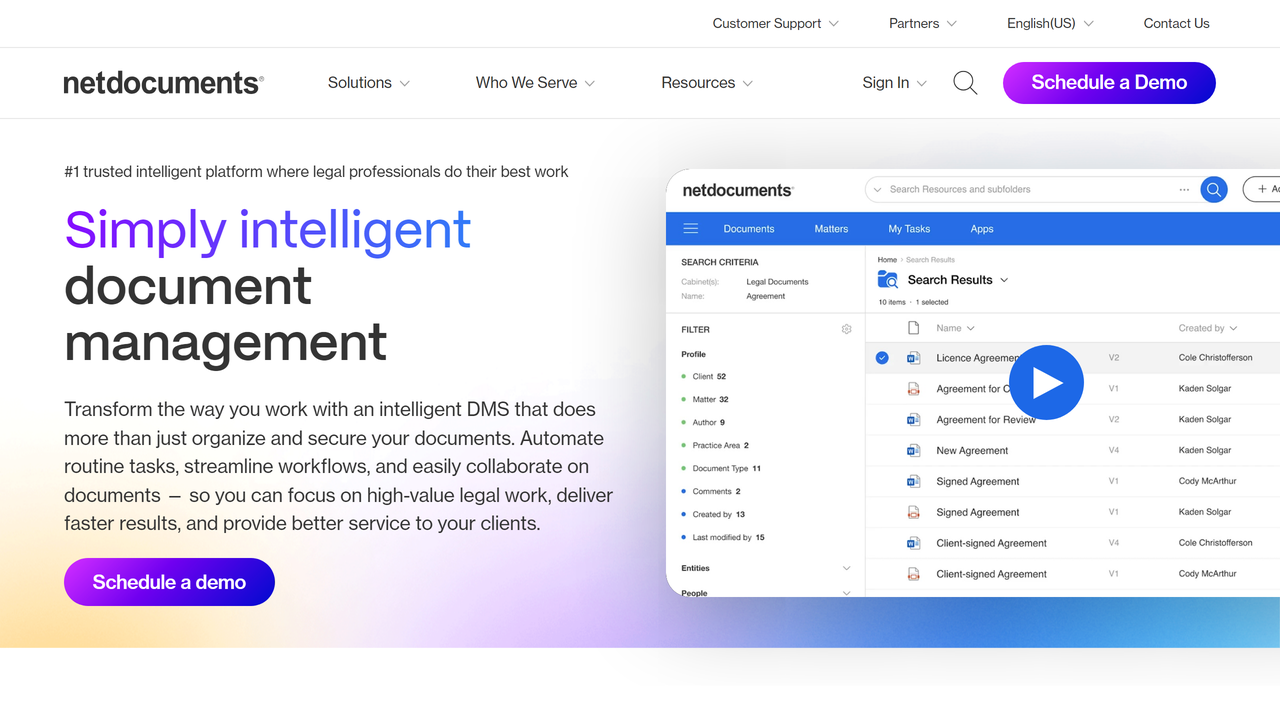
Overview
NetDocuments, founded in 1999 and headquartered in Lehi, Utah, operates a cloud-based document management system (DMS) serving more than 7,000 law firms, corporate legal departments, and public sector organizations globally, including many Am Law 100 firms. The company pioneered the cloud-first approach to legal document management with true software-as-a-service (SaaS) delivery and no on-premise infrastructure requirements.
Two moves in early 2026 define the company's current direction. On January 12, 2026, NetDocuments acquired OpenText's eDOCS legal DMS for $163 million, absorbing a large installed base of on-premises customers and committing to continued support with no end-of-life timeline. Then on March 4, 2026, the company launched Smart Answers, a generative AI search capability that lets legal professionals ask natural-language questions and receive cited answers grounded in their firm's own document repositories. Both moves position NetDocuments as a consolidation play: the cloud-native alternative for firms ready to modernize, and a trusted steward for those that are not.
Legal AI adoption in law firms rose from 37% in 2024 to 80% in 2025, according to NetDocuments' own tracking. The company's internal metrics reflect that shift: more than 800 firms began using NetDocuments AI capabilities in 2025, and 40% of new customers selected AI features at the time of purchase.
What users say
Practitioners consistently cite NetDocuments' cloud-first simplicity and out-of-the-box Microsoft 365 integration as primary reasons for choosing it over iManage, particularly at small- to mid-sized firms where rapid deployment matters more than deep customization. The workspace-based structure earns praise for intuitive design and fast user adoption.
The trade-offs are equally consistent. Teams at larger firms note that governance depth lags iManage for complex ethical wall configurations and records management workflows. Smaller practices report paying for capabilities they will not use, and setup typically requires technical expertise or consultant support, adding cost and implementation time. The 100-document limit per AI query and a 6-hour reset window after exceeding token limits are practical constraints that teams running high-volume document review workflows encounter quickly.
The user-specific conversation threads in the AI Assistant, which cannot be shared directly with colleagues, also draw criticism from teams that expect firm-wide knowledge sharing from an AI layer. Users must copy AI-generated responses into shared documents manually, which limits collaborative workflows.
AI capabilities
Smart Answers: grounded generative search
Smart Answers, launched March 4, 2026, is the most significant product change in NetDocuments' recent history. Rather than returning a list of documents in response to a query, the feature reads relevant documents and returns a conversational answer with citations, so a lawyer can verify the source before relying on it.
Dan Hauck, Chief Product Officer at NetDocuments, described the distinction in a March 2026 statement: "Any legal professional can open a public LLM and ask a question. But the answer they receive is the same answer every other firm gets, because those models draw from the same generalized training data. Smart Answers changes that equation. By securely connecting AI directly to a firm's own documents, matter history, and institutional knowledge, without compromising governance or client confidentiality, NetDocuments enables firms to activate the one advantage their competitors can't replicate: their own experience."
Smart Answers rolled out to all ndMAX Enterprise customers on March 31, 2026. It operates within existing NetDocuments security, governance, and ethical wall controls without requiring separate systems, contracts, or new user training.
Model Context Protocol connectivity
Alongside Smart Answers, NetDocuments expanded Model Context Protocol (MCP) connectivity to ChatGPT, Claude, Claude CoWork, and Claude's legal plugin, available to ndMAX Enterprise customers from April 1, 2026. MCP allows third-party AI applications to query NetDocuments content while the platform enforces its existing governance controls. This extends the hub strategy: rather than replacing external AI tools, NetDocuments becomes the governed data layer those tools query.
The launch puts NetDocuments in direct competition with iManage's Ask iManage (launched January 2026), Filevine's Legal Operating Intelligence System (October 2025), and Clio's agentic AI capabilities (October 2025).
AI Assistant technical specifications
NetDocuments runs its AI Assistant on Microsoft Azure OpenAI, using GPT-5 in US (Vault), DE, and EU/UK regions, and GPT-4.1 in the AU region. The close partnership with Microsoft includes an additional security layer ensuring Microsoft's content moderators cannot access AI Assistant query data.
The platform is architected to be LLM model-agnostic, meaning NetDocuments can switch providers as the market evolves without rebuilding the AI layer. As Optiable, a NetDocuments specialist firm, noted in April 2026: "The NetDocuments platform has been architected to be LLM model agnostic, meaning that it is flexible enough to change LLM providers in the future based on technological advancements, new customer needs, and business demands."
Practical limits to know before deployment:
- The AI Assistant analyzes up to 100 selected documents per query
- Per-document limit: 1 million characters (roughly 900 double-spaced pages) and 512 MB per file
- Supported formats: .doc, .docx, .pdf, .pptx, .txt, .html, .json, .md, .py, and others; Excel (.xlsx/.xls) extracts text but does not preserve row/column structure
- Conversation threads are retained for 30 days, with the timer resetting on each interaction
- Users must wait approximately 6 hours after exceeding token limits before querying again
- Conversation threads are user-specific and cannot be shared directly; responses must be copied to shared documents for team collaboration
- The Prompt Library is individual, not firm-wide
Optiable notes that because the AI Assistant grounds responses in selected documents rather than relying solely on the LLM's training data, "hallucinations or 'made-up' answers are virtually nonexistent."
eDOCS acquisition
The January 2026 acquisition of OpenText's eDOCS, historically known as Hummingbird DM and OpenText eDOCS DM, is the largest deal in NetDocuments' history. eDOCS serves law firms, corporate legal departments, and government entities that require on-premises control, a segment NetDocuments' cloud-only architecture had previously excluded.
NetDocuments has committed to no end-of-life timeline for eDOCS and will continue supporting the on-premises platform, with support transitioning from OpenText to NetDocuments in Q3 2026. Purpose-built migration tools and upgrade paths are available for eDOCS customers that want to move to the cloud or adopt NetDocuments' AI capabilities, but migration is not required.
The acquisition removes a competitive threat while creating a large pool of potential upgrade candidates. By positioning itself as a trusted steward rather than forcing migration, NetDocuments reduces churn risk among eDOCS customers and creates a longer-term modernization pipeline.
Use cases
AI-powered legal workflows
Law firms use NetDocuments as the central hub for AI-enabled document workflows. Embedded AI applications include auto-profiling, NDA analysis, contract risk analysis, and judge analytics. The platform serves as the foundation for generative AI document tasks, differentiating from research-focused or e-discovery starting points by keeping AI grounded in the firm's own matter history.
For teams evaluating open-source alternatives for structured extraction within legal pipelines, LangExtract offers a Google-developed Python library for LLM-based information extraction with source grounding.
Enterprise legal department management
Corporate legal departments manage contracts, litigation documents, and corporate records with integrated AI capabilities for document analysis and workflow automation. The eDOCS acquisition expands coverage to organizations with legacy on-premises requirements. Teams requiring no-code LLM-based extraction as a complement to a dedicated legal DMS may also evaluate Unstract, an open-source platform with hallucination mitigation designed for production-grade document workflows.
Integrated legal technology platform
Through integrations with Harvey, Legora, Thomson Reuters, and Vincent by Clio, NetDocuments connects with the broader legal technology stack. The September 2025 integration with 8am's unified legal technology platform, which includes LawPay, MyCase, and SmartSpend, extended this further. Leslie Witt, 8am's Chief Product Officer, stated the integration responded to "customer demand for best-in-class document management tools as firms scale."
Organizations in regulated industries that need AI-powered document processing with strong compliance controls may also consider Adlib, a Toronto-based provider specializing in accuracy validation for regulated enterprises. Law firms evaluating purpose-built legal case management with embedded document processing may also review SmartAdvocate, which targets personal injury and mass tort practices with AI-powered document workflows.
Competitive position
NetDocuments is cloud-native only, with no on-premises option. This sidesteps migration complexity but creates barriers for firms with on-premises data residency mandates. iManage supports hybrid deployment, giving it an advantage in that segment. NetDocuments' workspace-based structure and out-of-the-box Microsoft 365 integration (Outlook, Teams) without additional modules make it faster to deploy, which is why small- to mid-sized law firms increasingly choose it over iManage for cloud-first simplicity.
The governance gap is real. For firms requiring granular ethical wall configurations or complex records management workflows, iManage remains the more capable platform. NetDocuments' AI layer enforces existing permission-based controls and ethical walls, but the depth of configuration available does not match iManage's enterprise governance tooling.
The eDOCS acquisition partially addresses this by giving NetDocuments an on-premises-capable product for the first time, though eDOCS and the cloud NetDocuments platform remain separate offerings rather than a unified hybrid deployment model.
Security and compliance
NetDocuments holds SOC 2 Type 2, ISO 27001, HIPAA, and FedRAMP compliance certifications and meets GDPR standards. AI tools operate within the DMS's permission-based, encrypted environment. Client data is not used to train public models, and audit trails, access controls, and governance safeguards apply to AI-generated insights. The Microsoft partnership includes a contractual layer preventing Microsoft's content moderators from accessing AI Assistant query data.
Technical specifications
| Feature | Specification |
|---|---|
| Deployment model | Cloud-native SaaS only (eDOCS: on-premises, separate product) |
| Security certifications | SOC 2 Type 2, ISO 27001, HIPAA, FedRAMP |
| LLM infrastructure | Microsoft Azure OpenAI: GPT-5 (US, DE, EU/UK); GPT-4.1 (AU) |
| LLM architecture | Model-agnostic; provider can change without platform rebuild |
| AI document limit | 100 documents per query; 1M characters per document; 512 MB per file |
| Supported AI file formats | .doc, .docx, .pdf, .pptx, .txt, .html, .json, .md, .py, .ts, .php, .c, .cpp, .cs, .java, .tex |
| MCP connectivity | ChatGPT, Claude, Claude CoWork, Claude legal plugin (from April 1, 2026) |
| Integration count | 150+ technologies |
| Key integrations | Microsoft 365, DocuSign, Harvey, Legora, Thomson Reuters, Vincent by Clio, 8am platform |
| Mobile support | iOS and Android native applications |
| AI conversation retention | 30 days, timer resets on interaction |
| Geographic reach | North America, Europe, Asia, Australia, South America |
Company information
NetDocuments was founded in 1999 and is headquartered at 2500 W Executive Parkway, Lehi, UT 84043. The company serves more than 7,000 legal organizations globally, including many Am Law 100 firms. Target markets are law firms of all sizes, corporate legal departments, and government agencies.
CFO Hugo Doetsch departed in early 2026 to join AuditBoard, representing a notable transition in financial leadership at a period of significant acquisition activity.
Resources
- NetDocuments website
- Smart Answers announcement
- eDOCS acquisition details
- Support center
- Sales contact
HireLayer: Resume Parsing and Candidate Matching APIs
October 11, 2026
HireLayer: French resume parsing API that turns CVs into normalized JSON, plus job parsing, matching and ranking, from EUR 0.0445 per call.
HireLayer →DocuPipe: Schema-Driven Document Extraction Platform
October 6, 2026
New York schema-based extraction platform that turns PDFs, scans and spreadsheets into JSON, priced in credits, with an option to run it on-premises.
DocuPipe →Claix: Evidence-Backed Document JSON API for Agents
September 29, 2026
Madrid pay-per-call API that turns PDFs, spreadsheets, images and audio into schema-bound JSON with a cited source per field, built for AI agents.
Claix →