DocuCharm Company Profile: Y Combinator Document Automation
On This Page
DocuCharm was a two-person startup from Y Combinator's Winter 2019 batch that automated document-to-data extraction using AI and natural language processing (NLP). It ceased operations in 2020 and is now marked inactive on the Y Combinator directory.
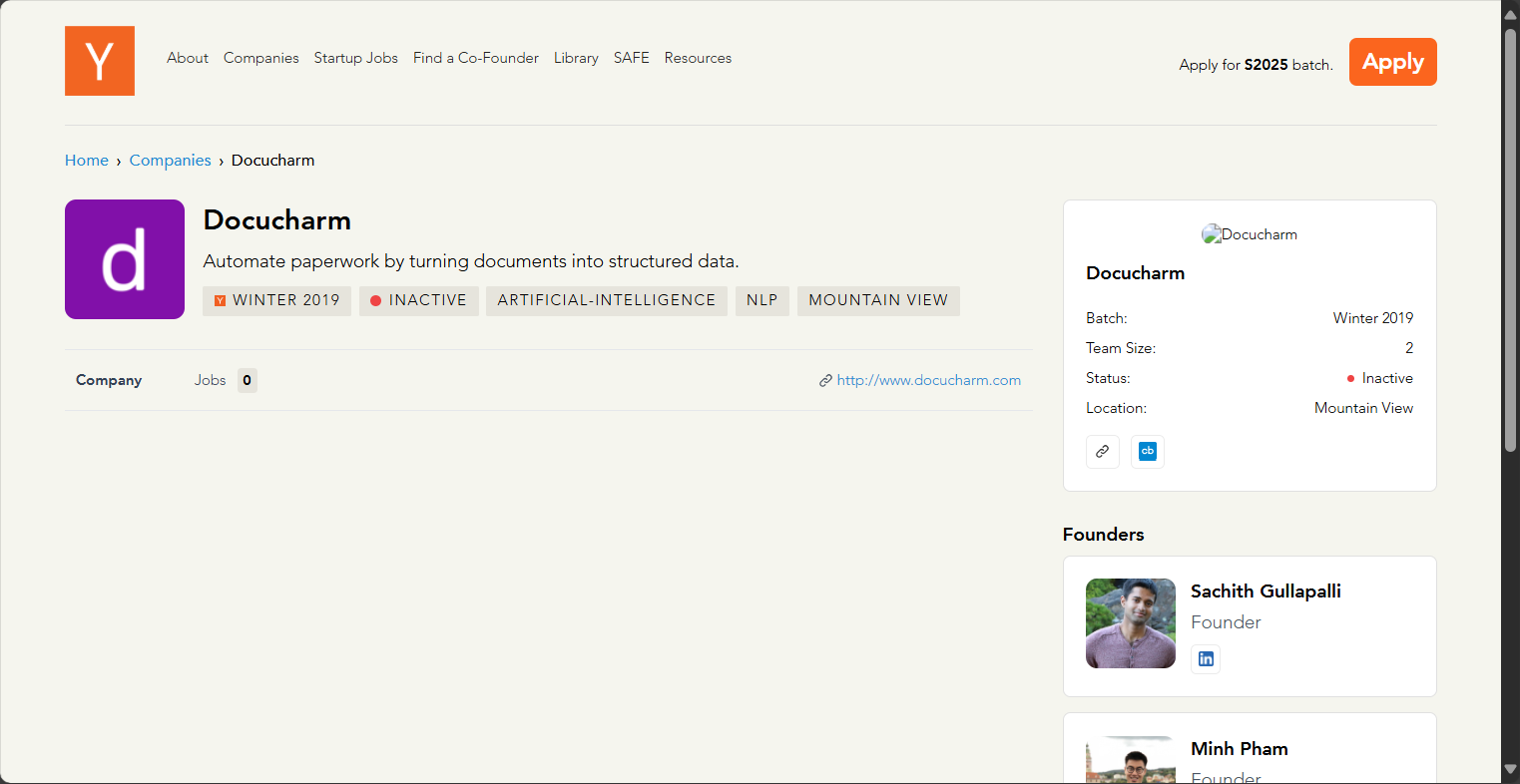
DocuCharm ceased operations in 2020. No active product, support, or contact options exist. This profile is maintained for historical reference and vendor comparison research.
DocuCharm company background
Sachith Gullapalli and Minh Pham founded DocuCharm in Mountain View, California, and entered Y Combinator's Winter 2019 accelerator batch. The company positioned its product as a tool to "automate paperwork by turning documents into structured data," targeting the same document extraction problem that larger, better-funded competitors were also pursuing at the time.
The two-person team size and absence of any disclosed funding round point to a startup that did not scale beyond the accelerator phase. DocuCharm's closure in 2020 followed a pattern common among early-stage intelligent document processing (IDP) ventures: insufficient capital and limited enterprise distribution made it difficult to compete against established players with dedicated sales teams and proven integrations. Klippa's 2026 OCR software comparison of leading vendors makes no mention of DocuCharm, confirming the company has not resumed operations despite the IDP market's continued growth.
The company's founding year is recorded as 2019 based on its Y Combinator batch. Earlier references to a 2012 founding date have not been verified by any primary source and are not supported by the Y Combinator directory entry.
How DocuCharm processed documents
DocuCharm's platform converted documents into structured data using AI and NLP, targeting organizations that managed high volumes of paperwork manually. The core workflow moved from document ingestion through data extraction and into downstream systems, with machine learning-based document classification routing files to the appropriate process.
The platform supported both on-premises and cloud deployment, which gave organizations flexibility around data residency and compliance requirements. Integration with enterprise systems allowed extracted data to flow into existing ERP and CRM environments without manual re-entry.
Compared to contemporaries like ABBYY and A2iA, DocuCharm operated at a fraction of the scale, with no disclosed enterprise customer base or published accuracy benchmarks. Its positioning as an AI-first, NLP-driven extraction tool placed it in the same category as better-capitalized peers, but without the distribution or product depth to compete at enterprise scale.
Use cases
DocuCharm targeted three document-heavy workflows common across finance, legal, and compliance functions.
Invoice processing
Automated invoice capture formed the clearest use case. The platform extracted vendor details, line items, and payment terms from invoices in multiple formats, then matched them against purchase orders to support accounts payable reconciliation. This type of workflow is now standard across active IDP vendors including UiPath and Hyperscience, which have continued developing it with enterprise-grade accuracy and audit tooling.
Contract management
DocuCharm extracted key dates, parties, and obligations from contracts and routed documents to appropriate stakeholders. Legal teams could use this to reduce manual review time and maintain visibility across active agreements. The capability was early-stage relative to what dedicated contract intelligence platforms now offer.
Regulatory compliance
Document workflow automation addressed retention policies and audit trail requirements in regulated industries. DocuCharm's classification and routing logic helped compliance teams track document status and demonstrate adherence to internal controls. No published case studies or customer outcomes are available to quantify the results.
Technical specifications
| Feature | Specification |
|---|---|
| Deployment options | On-premises, Cloud |
| Document formats | PDF, Word, Excel, scanned images |
| Core technology | AI, natural language processing |
| Team size at closure | 2 founders |
| Accelerator | Y Combinator Winter 2019 |
| Operational status | Inactive since 2020 |
Company information
DocuCharm is inactive. The Y Combinator directory lists the company as inactive, and no website, support channel, or contact option is available. Organizations that evaluated DocuCharm before 2020 have since migrated to alternative IDP vendors to continue document automation operations.
For teams researching the current IDP market, active alternatives in the document extraction space include ABBYY, UiPath, and Hyperscience, all of which have continued investing in the capabilities DocuCharm targeted.