Send AI: IDP Software Vendor
On This Page
Amsterdam-based intelligent document processing (IDP) provider using custom open-source AI models for document automation in logistics, insurance, and government sectors.
Overview
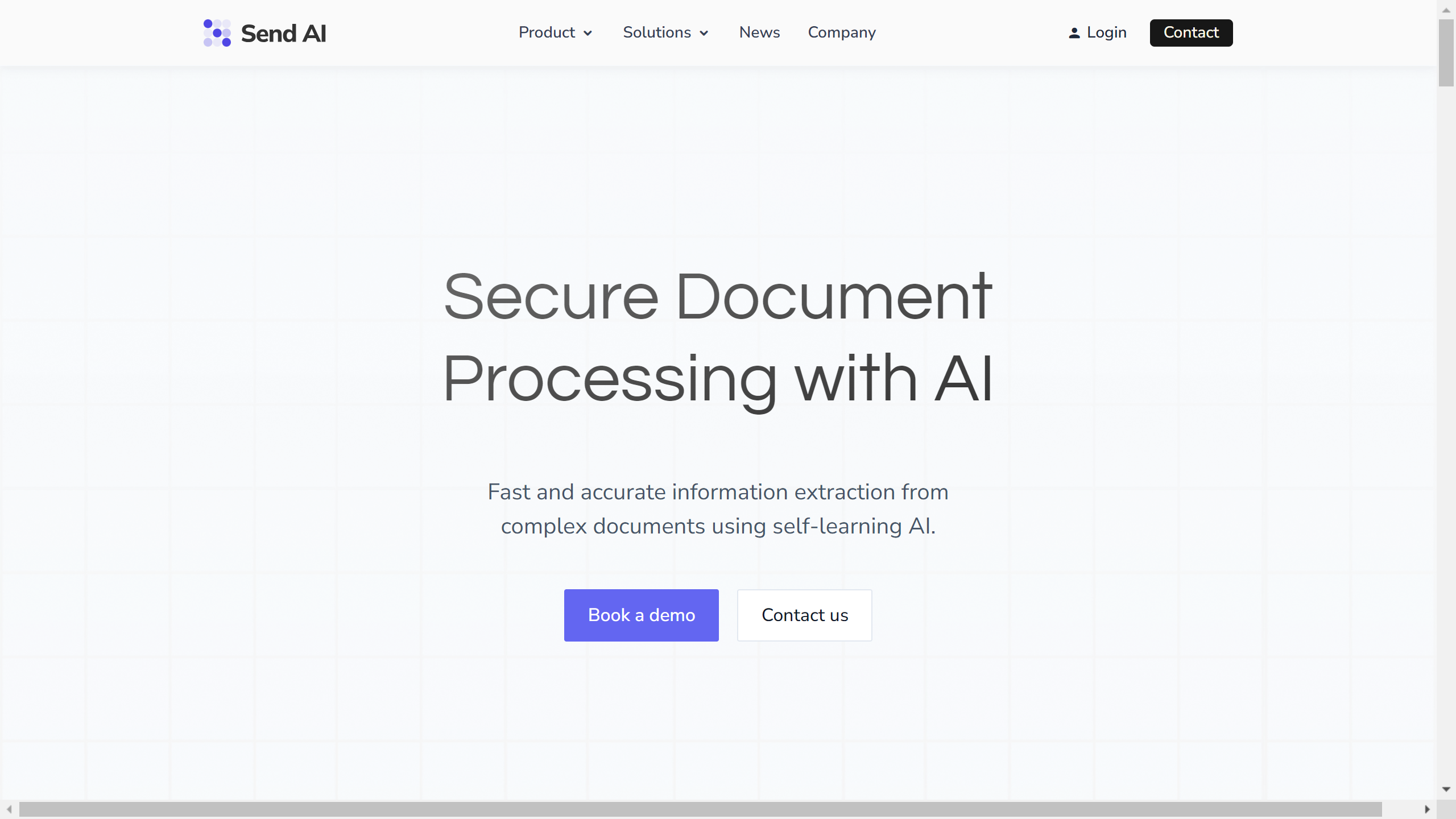
Send AI converts unstructured email and document data into structured formats for operations teams, using combinations of smaller open-source models rather than proprietary large language models. Founded in Amsterdam in 2021 as Autopilot by Thom Trentelman and Philip Weijschede, the company has raised $2.41M across two rounds, with the most recent close in January 2024. Investors include Gradient Ventures (Google's AI-focused fund), Keen Venture Partners, and Graduate Ventures. The company is revenue-generating with 8 employees as of early 2026.
The core differentiator is model isolation: each customer trains their own model on organization-specific documents, so proprietary document structures never touch shared infrastructure. This matters most in regulated industries where data residency and model ownership are procurement requirements, not preferences.
Send AI faces real visibility challenges. Gartner Peer Insights tracks 93 IDP solutions, with ABBYY and Nanonets leading customer recommendations. Send AI does not appear in that coverage. Pricing pressure compounds the challenge: Mistral AI's OCR 3 launched at $2 per 1,000 pages, compressing the cost advantage that smaller open-source vendors typically hold. At 8 employees and $2.41M raised, Send AI competes on specialization, not scale.
How Send AI processes documents
Send AI's pipeline starts with document pre-processing: automated preparation and segmentation that handles low-quality scans, photographed paperwork, and lengthy PDFs before extraction begins. Each organization's model trains on its own document corpus in isolation, meaning a logistics company's bill-of-lading model never shares weights or training data with an insurance carrier's claims model.
Extraction runs through combinations of smaller open-source models rather than a single large commercial model. This architecture keeps inference costs lower and gives customers full ownership of the trained model, not just access to a hosted API. A custom rule engine applies configurable validation logic after extraction, and human-in-the-loop workflows route low-confidence results for manual review before data moves downstream.
The platform runs on Google Cloud Platform and carries ISO 27001:2022, GDPR, and DORA certifications, covering the compliance baseline for European financial services and government procurement.
Use cases
Logistics document processing
Logistics teams process shipping documents, bills of lading, and customs paperwork from photographed documents and low-quality scans. Custom models train on company-specific formats, so a carrier's proprietary document structures stay within their isolated environment. The pre-processing layer handles the image quality variation common in field-captured documents before extraction runs.
Insurance claims automation
Insurance carriers use Send AI to automate claims intake from diverse document sources, including lengthy PDFs with mixed content types. Custom validation rules enforce data quality before records enter claims management systems, and human-in-the-loop workflows flag exceptions for adjuster review. GDPR compliance and audit trail generation are built into the processing pipeline.
Government document management
Government agencies process citizen submissions, administrative forms, and regulatory filings with modular segmentation and human-in-the-loop verification. Data sovereignty requirements are met through isolated, customer-controlled model training rather than shared cloud inference. DORA certification supports deployments in financial regulatory contexts.
Technical specifications
| Feature | Specification |
|---|---|
| AI approach | Self-learning models, open-source model combinations |
| Model isolation | Custom model per organization, no shared training data |
| Document types | Low-quality scans, photographed documents, lengthy PDFs |
| Processing | Modular segmentation, automated pre-processing |
| Validation | Custom rule engine, human-in-the-loop workflows |
| Infrastructure | Google Cloud Platform |
| Compliance | ISO 27001:2022, GDPR, DORA |
| Deployment | Cloud-based, scalable |
| Data ownership | Full customer ownership of data and trained models |
| Target industries | Logistics, insurance, government, maritime, finance, retail |
Company information
Send AI was founded in 2021 in Amsterdam by Thom Trentelman and Philip Weijschede, initially operating as Autopilot. The company has raised $2.41M across two funding rounds: an initial early-stage VC round in February 2022 and a $2.41M round closed in January 2024. Gradient Ventures, Keen Venture Partners, and Graduate Ventures hold minority stakes.
With 8 employees and confirmed revenue generation, Send AI is pre-scale by any measure. The investor composition, particularly Gradient Ventures' backing, signals confidence in the open-source model approach. But the gap between that early validation and analyst coverage in 2026 is real: buyers evaluating Send AI should weigh the specialization advantage against the support and integration depth that larger IDP vendors provide.
Evaluator note: Send AI does not appear in Gartner Peer Insights' 93-vendor IDP tracking as of early 2026. Independent customer references and case studies should be requested directly before procurement decisions.
Headquarters: De Ruijterkade 107, 1011 AB Amsterdam, Netherlands
Founded: 2021 (originally as Autopilot)
Founders: Thom Trentelman, Philip Weijschede
Funding: $2.41M total across two rounds (Gradient Ventures, Keen Venture Partners, Graduate Ventures)
Employees: 8
Revenue status: Revenue-generating
Resources
- Send AI website
- Silicon Canals: Send AI raises €2.2M pre-seed
- PitchBook company profile