Parseur: Email and PDF Data Extraction
On This Page
AI data extraction platform converting emails, PDFs, and documents into structured data with three extraction engines and 100+ million documents processed.
Overview
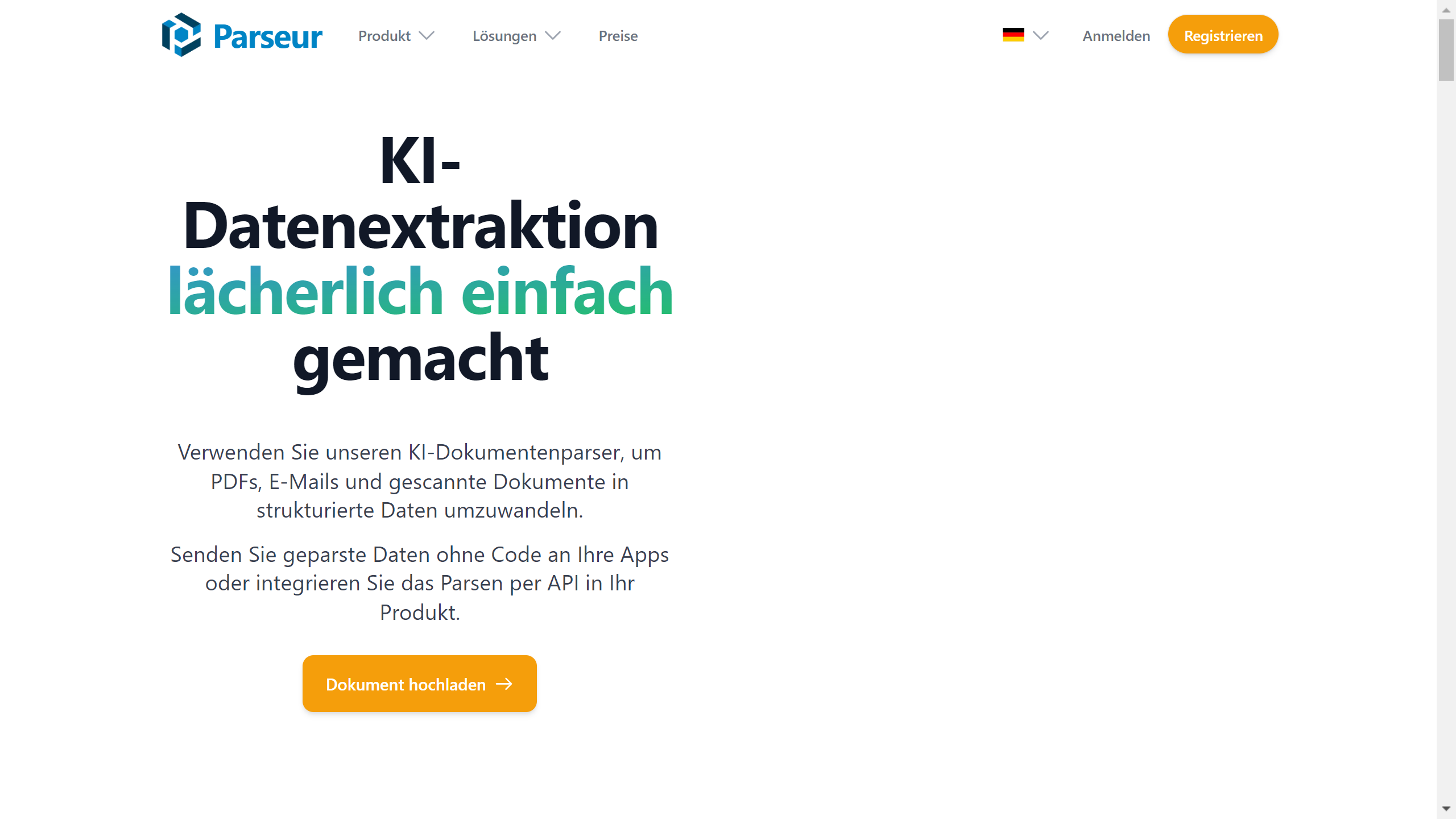
Parseur is an AI-powered data extraction platform for emails, PDFs, images, spreadsheets, text files, and HTML documents. Founded in 2016 and headquartered in Singapore, the platform runs three extraction engines: an AI engine for automatic field identification, Zonal OCR for template-based capture, and a text parsing engine for structured emails and HTML content.
The company's strategic direction has shifted twice in 18 months. In August 2025, the release of parseur-py 1.2.0 to PyPI introduced programmatic mailbox management, document uploads, and real-time webhook integrations, signaling an API-first pivot toward developer workflows. By early 2026, Parseur was framing that infrastructure investment in broader terms: positioning itself as a control point for agentic document extraction, which it defines as autonomous AI systems that plan and execute multi-step document workflows rather than simply extracting fields.
That positioning is backed by a deliberate thought-leadership campaign. In January 2026, Parseur published findings from a self-commissioned survey of 500 U.S. professionals in document-heavy roles. The headline tension: 69% of respondents are already using or planning to adopt agentic AI in 2026, yet 61% do not feel prepared for safe autonomous decision-making. The same survey found 88% discover errors in document-derived data at least sometimes, and 43% spend four or more hours per week correcting those errors. Co-founder and CEO Sylvestre Dupont framed the strategic logic directly: "The leap to AI-driven decision-making requires trust in the underlying data, clear governance and resilient validation processes." The survey is self-commissioned with no independent methodology audit, so the statistics reflect Parseur's own research rather than industry consensus.
Independent testing by evaluator Neha Gunnoo in March 2026 confirmed Parseur processed a real invoice PDF in under 60 seconds with no template setup required. The platform holds a 4.8/5 rating across 59 verified reviews on Capterra, with handwriting recognition cited frequently as a differentiator.
What users say
Practitioners consistently praise Parseur's setup speed and email parsing reliability. The ability to connect a shared inbox and begin extracting structured data within minutes, without template configuration, is the most frequently cited advantage in verified reviews. Handwriting recognition earns specific mention across multiple reviews, which is notable given that many SMB-focused extraction tools skip this capability entirely.
The friction point users identify most often is parser type selection. Parsio.io's January 2026 roundup noted a learning curve in choosing between the AI engine, Zonal OCR, and text parsing engine for a given document type. Teams processing a single, consistent document format report smooth onboarding; teams handling mixed document types report more trial and error before settling on the right engine.
Users comparing Parseur to enterprise alternatives like ABBYY and Klippa note the trade-off clearly: Parseur wins on self-serve access and time to first extraction, while enterprise platforms offer deeper approval routing and workflow orchestration that Parseur does not provide. For teams that need invoice approval chains built into the tool, practitioners report Parseur falls short. For teams that need clean structured data routed to a downstream system, practitioners report it delivers.
How Parseur processes documents
Parseur combines three extraction engines to handle different document types without forcing a single approach. The AI engine automatically identifies and extracts specified fields from variable layouts without requiring template configuration. The Zonal OCR engine uses visual box placement over a document template for consistent, repeating formats. The text parsing engine applies rule-based extraction to structured emails and HTML, where positional logic is reliable.
OCR capabilities cover native PDFs, scanned documents, images, and spreadsheets, with handwriting recognition across 60+ languages and scripts. Parseur claims 98-99% accuracy combining OCR, machine learning, and natural language processing (NLP), though no independent benchmark validates this figure against competitors. Industry context: manual invoice processing carries human error rates between 1.6% and 4%, with each correction costing up to $53 according to Resolve's invoice cost analysis.
The August 2025 Python SDK introduced CLI tooling and webhook management, enabling developers to trigger downstream systems the moment processing completes. This infrastructure underpins the company's agentic document processing framing: extraction that feeds autonomous workflows rather than human review queues. Similar architectural pivots are visible at UiPath and Hyperscience, though both operate at larger enterprise scale. Open-source alternatives pursuing comparable no-training extraction approaches include Unstract, which offers an LLM-based IDP platform with hallucination mitigation for production document workflows.
One capability gap worth noting: Parseur does not include built-in approval routing or multi-step accounts payable workflow features. Teams requiring invoice approval chains need to build that logic in a connected automation platform like Zapier or Make, or evaluate alternatives with native workflow orchestration.
Use cases
Invoice processing
Parseur extracts invoice numbers, line items, totals, and due dates from supplier invoices forwarded by email, routing structured output to accounting systems via webhooks or Google Sheets integration. Independent testing confirmed sub-60-second processing on real invoice PDFs without template setup. The company's own benchmarks claim 1-2 seconds per invoice at $2.36 per invoice cost, without third-party validation. For context, manual invoice processing costs businesses $15-40 per invoice with approval cycles averaging 8-14 days, according to Resolve's cost analysis. Competing platforms Docsumo and Rossum publish comparable accuracy and speed claims in the same range.
Lead generation from emails
Sales teams extract prospect information including names, companies, phone numbers, and requirements from inquiry emails and contact forms, pushing structured records to CRM systems through Zapier or direct API. The Parseur Google Sheets integration is a common destination for teams that want structured lead data without a CRM. Customers report saving 189 hours monthly, equivalent to $7,557 in labor costs, through automated email parsing, though this figure comes from Parseur's own published case material. Workist, a Berlin-based platform targeting mid-market ERP automation, pursues a comparable no-training implementation approach for similar business document workflows.
RFP response automation
Parseur's document parsing capabilities address proposal management workflows. The company is identified as a key player in the $2.43 billion RFP response automation market projected to grow at 21.7% CAGR through 2029. Competing platforms in this space include Instabase and Hypatos. For teams evaluating open-source options alongside commercial platforms, LangExtract offers a Google-developed Python library for structured extraction from unstructured text using LLMs with source grounding.
Technical specifications
| Feature | Specification |
|---|---|
| Extraction engines | AI engine, Zonal OCR, text parsing |
| SDK | Python 3.8+ with CLI and webhook management (parseur-py) |
| Supported formats | Emails, PDFs (native/scanned), images, spreadsheets, text files, HTML |
| OCR capabilities | Handwriting recognition, 60+ languages and scripts |
| Documents processed | 100+ million (as of 2025) |
| Accuracy claims | 98-99% combining OCR, ML, and NLP (self-reported) |
| Invoice processing speed | Under 60 seconds (independently tested); 1-2 seconds (vendor benchmark) |
| Integrations | Google Sheets, Zapier, Microsoft Power Automate, Make, QuickBooks, webhooks, 6,000+ apps |
| API | Webhooks and Python SDK (parseur-py on PyPI) |
| Free tier | 20 pages per month, all features included, no credit card required |
| Pricing model | Volume-based for paid plans |
| Privacy policy | Customer data never used for AI training |
| Compliance | SOC 2 compliant; HIPAA certification in progress; EU hosting with GDPR compliance |
| Customer distribution | 50% US, 30% European, 20% other regions |
| Third-party rating | 4.8/5 across 59 reviews on Capterra |
| Workflow limitations | No built-in approval routing or multi-step AP workflow |
Resources
- Website
- Python SDK on PyPI
- Email Parser
- Features
- About
- Agentic Document Extraction
- Pricing
Company information
Headquarters: Singapore (160 Robinson Road #14-04)
Founded: 2016
Co-founder and CEO: Sylvestre Dupont
Parseur is a bootstrapped company with no disclosed funding rounds. The 50-person-or-fewer team competes in the SMB and mid-market segment against enterprise platforms with significantly larger engineering organizations. The bet is vertical focus on email-to-data workflows rather than horizontal document AI coverage. EU hosting and a self-serve free tier lower the barrier to trial in a market where ABBYY, Klippa, and Ocrolus require sales engagement before a prospect can test the product.
The IDP market was valued at $2.30 billion in 2024 and is projected to reach $12.35 billion by 2030 at 33.1% CAGR, according to Grand View Research cited via Parseur. That growth rate creates room for focused players, but also draws larger vendors into the SMB segment Parseur currently occupies.
:::recent 3 :::