FutureVault: IDP Platform for Financial Services
On This Page
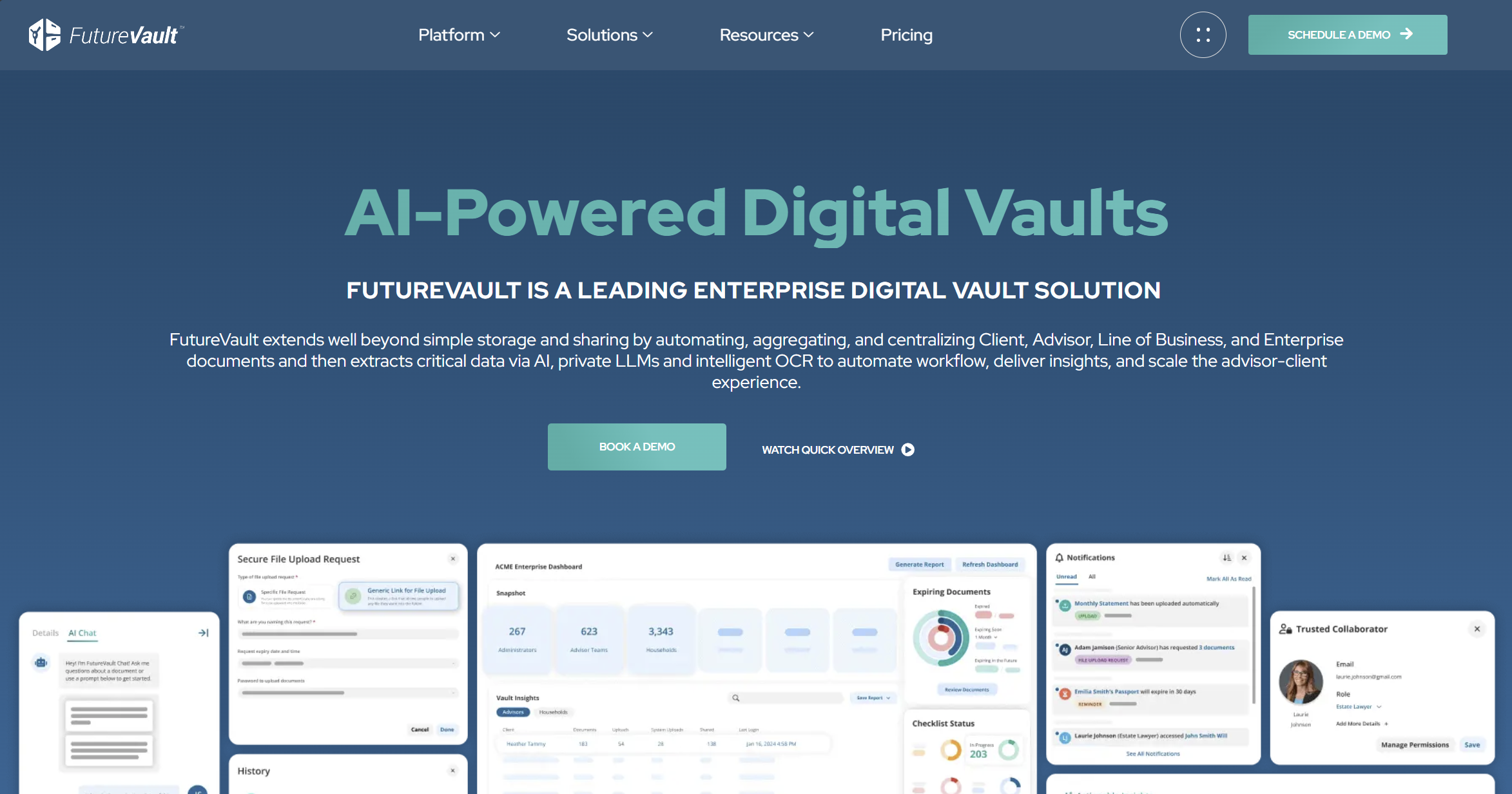
AI-powered Digital Vault and intelligent document processing (IDP) platform for financial services, using private large language models (LLMs) for wealth management automation.
Overview
 Click to load video from YouTube
FutureVault provides enterprise-grade digital vault solutions combining secure document management with intelligent document processing for highly regulated industries. Founded in Toronto by G. Scott Paterson (Executive Chairman), Brad Rosenberg, and CEO Daniel Kenny, the company has evolved from document storage to AI-powered workflow automation. The company explicitly rejects the "document storage" label. In a February 2026 interview covered by TipRanks, Kenny and CMO Kristian Borghesan framed the platform as dynamic document infrastructure: documents become queryable, structured assets rather than static files.
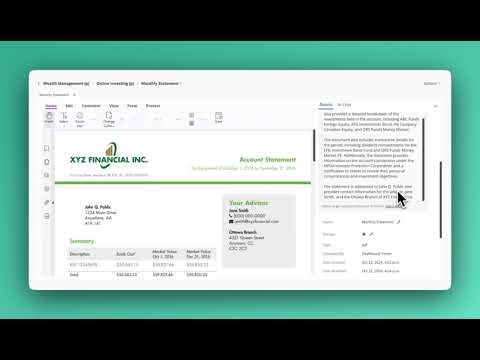
The platform uses private LLMs, OCR, and NLP to extract critical data from financial documents and automate compliance workflows. The private-LLM architecture is a deliberate compliance differentiator. Regulated financial institutions cannot route client data through public model APIs, and FutureVault's deployment keeps data within institutional boundaries. In March 2025, FutureVault secured $3 million in equity funding, bringing total funding to $3.5 million to support enterprise expansion.
 Click to load video from YouTube
The white-label deployment model means FutureVault surfaces under the client's brand rather than its own. This is a structural fit for institutions that cannot expose third-party vendor relationships to end clients, but it makes external validation harder to assess. Named enterprise deployments do not appear in public sources; buyers will need to request reference customers directly.
Separately, G. Scott Paterson was appointed Chairman of The FUTR Corporation in January 2026 while maintaining his FutureVault Executive Chairman role. FUTR Corporation, which completed its public listing in Spring 2025 after incubation as a FutureVault division, is developing the FUTR Agent App for consumer data monetization, a parallel track to FutureVault's enterprise focus.
Comparable IDP vendors include M-Files and DocuSign.
How FutureVault processes documents
FutureVault's data extraction pipeline combines patented Auto-Filing with private LLMs and knowledge graphs to move documents from ingestion to structured, queryable output without routing data through public AI infrastructure.
Ingestion and classification. Documents enter the platform through enterprise upload, advisor-initiated requests, or bulk distribution workflows. The patented Auto-Filing engine, granted a USPTO patent in 2021, classifies and routes documents automatically using AI-driven rules. Supported document types include wills and trust agreements, term life insurance policies, financial plans, tax packages, account statements, and performance reports.
Extraction and structuring. Advanced OCR and ICR (intelligent character recognition) handle structured and unstructured documents. Private LLMs then extract critical fields: maturity dates, policy details, financial values, and beneficiary information. These are surfaced as structured data rather than remaining buried in file contents. Cross-document querying allows the platform to answer questions that span multiple documents in a vault.
Knowledge graph layer. The March 2026 AI Advisor Insights Engine launch added a knowledge graph layer that connects extracted data points across documents. This enables the platform to surface relationships between a client's estate files, insurance policies, and portfolio reports that would otherwise require manual cross-referencing.
Event-triggered workflows. The Insights Engine surfaces intelligence on specific triggers: recently uploaded or viewed documents before client meetings, onboarding activity revealing document gaps, and newly added documents requiring advisor follow-up. These triggers fire automated actions including meeting preparation summaries, compliance reviews, and secure file requests, without manual intervention.
Output and integration. Extracted data flows to CRMs, data lakes, and downstream compliance systems through 1,000+ RESTful API endpoints with Swagger documentation. The platform connects to 7,000+ third-party tools including CRMs, portfolio management platforms, and custodians. Fiduciary audit trails log every action for regulatory review.
No processing accuracy figures or throughput benchmarks have been published. Buyers evaluating extraction quality will need to run their own document samples through a proof-of-concept engagement.
AI Advisor Insights Engine
On March 10, 2026, FutureVault launched the AI Advisor Insights Engine, the most significant product release in the company's history. The engine moves the platform beyond traditional IDP, where the goal is extracting and classifying documents, toward actionable intelligence generation, where documents trigger downstream workflows without human review.
CEO Daniel Kenny described the shift directly: "Every financial institution sits on a massive amount of intelligence inside client documents, but historically that information has been incredibly difficult to access or operationalize. The Advisor Insights Engine changes that dynamic by turning the document layer into a continuous intelligence engine that surfaces insights and drives meaningful advisor actions."
Chief Product Officer Simon Tipler framed the governance rationale: "AI in financial services must operate within a trusted, safe, and secure framework. By combining structured document data, knowledge graphs, and private AI infrastructure, we're enabling firms to unlock intelligence from their documents while maintaining full control over data access and governance."
The governance architecture includes granular permissions at both document and data level, audit-ready activity logging, and compliance controls aligned with SOC 2 Type II and PCI DSS requirements. This positions the Insights Engine as a straight-through processing layer for wealth management workflows where compliance, onboarding, and advisory tasks depend on rapid document understanding.
The document types covered, specifically tax documents, estate files, insurance policies, account forms, and portfolio reports, indicate focus on high-net-worth and institutional wealth management workflows. The event-triggered insight model targets two primary outcomes: advisor productivity and compliance risk reduction.
Use cases
Enterprise wealth management automation
Financial institutions deploy FutureVault to automate high-volume document distribution including tax packages, account statements, and performance reports. The IDP engine extracts maturity dates, policy details, and financial values to power enterprise reporting and regulatory compliance workflows. Enterprise Line of Sight dashboards provide real-time monitoring of vault activity and compliance events across hundreds of thousands of active vaults.
Advisor-client digital onboarding
Advisors use secure document collection through digital checklists and automated requests, eliminating email-based workflows. The Insights Engine surfaces onboarding gaps automatically, flagging missing documents and triggering secure file requests without advisor intervention. The Client Life Management Vault gives clients lifelong digital repositories that extend beyond investment management, holding documents that matter across life events rather than just account statements.
Document intelligence and compliance
Organizations extract actionable intelligence from wills and trust agreements, term life insurance policies, and financial plans using private LLMs, knowledge graphs, and OCR. Real-time data extraction integrates with CRMs and data lakes for compliance monitoring. Fiduciary audit trails support regulatory review in wealth management, banking, and insurance contexts.
Technical specifications
| Feature | Specification |
|---|---|
| Deployment | Cloud-based SaaS platform (white-label available) |
| AI technology | Private LLMs, knowledge graphs, NLP, machine learning, computer vision |
| OCR capabilities | Advanced OCR and ICR for structured and unstructured documents |
| Architecture | Multi-tiered (Enterprise, Advisor, Household, Client layers) |
| API integration | 1,000+ RESTful API endpoints, Swagger documentation |
| Integration partners | 7,000+ third-party tools including CRMs, portfolio management platforms, custodians |
| Security and compliance | SOC 2 Type II (Ernst & Young, 2021), PCI DSS, institutional-grade encryption |
| Authentication | Multi-Factor Authentication (MFA) |
| Access control | Patented multi-tier role-based permissioning |
| Scalability | Enterprise-grade supporting hundreds of thousands of active vaults |
| Data extraction | Real-time extraction using AI, private LLMs, and knowledge graphs |
| Accuracy and benchmarks | Not publicly disclosed |
Resources
- Company website
- Platform overview
- Intelligent document processing guide
- IDP platform documentation
- Integration ecosystem
- Security and compliance
- Customer testimonials
- News and press releases
Company information
- Website: futurevault.com
- Headquarters: Toronto, Ontario, Canada
- Leadership: Daniel Kenny (CEO), Simon Tipler (Chief Product Officer), Kristian Borghesan (CMO), G. Scott Paterson (Executive Chairman)
- Total funding: $3.5M (as of March 2025)
- Certifications: SOC 2 Type II, PCI DSS
- Company profile: Crunchbase