Parashift: IDP Software Vendor
On This Page
Swiss intelligent document processing platform leveraging shared AI knowledge base for automated data extraction across industries.
Overview
Founded in 2018 in Zurich, Parashift has built its intelligent document processing platform around three technical bets: zero-shot learning that eliminates the need for training data on new document types, agentic workflows that push straight-through processing rates above 90%, and bidirectional ERP integration that the company argues is where most IDP deployments actually fail.
In March 2026, Everest Group recognized Parashift as an Aspirant in its 2026 IDP Products PEAK Matrix and a Major Contender in the insurance-specific assessment. The insurance rating is the more significant signal: it places Parashift among providers with demonstrated delivery capability in a vertical where compliance, audit trails, and variable document structures are non-negotiable requirements. CEO Alain Veuve described the insurance recognition as validation of "our ability to deliver highly secure, compliant AI solutions that transform complex document workflows for regulated industries."
The Aspirant rating in general IDP is consistent with Parashift's profile as a specialist rather than a broad-market platform. The company competes most directly in financial services, insurance, healthcare, logistics, and professional services, where document complexity and regulatory requirements favor purpose-built solutions over horizontal platforms. Swiss-based peers with comparable regulated-industry focus include Acodis, which has specialized in variable document structures for regulated industries since 2016. A comparable collaborative training approach appears in DocBits, which uses swarm intelligence to pool model improvements across its customer base.
How Parashift processes documents
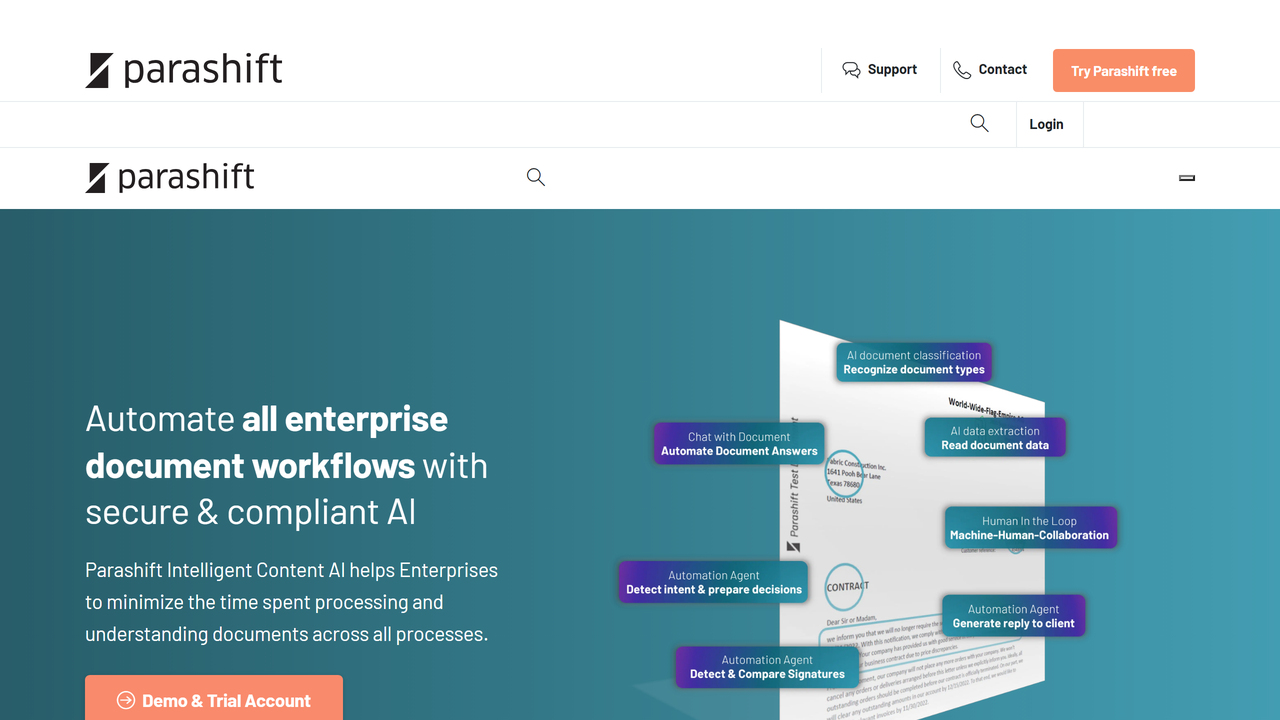
Parashift's extraction engine combines four proprietary technologies: Parashift Language Models, DocumentSwarmLearning, OneTouchLearning, and an Autonomous Retraining-Cluster. The shared knowledge base is the architectural foundation: every document processed across the customer base contributes to model improvement, so accuracy on common document types compounds over time without per-customer retraining.
The zero-shot learning capability is the most operationally significant differentiator for new deployments. Parashift claims that new document types can be configured in minutes rather than weeks, requiring zero sample documents compared to the 500 to 5,000 samples classic machine learning models typically need. Accuracy is described as "only just below" specially trained models, with effort reduction of up to 99% compared to few-shot approaches. These figures are self-reported and lack independent benchmarking, but the directional claim reflects a real shift in the IDP market away from template-based configuration.
As Lenja Weidenfeld of Parashift stated in February 2026: "The era of lengthy model training is coming to an end; zero-shot learning enables immediate extraction without historical data."
Where Parashift's architecture diverges from simpler extraction tools is in what happens after a field is read. The platform routes documents through confidence scoring before any downstream action. High-confidence extractions proceed to straight-through processing. Low-confidence cases route to a human review queue where corrections feed back into the model. Parashift positions this not as a fallback but as a deliberate design choice: "Don't invest in AI that claims to be able to do everything. Invest in AI that knows, and proactively informs you and your teams, when it needs help." In logistics and insurance deployments, the company reports that this human-in-the-loop approach reduces manual effort by up to 80% versus unassisted review.
Agentic workflows and ERP integration
Parashift's March 2026 positioning on agentic AI workflows marks a deliberate shift in how the company describes its product. The distinction it draws is between passive extraction, which reads and returns data, and agentic processing, where the system pursues a goal: reconciling extracted data against ERP master records, resolving discrepancies, and confirming matches before triggering downstream actions. Weidenfeld summarized the contrast as: "a bot follows a script; an agent pursues a goal."
The practical claim is that agentic workflows increase straight-through processing rates from the 60 to 70% typical of standard IDP deployments to over 90%. This figure is self-reported.
The ERP integration argument is where Parashift makes its most pointed competitive claim. The company argues that organizations lose up to 40% of their potential automation degree due to friction at system boundaries, where extracted data cannot be automatically matched and posted to SAP, Microsoft Dynamics, or Oracle without manual intervention. Parashift advocates API-first, bidirectional data exchange and defines "dark processing" as occurring only when there is an absolute match between extracted data and ERP master data. The 40% figure is unverified, but the underlying problem is a documented pain point in enterprise IDP deployments.
Use cases
Financial document processing
Automated processing of loan applications, bank statements, promissory notes, and regulatory filings with straight-through processing for standard documents and exception routing for complex cases. The shared knowledge base accelerates accuracy on document types common across banking, lending, and investment verticals without requiring per-institution template maintenance.
Insurance claims processing
Streamlined handling of claim forms, accident reports, medical documentation, and repair estimates across property, casualty, health, and auto insurance lines. Parashift's Major Contender status in Everest Group's insurance-specific PEAK Matrix reflects demonstrated capability here. The platform manages the complex, varied document structures typical in insurance workflows, where a single claim may contain dozens of supporting documents requiring accurate classification and extraction. Confidence scoring and human-in-the-loop routing are particularly relevant in insurance, where audit trails are a compliance requirement.
Contract management automation
Extraction of key contract elements including parties, dates, terms, and obligations for automated contract lifecycle management and compliance tracking. Zero-shot learning reduces the configuration burden for organizations processing diverse contract types across jurisdictions. Teams evaluating open-source alternatives for this use case may also consider Unstract, which offers a no-code LLM platform with hallucination mitigation for production-grade extraction workflows. Organizations with stricter data residency requirements may additionally evaluate Scry AI, which emphasizes on-premises deployment for regulated industries.
Technical specifications
| Feature | Specification |
|---|---|
| Deployment options | Cloud (SaaS), private cloud, hybrid |
| Document types | Invoices, purchase orders, receipts, forms, contracts |
| Languages supported | Multiple languages and character sets |
| OCR capabilities | Advanced OCR with layout recognition |
| Machine learning | Transfer learning, zero-shot, continuous improvement |
| Extraction accuracy | 80-99% (document type dependent) |
| Processing speed | Seconds per document |
| Integration methods | RESTful APIs, webhooks, direct connectors |
| ERP integrations | SAP, Microsoft Dynamics, Oracle |
| Security | SOC 2 compliance, encryption, access controls |
| Scalability | Dynamic scaling based on volume |
Company and partnerships
Parashift AG operates from Zurich's Technopark, a Swiss technology hub. The company was founded in 2018 and remains independent.
In May 2024, Parashift partnered with Alos Solution AG, a Swiss ECM specialist with 18 employees and over 400 customers, to embed Parashift's cloud-based extraction capabilities into Alos's document management platform. Alos brings over 75 years of document capture and storage expertise to the partnership. The arrangement reflects Parashift's channel strategy: embedding its extraction engine into established ECM platforms rather than competing with them directly. This approach is typical of specialized AI vendors targeting European mid-market customers who already have ECM infrastructure in place.
In January 2026, Parashift was named among key players in the handwriting recognition AI market alongside Microsoft, AWS, IBM, and Google, within a sector projected to grow from $3.25 billion in 2025 to $6.27 billion by 2029.
Resources
Company information
Parashift AG Technoparkstrasse 1 8005 Zurich, Switzerland Phone: +41 44 515 48 63 Email: info@parashift.ai