Evolution AI: Financial Document IDP for Banking
On This Page
Evolution AI builds intelligent document processing (IDP) software for financial and legal documents. Founded in 2015 and headquartered in London, the company serves Tier 1 banks and asset managers including NatWest, Deutsche Bank, and Dun & Bradstreet. CEO Martin Goodson is a former Oxford University researcher elected Chair of the Royal Statistical Society's Data Science and AI Section in 2019. CTO Rafal Kwasny brings 15+ years of enterprise IT experience from Credit Suisse, Coutts, and Deutsche Bank. The company is private; Firstminute Capital provided seed funding, and the UK Government awarded Evolution AI its largest-ever commercial AI research grant in 2017, with further Innovate UK awards in 2019 and 2020. Headcount and revenue are not publicly disclosed.
Source note: All customer outcome figures on this page originate from Evolution AI's own website. No independent third-party verification was found during research. The Verified? column in the outcomes table reflects this distinction.
Products
Evolution AI sells two named products.
Evolution Transcribe is a general-purpose IDP platform handling contracts, invoices, account statements, and other unstructured documents. It combines optical character recognition (OCR) with visual reasoning to interpret document layouts and tables. Integration options include REST API and SFTP file transfer. QA workflows support configurable confidence thresholds, spot or comprehensive checking, double-checking of mandatory fields, and dual sign-off requirements.
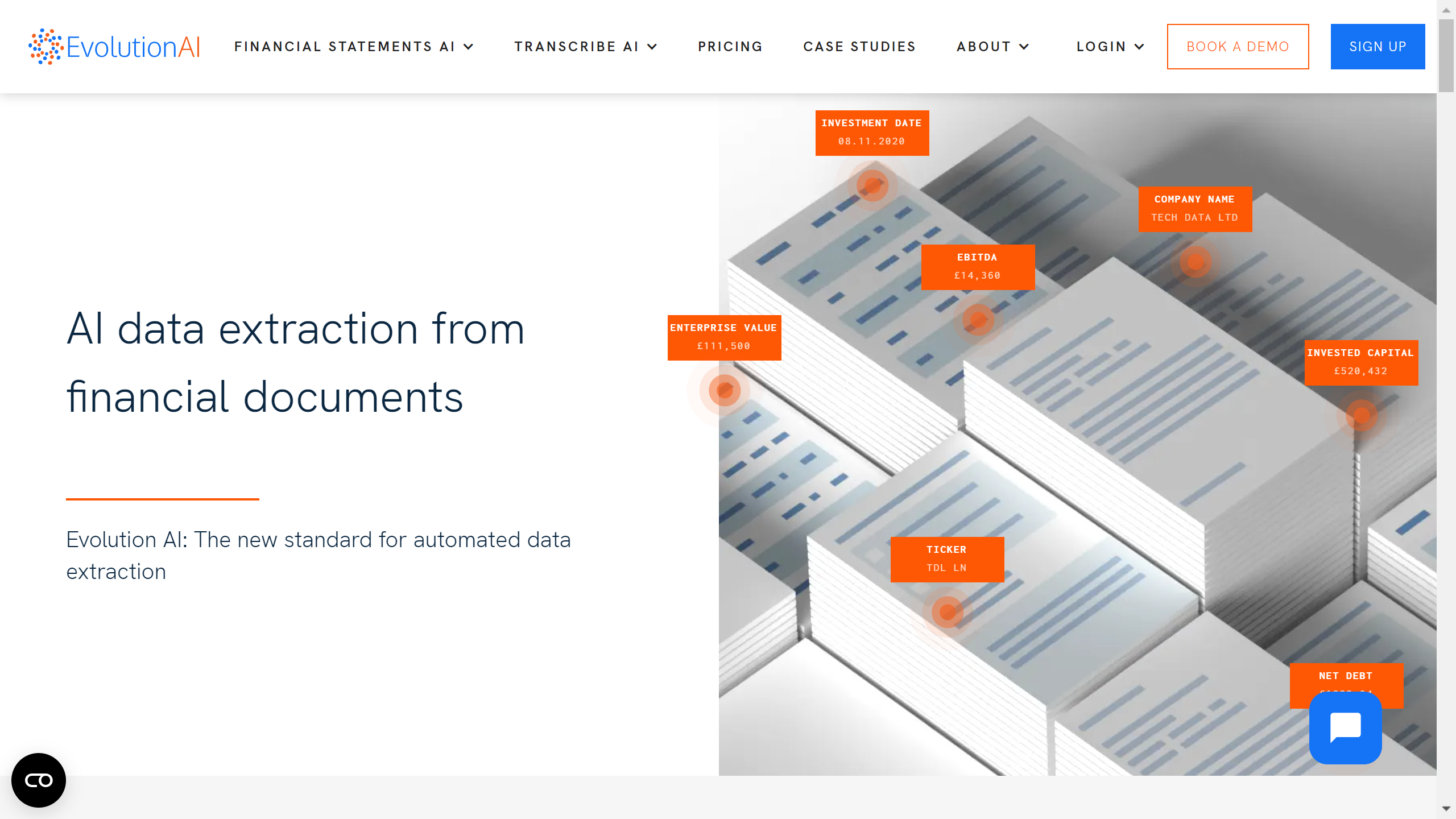
Financial Statements AI is a purpose-built extraction tool for balance sheets, income statements, and cash flow statements. It computes EBITDA, EBIT, and OPEX automatically; leverage ratios, profitability ratios, and cash flow metrics are on the product roadmap. The tool includes human-in-the-loop (HITL) validation and rule-based anomaly detection to flag inconsistencies that may indicate data errors or document tampering. Pricing is usage-based: £0.60 per page for standard extracts and £0.80 per page for balance sheets, with no subscription fee.
The platform's zero-shot algorithm enables extraction without template configuration. According to the Evolution AI product page, the self-learning model reaches over 90% accuracy after 25 documents and 98% after 200 documents. These figures are self-reported and carry no independent benchmark verification.
Customer outcomes
| Customer | Industry | Result | Verified? |
|---|---|---|---|
| NatWest | Retail/commercial banking | Extraction time reduced from 24 hours to seconds | Vendor-reported |
| DF Capital Bank | Specialist lending | 95%+ reduction in invoice processing time; 100% accuracy in POC | Vendor-reported |
| Unigestion | Asset management | 75% cost reduction on quarterly report extraction | Vendor-reported |
| YouLend | Embedded finance | 150,000+ funding instances facilitated via bank statement extraction | Vendor-reported |
| Deutsche Bank | Investment banking | Automated extraction from banking documents | Vendor-reported |
| Dun & Bradstreet | Business data | Document processing client (no outcome figure published) | Vendor-reported |
The DF Capital deployment is the most detailed on record. Rachel Taylor, Head of Change & Continuous Improvement at DF Capital, stated in the Evolution AI DF Capital case study: "It was 100% accurate when extracting the data, and that just blew us away." Processing time dropped from roughly 20 minutes per invoice with mandatory two-person quality control to near-instant, with system integration completed in May 2022.
The NatWest relationship carries a compliance signal relevant to any regulated-sector buyer. Mark Qualter, formerly Head of AI at RBS Group Commercial and Private Banking, noted in the Evolution AI RBS case study: "We are a regulated industry, so partners we work with have to be cognisant of that and also empathetic. If they don't get that, it really is end of story."
Use cases
Evolution AI targets three workflow categories where generic document AI platforms have historically underperformed.
M&A due diligence is the newest expansion. Financial Statements AI extracts structured data from target company financials and computes deal-relevant metrics automatically, reducing analyst time on manual data entry.
Asset management reporting covers quarterly report extraction from portfolio companies. The Unigestion outcome (75% cost reduction) is the primary evidence here.
Corporate banking and lending operations covers account statements, invoices, transaction reports, and regulatory filings. The YouLend deployment illustrates an embedded model: Evolution AI provides extraction technology that YouLend feeds into its own credit decisioning engine for banks, paytechs, and marketplaces. Jessica O'Hare, Head of Product at YouLend, described the arrangement in the Evolution AI YouLend webinar: "This obviously reduces the manual effort required but also massively speeds up the time-to-decision and the time to fund."
Market positioning
Evolution AI competes in a segment where horizontal IDP platforms such as ABBYY and UiPath also operate, but concentrates specifically on financial document types: bank statements, invoices, financial statements, and remittance documents. The DF Capital case study is instructive: DF Capital chose IDP over standard OCR because invoices contained asset-specific fields (make, model, serial number) that OCR-based tools could not reliably extract. This positions Evolution AI in deals where template-based or rules-based OCR has already failed a prospect.
The company's public content argues that generic large language models (LLMs) produce approximately one error per page when reading financial PDFs, and that specialized validation closes this gap. The claim originates from Evolution AI's own analysis and has not been independently benchmarked. Buyers should request vendor-neutral test results on their own document samples before treating this as a purchasing rationale.
The per-page pricing model is a genuine differentiator for buyers modeling total cost of ownership. At £0.60 to £0.80 per page, costs scale directly with volume and are predictable, contrasting with seat-based or platform-subscription pricing common among larger IDP vendors. High-volume buyers should model actual monthly page counts against this rate before comparing to flat-rate alternatives.
CTO Kwasny's prior roles at Credit Suisse, Coutts, and Deutsche Bank are relevant for enterprise banking procurement. The Enterprise RPA case study makes this explicit: partner co-director Paul Agnew cited trust in the team, not just the technology, as the deciding factor over competing products.