Caya: German Mail Digitization and IDP Platform
On This Page
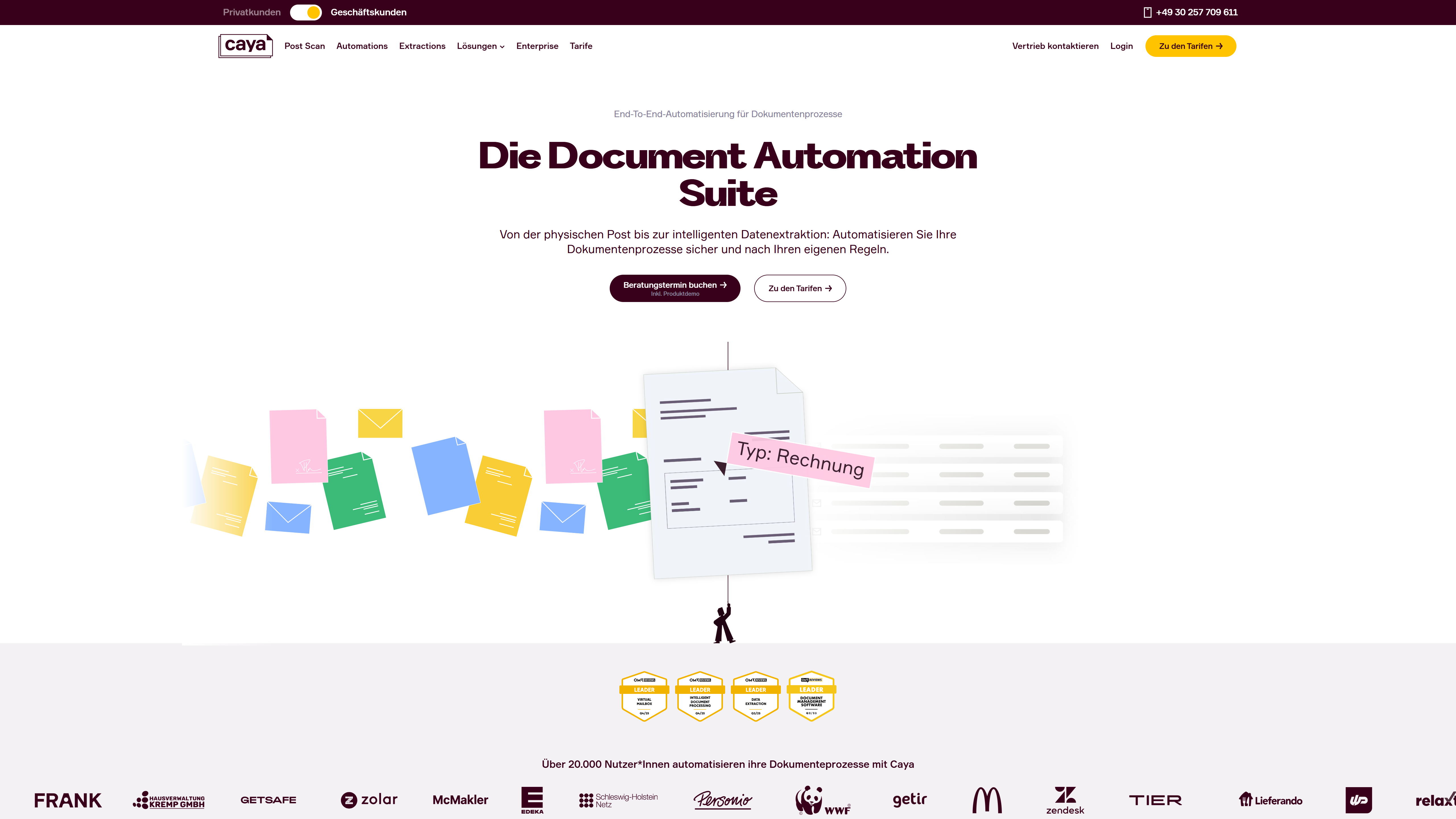
Caya automates the complete physical mail lifecycle for German businesses: from scanning and OCR classification through data extraction and GoBD-compliant archiving, all processed on German servers.
Overview
Founded in 2017 by Louis Pfitzner and Alexander Schneekloth in Berlin, Caya positions itself as Germany's leading mail digitization platform for small and midsize businesses. The platform handles the full document lifecycle: physical mail arrives at Caya's scanning facility, gets digitized with OCR-based classification, routes through configurable automation rules, and lands in a GoBD-compliant archive integrated with accounting and business management systems.
The company raised a Series A round in June 2023 led by DCF Capital Partners and neosfer, bringing total funding to $6.45M. At 45 employees serving 20,000+ customers, Caya operates as a focused vertical specialist rather than a broad intelligent document processing (IDP) platform. That specialization is both its competitive advantage and its ceiling: the platform excels at mail intake automation for German compliance requirements but does not offer an API, which limits adoption among enterprises needing programmatic integration.
Independent review platforms confirm strong product-market fit within its target segment. OMR Reviews reports scores of 9.2/10 on ease of use and 9.4/10 on customer support. GetApp shows a 4.9/5 support rating and 4.7/5 features score from 24 verified reviews. The consistent ratings across platforms suggest genuine user satisfaction rather than review inflation, though recurring complaints about OCR accuracy and mail processing delays point to operational scaling challenges.
Comparable IDP vendors include Parseur.
What users say
Practitioners consistently highlight Caya's value for remote document access. A real estate professional on SoftwareAdvice noted: "Since I travel abroad frequently, electronic mail delivery is essential for me. With CAYA, I can ensure that my documents are stored in a revision-safe manner with OCR capability." A consumer goods company user added: "Mail is scanned directly into the email inbox. This saves an essential work step in daily business operations."
The most cited frustration is support access. A verified user on GetApp stated in March 2026: "Support is only by email, which makes it more difficult for quick solutions." This concern appears across multiple platforms and reflects a structural limitation: Caya offers no phone support channel for real-time issue resolution, which matters when a business's physical mail is in the processing queue.
Pricing perception splits the user base. OMR Reviews flags pricing as high relative to the feature set, while GetApp's value-for-money score of 4.5/5 suggests most users find the cost acceptable. The gap likely reflects customer size: freelancers and small teams find the €9.99/user/month entry point reasonable, while larger organizations comparing against broader document management platforms may question the value.
SoftwareAdvice reports that 63% of user ratings are 5-star and 38% are 4-star, with zero ratings below 4 stars in the reviewed sample. That distribution is unusually positive and suggests Caya's self-selected customer base is well-matched to the product's actual capabilities.
How Caya handles mail automation
Caya's platform consists of three integrated products that move a document from physical envelope to structured business data.
Post Scan handles physical mail intake. Businesses redirect their postal address to Caya's scanning facility, where incoming items are digitized, classified by document type, and made available in the digital inbox. The OCR engine reads sender information, document type indicators, and content to route items automatically. This step eliminates the manual sorting that consumes staff time in paper-heavy workflows.
Document Automations applies rule-based routing after classification. Rules trigger on document type, sender, content keywords, or metadata to distribute items to folders, recipients, or downstream workflows. Property managers route tenant invoices to location-specific workspaces; tax consultants route client correspondence to individual client folders. The rules engine handles organizational hierarchies through multi-tenant architecture with role-based permissions.
Document Extractions pulls structured data from classified documents using OCR and AI-based recognition. The system extracts invoice amounts, dates, vendor names, and line items; contract parties and key dates; and form field values. Extracted data exports to connected accounting, ERP, and CRM systems. The platform stores documents for 90 days by default, with extended retention available, and maintains GoBD-compliant audit trails required for German tax law.
The PDF Toolbox rounds out the platform with editing capabilities: text highlighting, page splitting and merging, form filling, and electronic signature support for documents that require annotation or approval before archiving.
Use cases
Tax consultant document processing
Tax consulting firms digitize client mail by forwarding physical correspondence to Caya's scanning service. Post Scan captures incoming items, classifies them by type (invoices, receipts, bank statements, tax forms), and routes them to appropriate client folders based on sender and content. Document Extractions pulls invoice amounts, dates, vendor details, and expense categories for export to accounting software like DATEV. Mobile apps enable consultants to photograph on-site items for immediate processing alongside the scanned mail stream.
Property management mail automation
Property management companies process tenant correspondence, vendor invoices, and maintenance requests through automated routing workflows. Caya classifies incoming mail by property address and document type, distributing items to location-specific workspaces for regional managers. The platform extracts utility bill amounts and due dates for payment scheduling, routes maintenance quotes to approval workflows, and captures lease agreements for archive storage. Multi-tenant architecture supports organizational hierarchies with permissions controlling access by region, property, or user role.
Remote and mobile business operations
Self-employed professionals and digital nomads represent a core Caya segment. The platform eliminates the need for a physical presence to receive and process mail, providing a searchable online archive accessible via web, iOS, and Android. Integration with Zapier and Make enables these users to build lightweight automation workflows connecting Caya to their existing tool stack without developer resources.
Technical specifications
| Feature | Specification |
|---|---|
| Core products | Post Scan, Document Automations, Document Extractions |
| Technology | OCR, AI-based document recognition |
| Content types | Invoices, contracts, letters, forms, receipts |
| Deployment | Cloud-based (German servers) |
| Access | Web platform, iOS app, Android app |
| Languages | English, German |
| Integrations | 100+ system connectors; Zapier and Make supported |
| API | Not available |
| Compliance | ISO 27001, DSGVO (GDPR), DORA, GoBD |
| Document retention | 90 days default; extended retention optional |
| Multi-tenancy | Location and subsidiary management with role-based permissions |
| Pricing | From €9.99/user/month |
| Target customers | Freelancers, SMBs, tax consultants, property managers, legal guardians, franchises, banks, insurance brokers, coworking spaces |
Caya does not offer a public API. Teams requiring programmatic integration should evaluate this limitation against their technical requirements before committing.
Competitive position
Caya occupies a narrow but defensible niche: end-to-end physical mail automation with German compliance built in. Broader data extraction platforms like ABBYY treat mail digitization as one module among many and require more configuration to meet GoBD requirements. Caya's vertical focus means German SMBs get a purpose-built solution without the implementation overhead of a general-purpose IDP platform.
The trade-off is capability ceiling. Tracxn ranks Caya 442nd among 3,498 active competitors in the document management space, though the comparison set includes significantly larger organizations like Box and Kaltura that serve different use cases. Within the German SMB mail automation segment, Caya's 20,000+ customer base and consistent review scores suggest it holds a strong position. The absence of an API and the email-only support model are the clearest signals that the platform is not designed for enterprise-scale deployments requiring deep technical integration.
The $6.45M total raise is modest for a SaaS platform at this customer scale, which may constrain the pace of product development. The Series A in June 2023 provides runway, but Caya will need to expand its integration depth or move upmarket to sustain growth against better-funded competitors entering the German compliance automation space.
Resources
- Caya website
- Post Scan product page
- Integrations overview
- Help Center
- GetApp reviews
- OMR Reviews
Company information
Headquarters: Berlin, Germany
Founded: 2017
Founders: Louis Pfitzner and Alexander Schneekloth
Employees: 45 (November 2025)
Total funding: $6.45M (seed April 2020; Series A June 2023)
Investors: DCF Capital Partners, neosfer
Phone: +49 30 257 709 611
Email: business@getcaya.com, hello@getcaya.com
Contact: Sales inquiry
Customers: 20,000+