Rossum: Template-Free IDP with AI Agents
On This Page
Your AP team processes thousands of invoices monthly, but every new supplier format means another template to configure and maintain.
Rossum bets that specialist AI agents for accounts payable beat general-purpose automation platforms. They raised $104M from General Catalyst on that thesis and earned IDC Leader and Gartner Strong Performer designations. But "specialist" also means cloud-only SaaS with no on-premise option, and their $1.3 trillion transaction volume is self-reported. What brought you here determines which claims matter most.
IDC named Rossum a Leader in 2023-2024. Gartner rated them Strong Performer based on 20+ verified reviews spanning banking, logistics, insurance, government, and manufacturing. General Catalyst invested $100M in a single Series A. But Rossum is cloud-only, doesn't publish employee headcount, and offers no independent accuracy benchmarks. Analyst recognition confirms market presence; it doesn't confirm the platform handles your specific document types at production scale.
Rossum's Aurora engine reads document layouts through deep learning, skipping pre-configured templates entirely. Specialist AI agents then handle validation, three-way matching, and exception routing. Eurowag's deployment proves this across 60 entities with fuel invoice classification and tax calculations. But template-free still requires master data, business rules, and ERP mappings. The configuration burden shifts from document templates to workflow logic.
Eurowag cut invoice processing from 9 days to 4 days across 60 entities, pushing on-time payments from 60% to over 90%. Those numbers are compelling, but self-reported through Rossum's own case study. The 70% automation rate still means 30% of invoices require human review, and their next target of 75% depends on migrating from batch SFTP to real-time API. Strong proof of concept; less evidence at true lights-out scale.
Cloud-only SaaS with SOC 2 compliance, REST API, and two Python SDKs: rossum-api 3.8.0 (Python 3.10-3.14) and rossum-agent-client 1.1.0 (Python 3.12+). Streaming and async support are production-ready. But no on-premise deployment, no published language support count, and no pricing transparency. If your security team requires data residency or air-gapped processing, Rossum's architecture rules it out before the evaluation starts.
Rossum is an AI platform specializing in intelligent document processing with specialist AI agents, template-free cognitive extraction, and EU e-invoicing compliance for enterprise accounts payable teams.
Overview
Founded in 2017 in Prague by Tomáš Gogar, Petr Baudiš, and Tomáš Tunys, Rossum secured a $100 million Series A from General Catalyst in 2023, bringing total funding to $104 million. IDC named Rossum a Leader in its MarketScape for Intelligent Document Processing Software 2023-2024, and Gartner designated Rossum a Strong Performer in its 2025 Voice of the Customer for IDP Solutions based on 20+ verified reviews spanning banking, logistics, insurance, government, and manufacturing.
On April 15, 2026, Everest Group named Rossum one of ten Leaders in its 2026 IDP PEAK Matrix Assessment, alongside ABBYY, EdgeVerve, HCL Tech, Hyperscience, Infrrd, Microsoft, Nanonets, Tungsten Automation, and UiPath. Twenty-seven days later, on May 12, 2026, Coupa announced its acquisition of Rossum at Coupa Inspire 2026 in Las Vegas, ending Rossum's standalone vendor status. The deal extends Rossum's transactional LLM and AP automation across Coupa's spend management portfolio, combining the model with Coupa's $10 trillion community spend network. The acquisition is covered in detail in the May 12, 2026 news brief.
Rossum's product strategy centers on specialist AI agents for enterprise document automation, a deliberate counter-positioning against generalist AI agent platforms entering document processing. CTO Petr Baudis framed the distinction directly: "While generalist AI agents may seem like an appealing shortcut, they lack the specific skills, domain expertise, and guardrails needed to handle these workflows reliably." The bet is that vertical depth in accounts payable beats horizontal flexibility, a claim the company backs with deployments like Eurowag's 70% invoice automation across 60 entities.
In August 2025, Rossum achieved ISO/IEC 42001:2023 certification for its Artificial Intelligence Management System, becoming one of the first document automation vendors to meet the international standard for AI governance. The certification covers Rossum's full AI lifecycle: data management, model development, deployment, and ongoing monitoring. Combined with existing ISO 27001 and SOC 2 Type II attestations, this creates a compliance posture that directly addresses the EU AI Act for finance teams in regulated industries. As CEO Tomas Gogar stated in August 2025: "Responsible AI isn't an afterthought, it's core to our architecture."
Rossum's commissioned survey of 450 finance leaders across the UK, US, and Germany reveals a market still early in automation maturity. 54.2% have not fully automated their processes, with 1 in 10 still relying on manual data entry and Excel. The survey's deeper findings show that 61.6% of respondents prioritize accuracy of financial data over speed or cost savings, 35.8% demand AP systems that reliably flag all exceptions while passing standard invoices straight through, and a third say existing tools cannot scale with operational demands. Regional patterns diverge: Germany leads full automation at 38% with data accuracy as the top priority (55.3%), the UK shows the strongest hyperautomation ambition (40%) with 42.7% demanding human-readable audit trails, and US teams lead in formal KPI measurement (37.3%). All survey figures are Rossum-commissioned research through Appinio, not independent analysis.
How Rossum processes documents
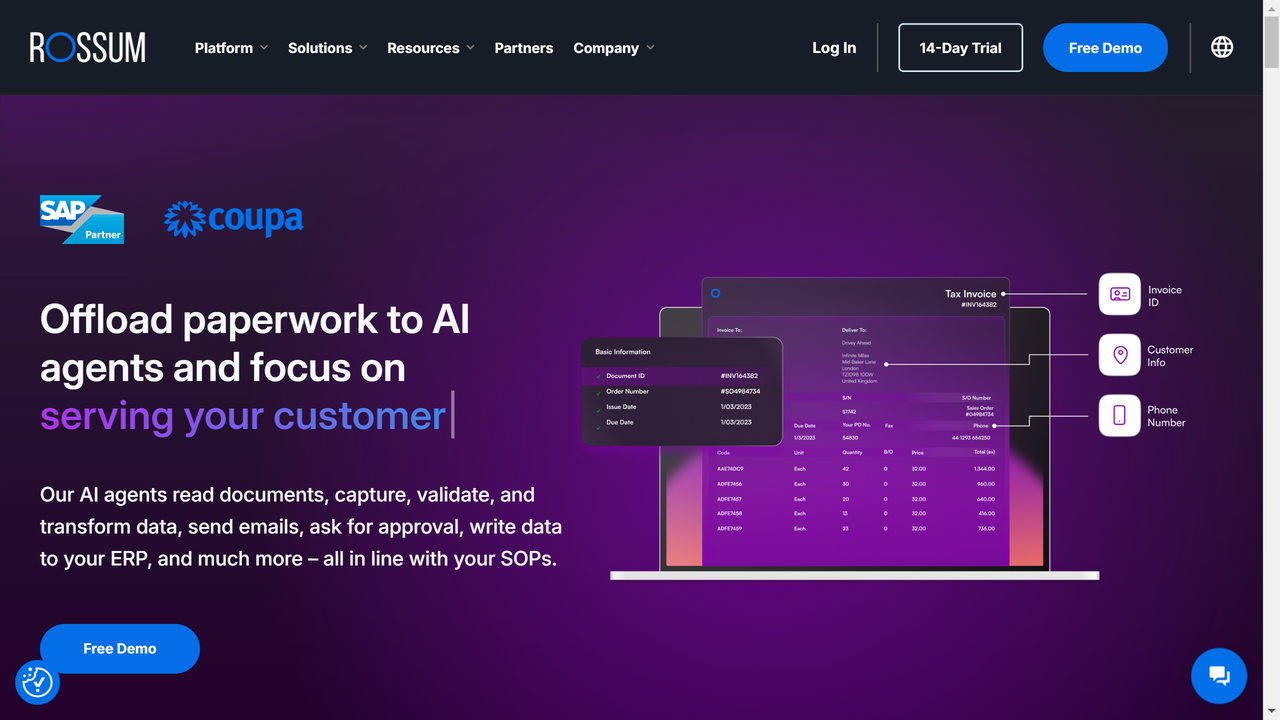
Rossum's Aurora engine provides template-free AI extraction that recognizes document layouts without pre-defined templates, handling transactional document types through deep learning and computer vision. Unlike rule-based IDP platforms that require manual template configuration for each document variant, Aurora processes documents with context understanding, adapting to layout variations automatically.
Aurora is Rossum's proprietary transactional large language model (LLM), introduced in February 2024 specifically to eliminate hallucinations from third-party models. The model extracts only information explicitly present on documents, a core design constraint that distinguishes it from general-purpose LLMs like GPT or Claude used by some competitors. Aurora 1.5, released in October 2025, added instant learning for 276 languages, handwriting support, and 4x faster processing for documents exceeding 100 pages. This contrasts with competitors like Hyperscience and ABBYY, which integrate third-party LLMs alongside proprietary extraction engines rather than building a dedicated transactional model.
The platform's specialist AI agents, launched February 2025, handle complex accounts payable workflows end-to-end across four capability areas. Procedures and actions enforce SOP-consistent execution. Reasoning infers data not explicitly present in documents. Datasets integrate enterprise master data for validation. Business and operational insights deliver enhanced reporting on agent performance. Rossum designed these agents for domain-specific document processing rather than general-purpose automation, requiring no IT involvement for setup. A Master Data Hub centralizes business rules and company data management, feeding agents with the context needed for validation and exception handling.
Agent architecture
Rossum's January 2026 R&D post reveals 500+ commits of engineering work on agent reliability, context optimization, and prompt engineering. The platform uses Claude models with MCP server integration for tool calling. Key architectural decisions include sub-agents for context isolation, where separate LLM calls with restricted toolsets prevent context bleed between tasks. Dynamic tool loading reduces baseline context from 8,000 tokens to approximately 800 tokens, a 90% reduction that directly improves reasoning speed and cost. A Skills Framework uses modular, version-controlled prompt units that can be updated independently without redeploying the full agent. Switching from Claude Sonnet to Opus 4.5 enabled a 70% reduction in prompt length while improving agent reasoning and reducing tool-calling loops. Rossum embeds agents directly into the platform UI as native panels rather than standalone chatbot applications, and uses regression testing frameworks for prompts to catch silent regressions in agent behavior. As one Rossum R&D engineer noted: "Making an agent work once is easy. Making it work reliably for the next person's question? That's the actual job."
Where Rossum goes beyond generic extraction is in domain-specific classification and calculation. The Eurowag deployment illustrates this depth: the platform distinguishes fuel-specific invoices from OPEX/CAPEX documents automatically, applies formula fields for tax and base amount calculations, runs date validations, and matches extracted data against master records before routing to ERP. These are native capabilities of the specialist agents, not configurable rules layered on top of extraction.
Three-way matching automatically correlates purchase orders, invoices, and receipts, while multi-channel reception captures documents through email, API, and portal interfaces. The Python SDK Suite (rossum-api 3.8.0 and rossum-agent-client 1.1.0) provides production-ready APIs with streaming capabilities and async/sync operations for developers building custom integrations.
E-invoicing compliance
With EU e-invoicing mandates rolling out across member states, Rossum has built a compliance plugin that positions the platform as a single hub for both structured e-invoices and unstructured PDF processing. The plugin supports seven country-specific formats: FatturaPA (Italy), XRechnung (Germany), ZUGFeRD (Germany), BIS3 (Nordic), KSeF (Poland), FacturX/CII (France), and Facturae (Spain). Transmission methods include Peppol, KSeF, and PDP, with plans to become an official Peppol endpoint.
The mandate timeline creates urgency: Belgium's B2B e-invoicing mandate took effect January 2026, Poland's KSeF launched February 2026, France follows in September 2026, and Spain in January 2027. Rossum's own survey found that 30.7% of finance leaders view global compliance as a top barrier to scaling, while 26.4% cite cross-border data security and integrity as their biggest concern with e-invoicing mandates. The plugin validates invoices against country mandates, flags errors for human review, and can enrich e-invoice XML data from attached PDFs. Unlike pure data extraction tools that handle only one format, this dual capability targets organizations navigating the transition period between paper-based and fully electronic invoicing.
Rossum claims to have processed over $1.3 trillion in transactions (self-reported via webinar, unverified by independent sources). If accurate, that figure places Rossum among the higher-volume AP automation platforms on the market.
Use cases
Automated invoice processing
Finance departments implement Rossum to eliminate manual data entry, with Aurora extracting header information, line items, and payment terms from invoices regardless of layout. The strongest quantified proof point comes from European fintech Eurowag, which achieved 70% invoice automation across 60 entities using a Rossum and Coupa integration feeding into SAP for payment posting. The implementation started in April 2023 and completed onboarding across all 60 entities by January 2026, a 34-month rollout that Eurowag's Product Owner Vojtěch Podaný called "straightforward."
End-to-end processing time dropped from 9 days to 4 days (55% reduction), on-time payments rose from 60% to over 90%, and median review time for non-automated invoices hit 45 seconds across 9,000 monthly invoices. As Marcella Mates, Head of Financial Operations at Eurowag, noted: "Eurowag now has clear visibility into Accounts Payable across all 60 entities. The data is more accurate and reliable, and this gives us better financial insights to make smarter and more strategic business decisions." All metrics are self-reported through Rossum's own case study. The next target is 75% automation after migrating from SFTP batch transfers to real-time Coupa API integration. Named enterprise customers also include Panasonic, Veolia, and Bosch. For a broader look at this space, see our invoice processing automation guide.
Purchase order management
Procurement teams use Rossum's three-way matching capabilities to automatically correlate purchase orders with invoices and goods receipts. The system's specialist AI agents handle discrepancy resolution and approval routing based on configurable business rules, with no IT involvement required for setup. Teams evaluating no-code alternatives for similar order automation may also find DOConvert relevant, as it targets supply chain and manufacturing purchase order workflows with ERP integration and no training requirements. Learn more about this workflow in our purchase order processing guide.
Logistics document processing
Transportation companies process bills of lading, shipping manifests, and customs declarations through Aurora, which extracts shipment details, container numbers, and destination addresses for integration with transportation management systems. Rossum's Gartner Voice of the Customer reviews confirm cross-industry adoption spanning banking, logistics, insurance, government, and manufacturing. See our logistics document processing guide for industry best practices. Teams evaluating open-source alternatives for similar extraction tasks may also find Unstract relevant, as it offers a no-code LLM platform with hallucination mitigation for production document workflows.
Technical specifications
| Feature | Specification |
|---|---|
| Deployment | Cloud-based SaaS platform |
| AI Engine | Aurora proprietary transactional LLM (deep learning, computer vision) |
| AI Agents | Procedures/actions, reasoning, datasets, business insights |
| Languages | 276 (Aurora 1.5, instant learning) |
| Document Types | Invoices, purchase orders, bills of lading, certificates, e-invoices |
| E-invoicing Formats | FatturaPA, XRechnung, ZUGFeRD, BIS3, KSeF, FacturX/CII, Facturae |
| Transmission | Peppol, KSeF, PDP |
| API Support | REST API with Python SDKs (sync/async, streaming) |
| Python Compatibility | 3.10-3.14 (rossum-api), 3.12+ (rossum-agent-client) |
| Data Export | JSON, XML, CSV, direct API integration |
| Security Certifications | SOC 2 Type II, ISO 27001, ISO/IEC 42001:2023 |
| Agent Context | Dynamic tool loading: 8,000 tokens reduced to ~800 tokens |
| Processing Speed | 4x faster for documents exceeding 100 pages (Aurora 1.5) |
| Transaction Volume | $1.3 trillion+ (self-reported) |
Resources
- Company Website
- Python SDK Documentation
- E-invoicing Plugin
- Customer Stories
- Document Automation Trends 2026 Report
- Blog: rossum.ai/blog
- Help Center: rossum.ai/help
Company information
Rossum is headquartered at 71-75 Shelton Street, Holborn, London WC2H 7JQ, United Kingdom. Co-founder and CEO Tomáš Gogar leads the company alongside CTO and co-founder Petr Baudis. Founded in 2017 with $104 million in total funding from General Catalyst, Rossum is positioned among the top 2026 IDP platforms alongside UiPath, ABBYY, and Hyperscience, with particular strength in invoice and financial document automation.
The ISO/IEC 42001:2023 certification, achieved in August 2025, signals a deliberate governance-as-product strategy. Ondrej Krticka, VP of Legal at Rossum, described it as complementing "existing ISO 27001 and SOC 2 Type II attestations to create a comprehensive security and governance umbrella" for enterprise customers in regulated industries. Named customers like Panasonic, Veolia, and Bosch operate in sectors where AI governance directly influences procurement decisions, suggesting the certification targets deal velocity in high-compliance verticals rather than serving as a checkbox exercise.
For a structured comparison of Rossum against other finance-focused IDP platforms, see the Rossum competitive analysis. Developers building structured extraction pipelines with LLMs may also want to review LangExtract, Google's open-source Python library for grounded information extraction from unstructured text. Finance teams seeking outcome-based pricing models with zero invoicing until results are achieved may also want to evaluate AmyGB as an alternative approach to IDP procurement.