FileHold: Document Management Software Vendor
On This Page
Canadian document management software provider acquired by KeyMark in 2024, offering Microsoft-integrated DMS solutions with a 2-hour installation guarantee.
Overview
KeyMark acquired FileHold Systems Inc. on December 31, 2024, transforming the Vancouver-based company into FileHold Systems ULC under the US automation integrator's portfolio. Jim Wanner, KeyMark CEO, described the acquisition as filling "a gap in our current offerings, enabling KeyMark to approach a previously unserved market segment with document management solutions." The deal brought a 20-year-old independent DMS vendor into a broader intelligent automation stack.
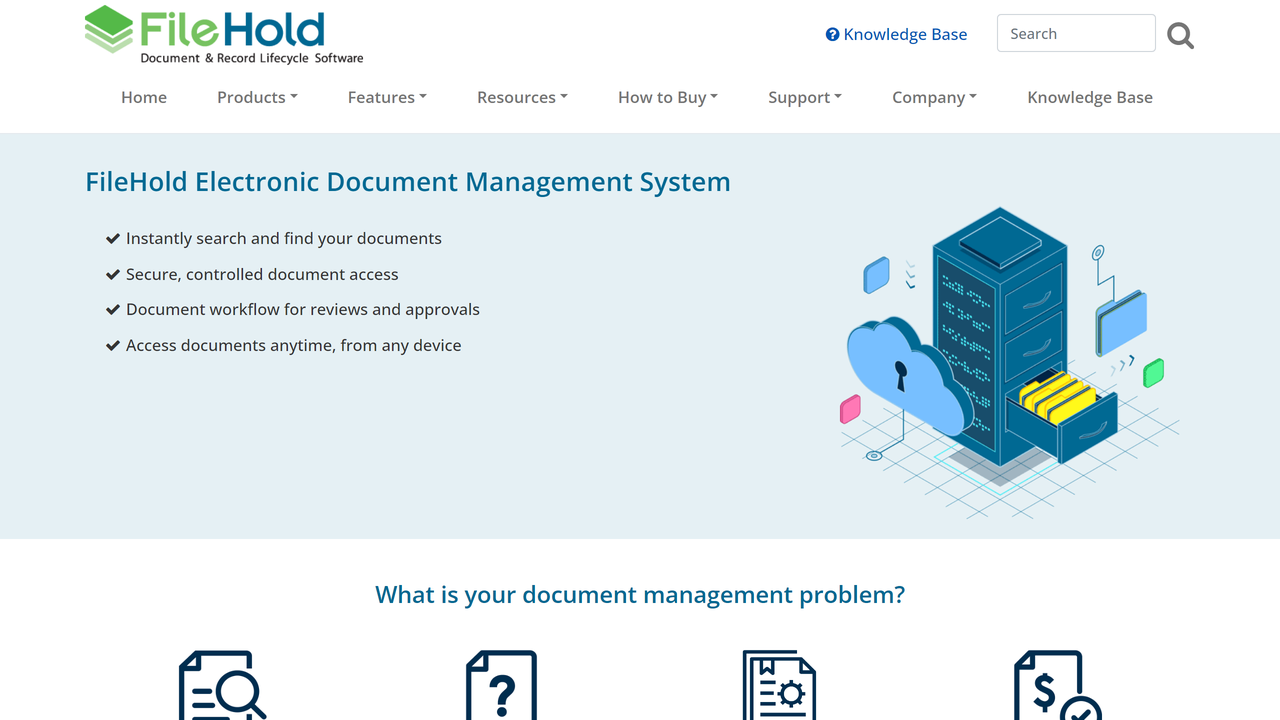
Larry Oliver, FileHold President, has consistently framed the platform's value around operational simplicity: enterprise-grade document management that extends beyond eliminating paper and automating workflow processes. The platform holds Microsoft Gold Development Partner certification with deep Office, Active Directory, and SharePoint integration, and backs deployment with a 2-hour installation guarantee.
Under KeyMark ownership, FileHold has moved on product and recognition. In January 2026, it launched FileHold 17 alongside two new products: a Customer Forms Portal and a DataRoom solution for M&A workflows. That same month, it received Capterra "Best of" badges across 10 categories and a 4.7/5 user rating, though reviews note AI capability gaps relative to competitors like Laserfiche. Gartner Digital Markets recognized FileHold across four categories: Value, Usability, Customer Support, and Recommendations, based on aggregated end-user reviews from Capterra, GetApp, and Software Advice. These are not Magic Quadrant placements; no scores or review counts were disclosed.
The picture that emerges from independent data is a platform with strong retention among existing users and a narrowing competitive position against AI-native alternatives. SoftwareReviews records an 85 Likeliness to Recommend score, a 100% Plan to Renew rate, and a +95 Net Emotional Footprint as of 2026. The same data source captures the tension: a December 2025 user review states FileHold "is not very modern thing and also has no AI and automation." FileHold competes on operational excellence and compliance rigor, not innovation velocity.
What users say
Independent user data from SoftwareReviews tells a consistent story: practitioners value FileHold for Microsoft integration and deployment flexibility, but flag the absence of AI-driven automation as a meaningful gap against modern platforms.
Sonali K., an IT professional in the technology industry, offered the clearest summary of both sides in December 2025: "Filehold gives the best integration with Microsoft tools and also gives the best flexible deployment," and separately, "It is not very modern thing and also has no AI and automation." That combination, strong infrastructure fit paired with limited intelligent processing, defines how current users experience the platform.
Ben Aston, writing for The Digital Project Manager in April 2026, highlighted the virtual folders feature as a genuine differentiator: "A PM can pull together contracts, design specs, and invoices into one place even when they're stored in completely different parts of the system." He also noted that "retention and disposition policies are built in as standard, and every user action is captured in a full audit trail," calling the records management capabilities "genuinely impressive for enterprise use."
Friction points cluster around mobile access and support. A June 2024 review noted the lack of a mobile app limits accessibility and that the workflow designer lacks intuitiveness. A separate June 2024 reviewer in the IT and media industry flagged slow support response times and resource-intensive on-premises installation. These are operational concerns rather than architectural failures, but they reduce competitive appeal for organizations prioritizing distributed, agile workflows.
The 100% Plan to Renew rate signals strong retention among users already embedded in Microsoft-dependent workflows. New customer acquisition faces a harder argument against platforms that lead with native AI extraction.
How FileHold processes documents
FileHold follows a capture-index-route model built on Microsoft infrastructure. Documents enter the system through web browser upload, Microsoft Office integration, or mobile apps, and are stored against a configurable metadata schema tied to Active Directory user identities.
Server-side OCR is available as an optional module, converting PDF and TIFF files into searchable text at ingestion. Classification and indexing rely on user-defined metadata fields and folder hierarchies rather than AI-driven extraction. This is a deliberate design choice that prioritizes predictability over automation depth. Eleven pre-configured user roles control access at the document and folder level, with customizable permissions layered on top.
Workflow automation routes documents through configurable review and approval sequences, with electronic signature capture at each stage. The Web Services API connects FileHold to back-office systems for bidirectional document exchange. The optional Customer Forms Portal extends document collection to external parties, feeding submissions directly into the core repository.
This architecture positions FileHold closer to structured document management than to AI-powered intelligent document processing. That trade-off simplifies deployment and administration but limits autonomous extraction capabilities compared to platforms like ABBYY or Hyland. For regulated industries where audit trails and retention policies matter more than zero-touch extraction rates, that trade-off is often acceptable.
FileHold earns its spot as one of the best on my shortlist because of how well it handles enterprise-scale document management without sacrificing control. I particularly like the virtual folders feature, which lets project managers aggregate documents from across the entire library into a single personal view. Ben Aston, The Digital Project Manager, April 2, 2026
Use cases
Municipal records management
Ontario municipalities implement FileHold with TOMRMS for complete records lifecycle management. Clerks index bylaw documents, council minutes, building permits, and zoning applications with retention schedules. Automated workflows route approvals through department heads while maintaining compliance audit trails.
Mergers and acquisitions
The DataRoom solution launched in January 2026 manages confidential documents during M&A transactions. Secure access controls limit stakeholder visibility to specific document sets, audit trails track all access activity, and automated workflows manage due diligence document requests and approvals. For a comparison of dedicated virtual data room providers, see Drooms.
Quality management documentation
Manufacturing organizations manage ISO quality system documentation including SOPs, work instructions, and corrective action records. Version control tracks revisions, electronic signatures capture quality manager approvals, and automated distribution notifies staff of procedure updates.
Technical specifications
| Feature | Specification |
|---|---|
| Platform | Microsoft SQL Server, Windows Server, .NET framework |
| Ownership | FileHold Systems ULC (KeyMark subsidiary since Dec 2024) |
| Access Methods | Web browser, Microsoft Office integration, mobile apps |
| Security | 11 pre-configured user roles, customizable permissions |
| Optional Features | Workflow module, server-side OCR, Customer Forms Portal, DataRoom |
| API | Web Services API for third-party integration |
| Deployment | On-premise, cloud, hybrid |
| Installation | 2-hour installation guarantee |
| Pricing | Starting at $1,200/year for 5 users |
| Target Market | Mid-market enterprises, municipalities, government agencies |
| Current Version | FileHold 17 (released January 2026) |
Resources
- Website
- Standard Features
- Optional Features
- KeyMark Acquisition Announcement
- SoftwareReviews Profile
- The Digital Project Manager 2026 Assessment
- Document Archiving Solutions
Company information
Headquarters: Vancouver, British Columbia, Canada
Company Type: FileHold Systems ULC (KeyMark subsidiary since December 31, 2024)
Target Market: Mid-market enterprises, municipalities, government agencies
Partner Network: Implementation partners including Image Advantage
Notable Deployments: Multiple Ontario municipalities