Semantha: Semantic AI Document Processing
On This Page
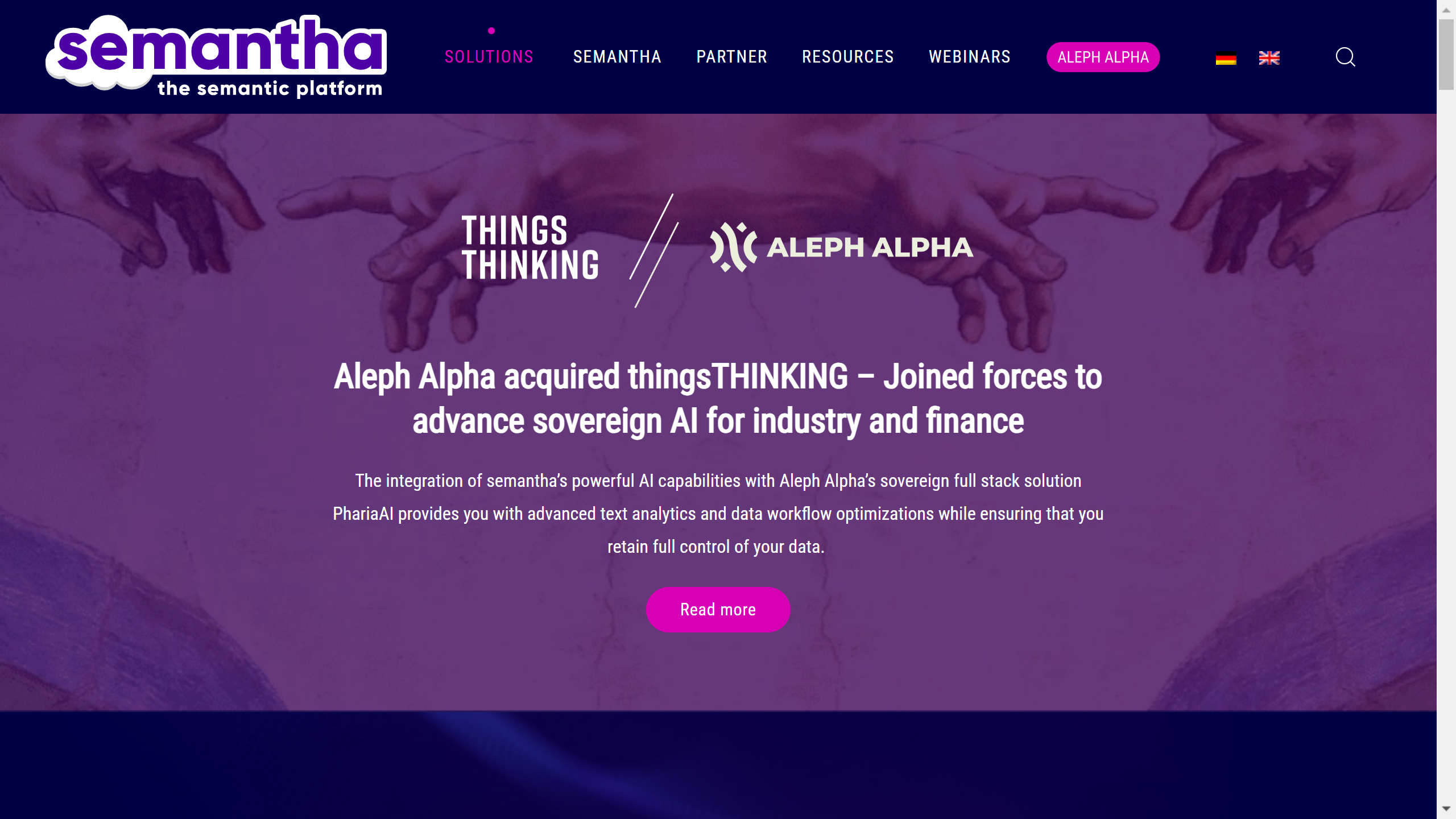
Semantha is a semantic AI platform developed by thingsThinking GmbH (Karlsruhe), built on natural language processing research from the Karlsruhe Institute of Technology. Once an independent IDP vendor, Semantha was acquired by Aleph Alpha on April 24, 2025 and integrated into the PhariaAI enterprise AI platform; procurement now runs through Aleph Alpha's enterprise sales motion. The platform distinguishes itself from competitors like ABBYY and UiPath by performing semantic document understanding without requiring training or fine-tuning: a search for "The road was icy" returns results containing "The road was slippery" because the system matches meaning, not words.
Overview
Semantha was founded in 2017 as a spin-off from the Karlsruhe Institute of Technology by Sven Körner, Mathias Landhäußer, Georg Müller, and Abdelmalik El Guesaoui. The company raised approximately €4.5 million in 2021, including investment from Earlybird Venture Capital, which also holds a stake in Aleph Alpha. The acquisition price was a single-digit million euro sum, making it a modest acqui-hire rather than a strategic premium transaction.
The acquisition is Aleph Alpha's second in consecutive years, following its purchase of Lengoo, a Berlin enterprise translation platform. The pattern reflects deliberate horizontal NLP portfolio-building: translation coverage with Lengoo and semantic document understanding with Semantha represent portfolio expansion rather than vertical deepening. Aleph Alpha, which raised €460 million in 2023 and has since shifted from training its own large language models to B2B enterprise AI consulting, is acquiring proven domain-specific capabilities rather than building them internally.
The acquisition rationale was explicit on the people side: Heise.de reports that most thingsThinking staff were retained, with industry-specific knowledge in automotive, finance, and public administration cited alongside the technology itself. Christopher Kränzler, Vice President of Product at Aleph Alpha, stated: "This acquisition unites proven technology and an exceptional team. thingsTHINKING's deep domain knowledge and proven track record in building verticalized AI solutions will expand our capacity to help customers across the industrial and financial services sectors in transforming their processes with AI."
What remains unresolved is commercially significant: neither party has disclosed whether Semantha continues as a named product within PhariaAI or becomes an unnamed capability. Aleph Alpha's best-known customer, the German Federal Employment Agency, anchors its public-sector positioning; Semantha's automotive and financial services deployments, with named customers including BASF, Hella, and HDI, extend that reach into private enterprise. Both companies share data sovereignty as a differentiator: on-premises deployment and GDPR compliance position them against cloud-dependent alternatives from Microsoft and Google, making the alignment commercially coherent rather than incidental.
How Semantha processes documents
Semantha operates through adaptive AI that processes text-driven workflows without training or machine learning model development. Rather than matching keywords, the platform interprets meaning: it finds semantically equivalent content across differently worded text, transforming unstructured documents into structured information at the meaning level. As founder Sven Körner describes it: "Our software understands natural language regardless of the word choice. It is able to read large amounts of text and find the desired content, no matter how it was formulated."
The JSON-based REST API with Python SDK distributed via PyPI supports Microsoft Office, PDF, XML-based ReqIF, and custom XSL transformations for bulk processing. This no-training architecture is the core differentiator against machine learning-heavy competitors like Rossum and Hyperscience, where model development and fine-tuning add weeks to deployment timelines.
Customer implementations demonstrate the efficiency gains this approach enables. Insurance policy checking became 40% faster, and contract reviews at Heidelberger Volksbank dropped from 20 days to 2 hours. The City of Heilbronn achieved automated letter categorization that eliminates manual pre-sorting, processing 600 letters daily with automated routing. HELLA reported that preprocessing minimizes repetitive processes, enabling faster customer feedback. Across implementations, customers report a 98.75% resource reduction, a metric reflecting the no-training architecture's advantage over template-based extraction approaches.
The platform's three core modules cover the primary enterprise document workflows: Analyzer performs hotspot detection, Compare handles document comparison, and Requirements manages specification evaluation using historical data classification. Semantha Structure Navigator provides document structure visualization; Smart Cluster enables automated document clustering. Enterprise search capabilities deliver semantic search across document repositories with multi-language processing support.
Use cases
Legal and financial services
Legal departments use Semantha Analyzer for contract review, risk identification, and compliance verification through semantic analysis of contract clauses across varying legal language. At Heidelberger Volksbank, contract review time fell from 20 days to 2 hours, a reduction that reflects the platform's ability to process legal language without requiring document-specific model training. Insurance companies process high volumes of claims correspondence while maintaining GDPR compliance, with policy checking running 40% faster than manual workflows. HDI is among the named insurance customers in this segment.
Automotive and engineering
Engineering teams deploy the Requirements module to analyze technical specifications, identify inconsistencies, and map relationships between requirements across product development cycles. The Polarion extension for AI-powered requirements evaluation extends this into requirements management toolchains, automating analysis by using existing project knowledge and generating Requirements Interchange Format files. BASF and HELLA are named customers in this segment, positioning Semantha against specialized requirements tools in automotive and manufacturing workflows where the no-training approach reduces deployment overhead compared to traditional OCR and data extraction platforms.
Public administration
The City of Heilbronn deployed Semantha for automated letter categorization, eliminating manual pre-sorting across 600 letters daily with automated routing. This public administration use case aligns with Aleph Alpha's broader positioning, particularly given that the German Federal Employment Agency is Aleph Alpha's best-known customer, suggesting the combined entity will pursue further government sector expansion under the PhariaAI umbrella.
Technical specifications
| Feature | Specification |
|---|---|
| Core modules | Requirements, Structure Navigator, Compare, Analyzer, Topic Check, Smart Cluster |
| AI technology | Semantic analysis, NLP, adaptive AI |
| Training requirements | None; no model training or fine-tuning required |
| Language support | Multi-language processing |
| Data processing | Unstructured to structured data transformation |
| Architecture | Scalable web service with JSON REST API |
| SDK | Python SDK via PyPI |
| File formats | Microsoft Office, PDF, XML/ReqIF, custom XSL |
| Deployment | On-premises, cloud, PhariaAI sovereign AI infrastructure |
| Compliance | GDPR-compliant, data security controls |
| Pricing | Annual licensing (SaaS via Microsoft AppSource) |
| Target industries | Automotive, chemicals, insurance, legal, finance, public administration |
Resources
- Website
- Microsoft AppSource: Semantha Platform
- Polarion Extension: AI-Powered Requirements Evaluation
- Aleph Alpha acquisition announcement
- Heise.de: Aleph Alpha acquires semantics specialist Thingsthinking
- AllAboutAI: Aleph Alpha acquires thingsTHINKING
Company information
Parent company: Aleph Alpha (Heidelberg, Germany); thingsThinking GmbH acquired April 24, 2025 for a single-digit million euro sum. Aleph Alpha's second acquisition after Lengoo.
Headquarters: Karlsruhe, Germany
Founded: 2017 as a spin-off from Karlsruhe Institute of Technology
Founders: Sven Körner, Mathias Landhäußer, Georg Müller, Abdelmalik El Guesaoui
Research background: 14+ years of NLP and AI research at Karlsruhe Institute of Technology
Funding: €4.5 million raised in 2021, including Earlybird Venture Capital; acquisition terms were a single-digit million euro sum
Vendor status: No longer an independent IDP vendor. Go-to-market runs through Aleph Alpha and PhariaAI. Whether Semantha continues as a named product or becomes an unnamed capability within PhariaAI has not been disclosed by either party.