Botminds AI: IDP Software Vendor
On This Page
No-code agentic AI platform with governance-first architecture for auditable document processing and workflow automation.
Overview
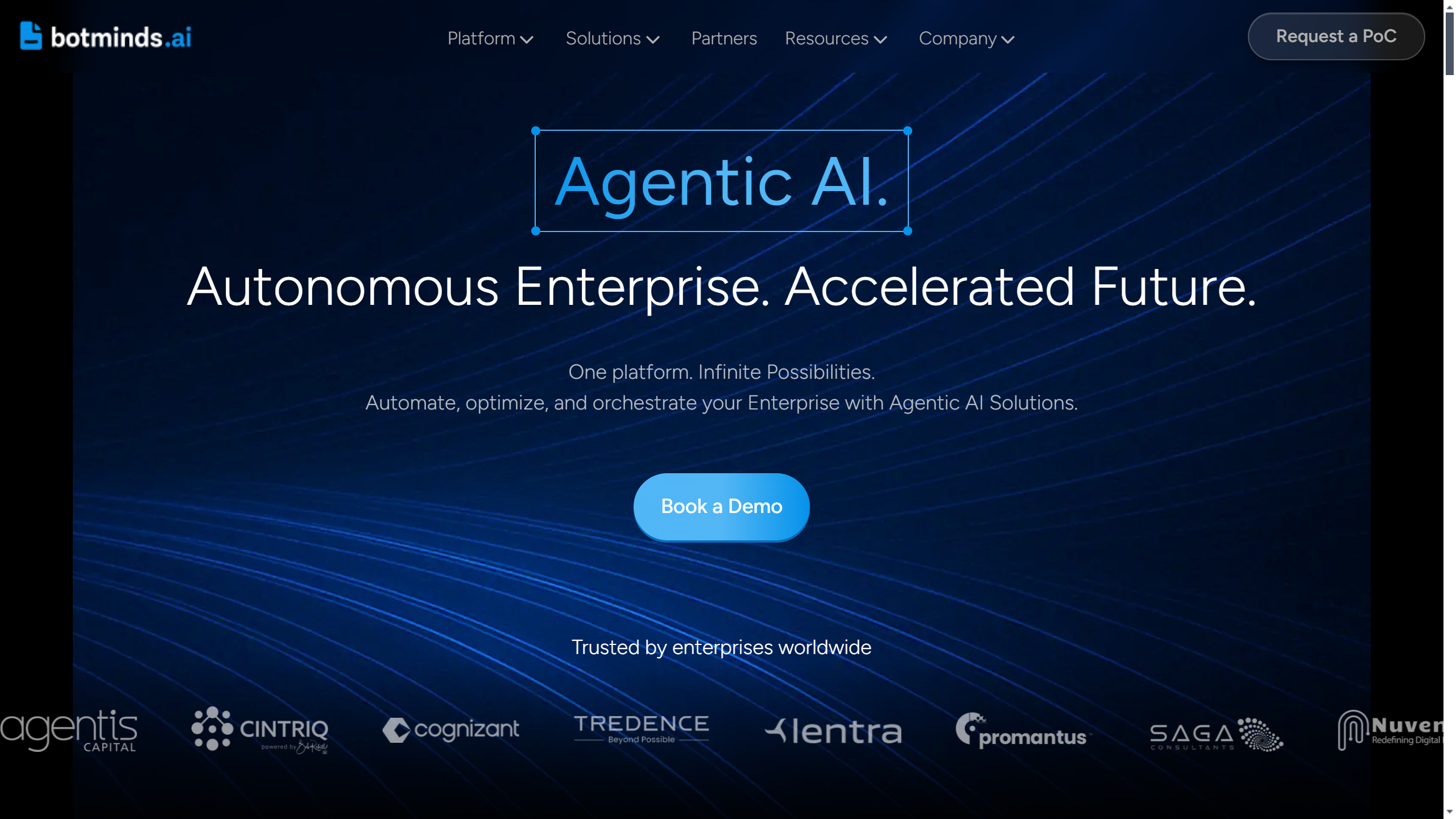
Founded in 2015 and based in Bellevue, Washington, Botminds AI has evolved from a document processing vendor into a governance-first enterprise AI platform. The company's positioning, articulated by CEO Gokul Ganapathi in early 2026, treats accountability rather than execution capability as the primary bottleneck for enterprise AI adoption. This targets compliance-heavy buyers who have stalled on proofs-of-concept rather than organizations still evaluating whether to automate at all.
That thesis is expressed in a three-tier architecture: L1 Agentic Search with audit trails, L2 Agentic Automation with bounded workflows, and L3 Agentic Systems with policy-aware operations. The Microsoft Azure OpenAI integration combines proprietary domain models with foundation model capabilities in private instances, delivering a 90% reduction in solution development time and 15-20% accuracy improvements.
On market position, Botminds achieved 5x growth from 0.1% to 0.5% IDP market share year-over-year, though it trails UiPath IXP (6.6%) and ABBYY Vantage (6.2%) by a wide margin. The company is expanding its go-to-market through channel partnerships: in June 2025, Covasant Technologies, a Texas-based agentic AI services firm, announced a strategic partnership to deploy Botminds across Healthcare, BFSI, Manufacturing, and Media sectors. By February 2026, Botminds took Presenting Partner sponsorship at the ME Gen AI & Analytics Summit in Dubai, deploying four senior executives with vertical-specific demos for pharma, finance, and sales. No regional revenue figures or named customers have been disclosed, so confirmed traction in either channel remains unverified.
How Botminds AI processes documents
Botminds processes documents through its three-tier agentic architecture, where each layer adds a distinct governance constraint. L1 Agentic Search handles retrieval with built-in audit trails, making every query traceable. L2 Agentic Automation executes bounded workflows where automation operates within policy-defined limits rather than open-ended agent loops. L3 Agentic Systems coordinates policy-aware operations across enterprise systems, propagating compliance rules through the entire processing chain rather than applying them as a post-processing check.
Data extraction combines proprietary domain models with Azure OpenAI foundation models via private instances, preserving data sovereignty while accessing general-purpose language capabilities. The platform claims 98%+ document processing accuracy and 99% batch traceability. Processing capacity reaches up to 20,000 pages per license, as demonstrated in the IIT Madras construction contract partnership.
The no-code interface allows enterprise teams to configure extraction, classification, and workflow rules without developer involvement. A conversational AI layer enables natural language querying against processed document repositories. All outputs carry lifecycle metadata including who processed what, when, and under which policy version. Botminds positions this as its primary differentiator against horizontal IDP platforms that add compliance as an afterthought rather than building it into the processing pipeline from the start.
The Covasant partnership extends this architecture into services delivery. Vikas Anand, VP of Sales, Partnership and Alliances at Botminds, stated: "Our partnership with Covasant strengthens our go-to-market by combining their deep domain and service delivery expertise with our no-code Agentic AI platform." For enterprises that need both the platform and implementation guidance for complex, decision-intensive workflows, the channel model addresses a gap that direct sales alone cannot fill.
Use cases
Construction and engineering
Through its IIT Madras academic partnership, Botminds is training its platform on construction engineering contract automation. The workflow covers automated extraction, generative AI summarization, risk analysis, and contract drafting across complex multi-party construction documentation. The platform's 20,000-page-per-license capacity is sized for large infrastructure projects where contract volumes routinely span thousands of documents. See also the construction document management guide for implementation context.
Financial services
The Filings Automation agent targets finance teams processing regulatory filings and structured financial documents. The governance-first architecture maps directly to financial services compliance requirements: every extraction decision is logged, every workflow step is bounded by policy, and audit trails are generated automatically rather than reconstructed after the fact. The Microsoft case study documents the 15-20% accuracy improvement achievable when proprietary financial domain models are combined with Azure OpenAI capabilities. Covasant's BFSI domain expertise extends this use case into service delivery for banks and insurers that lack internal implementation capacity.
Healthcare and life sciences
The Covasant partnership explicitly targets Healthcare and Life Sciences as a primary vertical. Botminds' BMR Intelligence agent, designed for pharmaceutical document workflows covering regulatory submissions, clinical trial documentation, and manufacturing batch records, provides the traceable, policy-constrained processing that regulated healthcare environments require. No customer references or accuracy benchmarks specific to healthcare have been disclosed publicly.
Manufacturing and media
Covasant's partnership announcement names Manufacturing and Media and Communications as target sectors, though Botminds has not published vertical-specific agents or case studies for either. These sectors represent expansion targets rather than documented deployments.
Sales and conversation intelligence
The Conversation Intelligence agent targets sales operations teams processing call transcripts, meeting notes, and customer correspondence. This is the furthest from Botminds' core IDP positioning and the least documented of the vertical products. It signals intent to expand beyond structured document processing into unstructured conversational data, though no production deployments have been confirmed.
Technical specifications
| Feature | Specification |
|---|---|
| Platform architecture | Three-tier governance: L1 Agentic Search, L2 Agentic Automation, L3 Agentic Systems |
| Proprietary technology | Custom domain AI models with Azure OpenAI private instance integration |
| Processing capacity | Up to 20,000 pages per license |
| Document processing accuracy | 98%+ |
| Batch traceability | 99% with full audit trails |
| Development speed | 90% reduction in solution development time (Azure OpenAI integration) |
| Accuracy improvement | 15-20% with hybrid proprietary and foundation model approach |
| Deployment | Enterprise-grade with policy enforcement |
| Market position | 0.5% IDP market share (5x year-over-year growth; trails UiPath IXP at 6.6%, ABBYY Vantage at 6.2%) |
| Vertical agents | BMR Intelligence (pharma), Filings Automation (finance), Conversation Intelligence (sales) |
| Interface | No-code configuration with conversational AI query layer |
| Target sectors via Covasant | Healthcare, BFSI, Manufacturing, Media and Communications |
Resources
- Website
- Governance strategy
- Microsoft Azure OpenAI case study
- IIT Madras partnership
- Covasant partnership announcement
- IDP overview
- Agentic document processing guide
- Security and compliance capabilities
Company information
Bellevue, Washington, United States. Founded 2015.
Key executives: Gokul Ganapathi (CEO and Co-Founder), Vikas Anand (VP Sales, Partnership and Alliances), Gorpam Azmatulla Khan (EVP Enterprise Solutions), Beniston Jayapul (Director of AI Engineering)
Source gap: Employee count, revenue, and total funding are not publicly disclosed. Middle East customer references and regional revenue figures were not available as of February 2026. The Covasant partnership was announced via first-party press release; independent verification of joint customer outcomes was not found as of April 2026.