Drooms: Virtual Data Room Platform
On This Page
European virtual data room provider with AI-powered document processing for M&A, real estate, and NPL transactions, emphasizing GDPR compliance and full EU data sovereignty.
Overview
Drooms is a European virtual data room (VDR) provider specializing in M&A, real estate, and non-performing loan (NPL) transactions. The platform combines secure document sharing with machine learning-based search and automated document organization. Data storage is contractually limited to Germany and Switzerland, satisfying GDPR requirements at the infrastructure level.
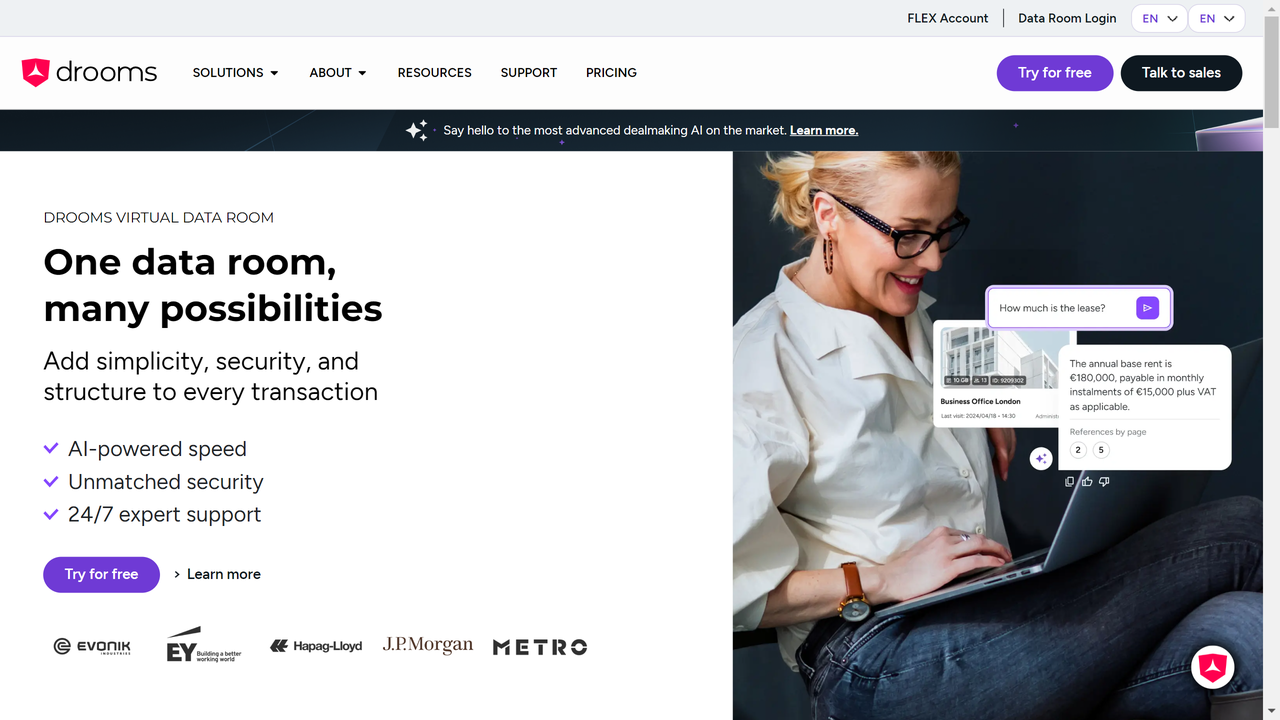
In January 2026, Drooms launched the Drooms AI Assistant, claiming a 50% reduction in deal preparation and due diligence time. The same release added Drooms Chat for secure collaboration and an Online Archive for post-deal storage, extending the platform from individual transactions to complete asset lifecycle management.
By early 2026, Drooms had sharpened its competitive positioning around digital sovereignty. The company's 2026 sovereignty analysis cites June 2025 Senate testimony in which Microsoft France acknowledged it cannot guarantee that data stored in France would be shielded from US judicial requests under the CLOUD Act. Drooms frames this as validation of its "full EU isolation model": EU ownership, EU operations, and governance exclusively under EU law. Non-European hyperscalers control approximately two-thirds of the EU cloud market, and Drooms argues that "EU-hosted" infrastructure does not deliver true sovereignty if the operator is subject to non-EU jurisdiction.
CEO Alexandre Grellier frames AI as a productivity multiplier rather than a replacement: "AI will not take over deal sourcing or due diligence on its own, but it can simplify access to more and better deals," a deliberately conservative positioning that aligns with enterprise clients cautious about automation risk.
Drooms' authority in the market extends beyond software. Its fourth annual Real Estate Trends Report, published in early 2026 and drawing on anonymized platform data plus a survey of 80 real estate professionals, has become a reference point for European transaction intelligence. The platform's transaction mix runs 70% real estate and 30% corporate finance, energy, and legal deals, providing data depth that competitors without equivalent transaction volume cannot replicate.
How Drooms processes documents
Drooms processes documents through a pipeline combining OCR-enabled ingestion, ML-based search, and AI-driven organization. Uploaded files in PDF, Excel, JPEG, PowerPoint, and DOCX formats are indexed for full-text search and routed through the Findings Manager for automated extraction of transaction-relevant data points.
The Drooms AI Assistant, launched in January 2026, automates document organization and analysis tasks that previously required manual preparation. Three documented AI use cases cover analyzing large data volumes, structuring documents, and preparing due diligence processes. Per-deal data volumes held at 3.6 GB in 2025, a level Drooms attributes to growing legal and regulatory requirements rather than deal complexity alone, contextualizing the scale at which these AI functions operate.
A key architectural distinction: Drooms develops its AI capabilities in-house rather than routing data through external hyperscaler services. The company's stated rationale is that third-party AI services introduce uncontrolled dependencies and potential compliance violations for regulated buyers. As Drooms put it in its 2026 sovereignty analysis: "In 2026, many organisations are realising that 'AI everywhere' is incompatible with 'control nowhere'. The winning model is AI that is developed in-house and lives inside a sovereign, well-governed platform."
Built-in translation across six languages (English, German, Italian, Spanish, French, Dutch) supports cross-border transactions without external tooling. Access controls are granular: role-based permissions with detailed audit trails govern who can view, download, or annotate each document. All connections use AES 256-bit encryption over SSL, with two-factor authentication required.
Note on AI feature boundaries: The three AI use cases above are described in Drooms' published research as current platform functions, but available sources do not specify which are branded product features versus characterizations of how clients use the platform. Verification against Drooms' product documentation is recommended before making specific capability claims.
Use cases
M&A due diligence
Investment banks and private equity firms upload financial statements, contracts, and corporate records to secure data rooms. The AI Assistant automates document organization and analysis, while buyers review materials with OCR-enabled search and add annotations through integrated Q&A workflows. Drooms' platform handles 30% corporate finance and adjacent verticals, reflecting meaningful M&A usage beyond the real estate core. Marc F. Bloksma, Managing Director at Promecon, described Drooms as "the product of choice in terms of innovation and service" for M&A advisory firms.
Real estate transactions
European real estate transaction durations averaged 363 days in 2025, flat year-on-year and the first non-record in Drooms' four-year survey history. The UK hit a new record of 577 days while Germany posted its first-ever decline to 398 days. Against that backdrop, 49% of the 80 surveyed professionals expect AI to let them evaluate and process more deals with the same headcount, and 60% plan to be more active in 2026 than 2025.
Cross-border targets concentrate on Spain (43% of respondents), DACH (37%), and CEE (34%), with 47% citing differing regulatory environments as the primary hurdle. These conditions directly favor Drooms' multilingual platform and GDPR-compliant infrastructure. Real estate investment firms manage property sales by organizing site plans, leases, and inspection reports, with AI search locating specific clauses across lease agreements and translation features enabling cross-border transactions with international buyers.
NPL portfolio management
Financial institutions and distressed debt investors use the platform for non-performing loan transactions, applying AI-powered document processing to analyze loan portfolios and conduct due diligence on distressed assets. The regulatory documentation burden in NPL transactions is a primary driver of the sustained 3.6 GB average data volume per deal, making structured digital workflows particularly valuable in this segment.
Digital sovereignty as a selection criterion
Drooms' sovereignty positioning reflects a structural shift in European enterprise procurement: regulatory compliance and data residency are becoming primary selection criteria for transaction platforms, not secondary features. Emerging EU frameworks including DORA, NIS2, and the AI Act are pushing transaction-heavy sectors in M&A, real estate, private equity, banking, energy, and defense to scrutinize digital dependencies more carefully.
The Microsoft CLOUD Act testimony provides concrete evidence for a claim Drooms has long made: that "EU-hosted" infrastructure does not guarantee EU legal protection if the operator is subject to US jurisdiction. Drooms' competitive position in this argument depends on execution. Positioning alone does not guarantee adoption if the platform's performance, pricing, or feature depth lags hyperscaler offerings. The company's ability to compete will hinge on whether European buyers prioritize sovereignty enough to accept potential trade-offs in scale, ecosystem breadth, or cost.
For procurement teams evaluating security and compliance capabilities, the practical implication is straightforward: ISO 27001 certification and GDPR-compliant hosting are table stakes in this market. The differentiating question is whether the platform operator itself is subject to non-EU law, regardless of where servers are physically located.
Technical specifications
| Feature | Specification |
|---|---|
| Deployment | Cloud SaaS (Germany/Switzerland data centers) |
| Document formats | PDF, Excel, JPEG, PowerPoint, DOCX |
| AI features | Workflow automation, OCR, ML-based search, Findings Manager |
| AI development | In-house (no external hyperscaler AI services) |
| Translation | 6 languages (EN, DE, IT, ES, FR, NL) |
| Security | AES 256-bit encryption, SSL, 2FA |
| Platforms | Windows, Mac desktop; iOS mobile |
| Certifications | ISO 27001:2022, ISO 27001:2013, ISO 27018 |
| Compliance | GDPR, data processing in Germany/Switzerland only |
| Legal jurisdiction | EU law exclusively |
| Support | 24/7 multilingual expert support |
| Avg. data volume per transaction | 3.6 GB (real estate, 2025) |
Resources
- Website
- Documentation
- Digital sovereignty and EU cloud governance (drooms.com)
- Real Estate Trends Report 2026 from assetphysics.com
- Real Estate Trends Report 2026 from altii.de
- AI as beacon of hope for property deals from propertyweek.com
- Real estate document processing guide
- Security and compliance capabilities
- Data extraction capabilities
Company information
Headquarters: Frankfurt, Germany
Co-Founder and CEO: Alexandre Grellier
Certifications: ISO 27001:2022, ISO 27001:2013, ISO 27018
Data processing: Germany and Switzerland exclusively
Legal jurisdiction: EU law only
Annual research: Fourth consecutive Real Estate Trends Report published 2026, drawing on anonymized platform transaction data and a survey of 80 real estate professionals across Europe.