ORKOM: Document Extraction With Cross-Document Checks
On This Page
- Overview
- Checks run on extracted values, without calling a model again
- Three-way invoice matching with per-supplier tolerances
- Review, audit trail and workflow versioning
- Use cases
- Supplier invoices in distribution and e-commerce
- Technical services and repair orders
- Compliance files at insurers and mutuals
- Recent moves: Databricks, a build-vs-buy argument and SIDO Lyon
- EU hosting by default, with a US model option to watch
- Technical specifications
- Resources
- Company information
A Bordeaux intelligent document processing (IDP) platform that reads invoices, delivery notes and case files, checks the extracted values against each other and against reference data, and sends only the exceptions to a person.
Overview
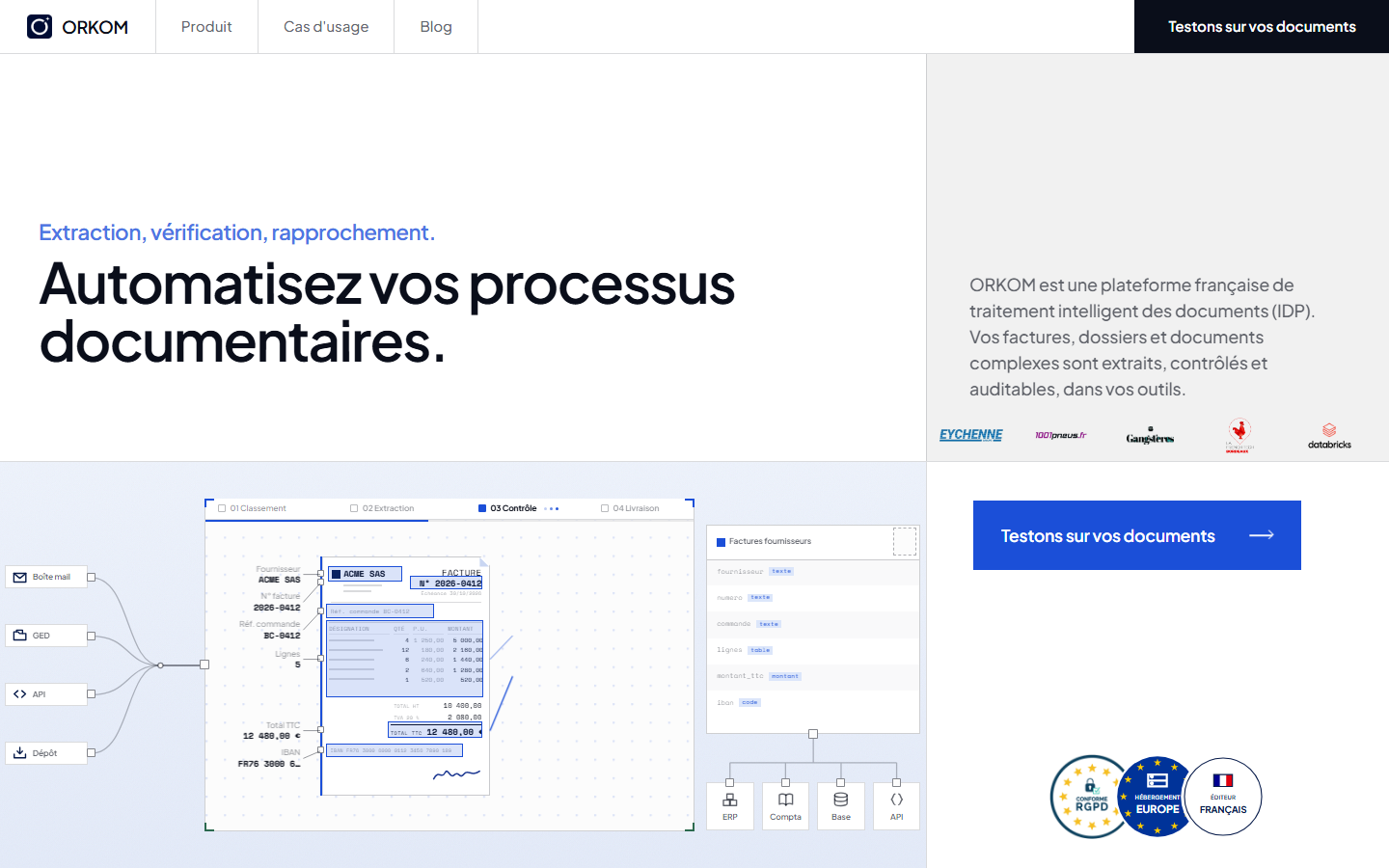
Most extraction tools in this IDP vendor directory stop when a value has been read. ORKOM is built around what happens next. Its homepage names three verbs, extraction, verification and reconciliation, and the product weight sits on the last two: a supplier invoice is matched line by line against its purchase order and delivery note, a subscription file is checked for the same name and IBAN across every document in it, and a health quote is compared with the policyholder's contract and ceilings. When the checks pass, the data goes to the ERP; when they fail, a reviewer sees the documents and the conflicting values side by side.
The company is young and small. ORKOM SAS was registered in Bordeaux on 22 October 2025 with €1,000 of share capital, CEO Antoine Degoy as president and CTO Rayan Azmatally as directeur général. It has announced no funding round and declares no salaried headcount band in the national register. Its commercial proof so far is three customer quotes on the homepage, a July 2026 entry into the Databricks Connected Partner Program, and membership of French Tech Bordeaux.
The buyer ORKOM is written for is a mid-market operations or finance team in France: accounts payable in distribution and logistics, file intake at insurers and mutuals, and accounting firms. Its closest French comparisons are Koncile, Mindee and, for invoice automation, Itesoft and Esker. Rossum and Klippa compete for the same accounts payable workload across Europe.
Checks run on extracted values, without calling a model again
A workflow is assembled from six blocks: reception, extraction, verification, human review, generation and output. Documents arrive by email, API, webhook, upload or from a document management system, as PDFs, scans, photos, Word or Excel files of up to 1,000 pages. Extraction is template-free: the user describes each field in plain language, typed as text, number, date, list, table or boolean, rather than drawing zones. Every value comes back with a confidence score and a link to where it was read.
The verification layer is the part that separates ORKOM from a parsing API. According to the workflow page, rules work at three levels:
| Level | Example checks |
|---|---|
| Single document | Format of a field, presence of a signature |
| Across documents | Same name on three documents, IBAN identical on two |
| Against reference data | Article in the product catalog, company number in the SIREN registry |
Rules are applied to values that have already been extracted, with no further model call, so the vendor states that the same dossier always produces the same result. That is the right design for quality verification in regulated or audited processes: the probabilistic step is confined to reading, and the pass or fail decision is reproducible. The model behind the reading step is not named on the product pages. The data processing agreement answers the question: Google Cloud Vertex AI in the EU by default, with Anthropic's Claude API as an option that the customer switches on.
Three-way invoice matching with per-supplier tolerances
Invoice reconciliation is the most detailed use case ORKOM publishes. Each invoice line is compared with the matching purchase order line and delivery note line, joined on the article reference. Tolerances are set in percent or as an absolute amount, globally or per supplier. Partial deliveries against one order are added up over time, and an invoice cannot pass for more than was delivered. A price or quantity gap beyond tolerance, an article missing from the order, or a missing document sends the dossier to review before payment.
Delivery notes show where the confidence scores matter. The delivery note page targets documents photographed on the loading dock, folded, stamped over the table or scanned from a carbon copy, and extracts handwritten reserves along with the line they refer to. Its own sample result reports 99% confidence on the delivery note number and 98% on the date, against 74% on the handwritten reserve text and 71% on the type of discrepancy. Those numbers are an illustration, not a benchmark, but they are honest about where handwriting recognition still needs a reviewer.
Review, audit trail and workflow versioning
Human review is a queue, not an afterthought. The supervision view sorts dossiers into in progress, in review, validated and failed. A reviewer validates, corrects in place or sends a dossier back, and each validated dossier carries the name of the person who decided. The audit trail timestamps reception, extraction, checks, review, validation and delivery, and records who changed which value from what to what. Dashboards report success rate, share of auto-validated dossiers, median latency, processing cost per dossier, and fields ranked by how often reviewers correct them.
One governance feature is uncommon at this size. Published workflows can't be edited; changes happen in a draft, and the changelog classifies each change as minor, additive or breaking, with an impact analysis on past dossiers. For a team whose ERP import depends on a stable output schema, that is the difference between changing an extraction field and breaking a month-end close.
Use cases
Supplier invoices in distribution and e-commerce
The online tire retailer 1001Pneus is the reference customer. Its CEO is quoted on the homepage as saying ORKOM automated the extraction and structuring of 100% of supplier invoices within three months. The Databricks partnership post adds that 1001Pneus sends thousands of supplier invoices a month, that ORKOM extracts line items and reconciles them with purchase orders, and that the consolidated data is loaded into Databricks. No accuracy, straight-through processing rate or volume figure beyond "thousands" is published.
Technical services and repair orders
Groupe Eychenne's technical services director is quoted as saying processing time was divided by four and data reliability increased. ORKOM also lists repair orders, including handwritten parts and labor lines, as a transport and logistics use case.
Compliance files at insurers and mutuals
In an April 2026 LinkedIn post, Antoine Degoy introduced a document controller agent for files of 10 to 20 documents, such as contracts, company registrations, bank details and identity documents. It checks that the account holder matches the company representative, that documents are in date and that the registration number is consistent throughout. He put the manual effort at two hours per file against a few minutes with ORKOM. The claim is the vendor's own and names no customer. The same logic appears as published use cases for subscription files, file completeness and health quote control.
Across all 13 published use cases, ORKOM gives sector tags but no customer figures. The two use cases it placed on the French Tech Bordeaux platform in May 2026 are described conceptually as well.
Recent moves: Databricks, a build-vs-buy argument and SIDO Lyon
Three signals from mid-2026 show where the company is pointing. The July 2026 Databricks Connected Partner Program membership targets data teams that want document data in their lakehouse, and the announcement is candid that the link runs over the API, like any other destination, rather than through a certified connector. A September 2026 article by the CTO argues against building extraction in-house by listing seven production workstreams a prototype skips: format variability, table rows, detecting wrong values, an evaluation harness, checks against reference data, a review interface and model migrations. That list maps closely onto ORKOM's own feature set, which is the point of the article. On 16 and 17 September 2026 the company is exhibiting at SIDO Lyon on stand E132, processing documents visitors bring to the stand.
EU hosting by default, with a US model option to watch
ORKOM's security page lists EU infrastructure, TLS 1.3 in transit and AES-256 at rest, TOTP two-factor authentication, role-based access, isolation between customer organizations, daily backups with point-in-time recovery, and a 48-hour breach notification commitment. Customer documents are not used to train ORKOM's models or its subprocessors' models. A GDPR Article 28 agreement is signed before production, with an annual audit clause.
The "European hosting" badge holds for the default configuration. The DPA names Anthropic, PBC in the United States as a subprocessor when a customer selects the Claude API, with transfers covered by standard contractual clauses and the EU-US Data Privacy Framework. Buyers with strict data residency requirements should confirm in writing which model provider is active on their account. ORKOM claims no ISO 27001 or SOC 2 certification of its own; an on-premises deployment is offered but not described in public documentation.
Technical specifications
| Feature | Specification |
|---|---|
| Workflow blocks | Reception, extraction, verification, human review, generation, output |
| Input channels | Email, API, webhook, upload, document management systems |
| Input formats | PDF, scans, images, Word, Excel; up to 1,000 pages per document |
| Extraction | Template-free, fields described in natural language; text, number, date, list, table, boolean |
| Evidence | Confidence score and source location per value |
| Rules | Single-document, cross-document and reference-data checks, computed without model calls |
| Matching | Line-level three-way match with tolerance per rule or per supplier |
| Human review | Side-by-side queue; validate, correct or return; reviewer named on each dossier |
| Audit | Timestamped trail with before and after values; audit logs kept two years |
| Versioning | Immutable published workflows, changelog with impact analysis |
| Output | JSON, Excel, CSV, custom schemas; ERP, accounting, databases, APIs |
| Named integrations | SAP, Gmail, Google Drive, Sinari TMS, Databricks (via API) |
| Models | Google Vertex AI (EU) by default; Anthropic Claude API (USA) optional |
| Deployment | ORKOM cloud on Google Cloud in the EU; on-premises offered |
| Security | TLS 1.3, AES-256, TOTP two-factor, role-based access, no training on customer data |
| Certifications | None claimed; GDPR processor agreement |
| Pricing | Not published |
Resources
- ORKOM website
- Workflow builder and supervision
- Use cases
- Invoice, order and delivery note matching
- Security and data processing agreement
- Databricks Connected Partner Program announcement
- Blog
Company information
ORKOM SAS
22 rue François Mauriac
33200 Bordeaux, France
SIREN 993 033 943, RCS Bordeaux, incorporated 22 October 2025
Share capital €1,000
Founders: Antoine Degoy (CEO, président) and Rayan Azmatally (CTO, directeur général)
contact@orkom.fr
orkom.fr
The company is registered in Bordeaux and belongs to French Tech Bordeaux, while its CTO works from Grenoble. No outside funding has been announced, so buyers weighing a multi-year contract should ask about runway and about the data export and deletion terms, which the security page describes as a self-service JSON export and a 30-day read-only period before an organization is purged.